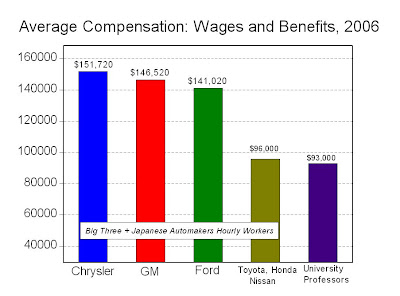
Why a dollar spent on a Toyota buys you better quality than a dollar spent on a GM – it’s actually going into the car.
h/t.

Why a dollar spent on a Toyota buys you better quality than a dollar spent on a GM – it’s actually going into the car.
h/t.
Autoworkers have built vehicles that wisk us across this huge country — safely, reliably, cool in summer, warm in winter, music n’ all 🙂
Some Profs have sort of invented some useful items/ideas.
But it seems that most only turn out Suzukis — the ones with no wheels.
Interesting, do you have a cost per km comparison from an unbiased source?
I don’t find the comparison to salaries in academia useful, either. It’s the one to Japanese manufacturers that tells the story.
The Uni prof one IS useful. Nearly everyone’s expectations of AVERAGE total comp wouldn’t have Big 3 autoworkers making 60% more than university professors. Yes autworkers make a lot, especially senior ones, and with overtime you can do well, but AVERAGE of 150k???
The whole point of mass university education is to move up the income ladder. For sure there’s law of large number issues, but that’s rather shocking. Will make guidance counsellors and parents jobs harder!
But how many cars/trucks did they produce per worker? Thats the important factor. Let’s see a chart that shows compensation/company earnings figures. And factor out the robots.
I have to believe that the management would not pay extravagant compensation for poor results. Foreign workers are often not as efficient on a one to one basis with American/Canadian workers.
Assembly line workers don’t make $150000/year. The higher costs for US workers is because of the high health care costs for retirees. The automakers didn’t plan for these expenses and now the retirees and current workers are going to be screwed.
Those are not foreign workers. Those are US plants for the Japanese three.
“Toyota, Honda, Nissan (in U.S.): $48.00 ($96,000 per year”
One commenter on the page duly noted:
GM workers’ wages are not that much more than the U.S. Japanese automakers, but the total compensation and legacy drives the hourly cost higher. Those costs are allocated across the active workers’ payroll.
The U.S. automakers decided to fund their future retiree liabilities from future profits instead of putting the money in an account when times were good. Although the shortfall is magnified by the unforeseen health care cost escalation, a lack of long-term planning is the real culprit. Does anyone really believe that the Big 3 did not realize years ago that unfunded retiree benefits would be a problem in the future? Workers are expected to save money for future obligations, so why aren’t corporations?
Before the U.S. automakers can realistically be compared to the Japanese transplants, the Japanese need a few generations of retirees and elder employees. Directly comparing the Japanese transplants to the U.S. Big 3 is like comparing the present NFL players to the former players who are 50 to 80 years old.
It’s difficult for old companies to compete against new companies. The old companies and their workers, however, built this country‘s infrastructure, so as bad as the connotation of the word “entitlement” is, they are. The past generations’ contributions to the U.S. and what it stands for just cannot morally be ignored.
I think the biggest thing to take out of this is not whether these amounts are absolutely accurate but to note that someone screwing “Nut A” onto “Bolt B” for 8 hours a day, day-after-day, don’t deserve either $96K or $155K per year…it should be more like $50-60K, if that.
Union demands for compensation are driving companies out of NA and into the third world, making things worse for the country. The time for unions is long since over.
“…Foreign workers are often not as efficient on a one to one basis with American/Canadian workers…”
Foreign workers aren’t the competition.
“…Labor-cost competition has come to the auto industry, and not just from $3-an-hour Mexico and $1-an-hour China. Toyota, Honda, Nissan, Mercedes and BMW operate nonunion plants in this country. Their labor costs are much lower than those of the Detroit companies–$42 an hour including benefits at Nissan, for example, versus $70 at Ford. The newcomers have next to no pension costs, because their workforce is younger, and hardly any costs for retiree health care because they never offered this benefit. The import factories spend less on health insurance for current workers because the workers contribute…”
http://members.forbes.com/forbes/2007/0521/058.html
Meanwhile in Canada the CAW liars are prepared to offer Magna “a competitive and “high-performance” labour agreement to prevent it from setting up shop in the US.
…Buzz Hargrove, president of the CAW, said the union is “quite willing” to negotiate non-traditional labour deals when factories are built from scratch. But he cautioned that “nothing is on the table” at the moment related to Magna’s new factory….
http://www.canada.com/nationalpost/financialpost/story.html?id=edf3a924-917b-4638-90a5-c3b624d28710&k=31488
Seems to me the rank and file unionized commies are suffering from some capitalistic greed!
My sincere hope is that the big three fail, all of the Chavistas that work there get laid off permanently. Good riddance.
Does it include the special under the table costs? Without these expenses we would have to do without the NDP.
Eeyore : So that goes for the worker installing the brakes on your car? How about the person that installs the seatbelts? News flash. We live in capitalist countrys here and in the US. Folks get paid what the market says the work is worth. Jealousy gets you nowhere.
KPD : and as you wave good bye to the NA big three, be sure to hang around at the parade for the rest of our economy.
Jim, unions do not operate as a capitalistic endeavour…they operate as thugs blackmailing the capitalists. Note that I am not slagging the union members…just the unions themselves.
Wow, those unions are so beneficial to the average worker!
Wow, those unions are so beneficial to the average worker!
ding ding ding – Tim wins the prize, it’s the cost of pensions and (cough) private health insurance in the US that drives up the cost for the big 3. Toyota isn’t unionized to mess up their pretty numbers. Since Toyota’s labour costs are so much less – WHY prey tell isn’t that passed on to the consumer? The question about cost per km hasn’t been answered. Don’t get me wrong, Toyota builds a good vehicle, BUT it’s not as good as people PERCEIVE it to be.
Being a union member and having been in a lockout I can speak with a LITTLE authority. Companies have many means of putting pressure on union members to get the deal that they want, or in many cases, a reduction in benefits etc. that is the situation I was in.
As a union member, the only tool we have at our disposal is the removal of our labour. And please, let’s not lump public sector unions with those in the private sector. Public sector unions are generally monopolies and many if not most of their members regard their employer as “The Government”. Compare the raises given to nurses, teachers, etc. and compare them to, say a telephone worker where they received a 2% raise per year and no retro for the 5 years they had no raise.
Admittedly some unions come across as thugs and bullies but the overwhelming majority realize that if the company fails then everyone suffers. It’s the greedy unions that seem to get all the press.
the union is it’s members and there are many defunct companies in north america that went under because of excess union demands. increase the profit and productivity and you are elligible for more money. you don’t ask for more and then hope profit and productivity just sort of increase.
Japanese quality is no coincidence…it started when their industrial engineers embraced the quality teachings of Edward Deming after Dr, Deming’s TQM methods were rejected by north American industrialists in favor of volume production methods.
A young student of Deming’s improved upon his total quality management methodology by making it into a mathematically driven total mindset of quality…it is the practice and expansion of the Taguchi theorems that drives Japanese industrial/production engineering as well as their management…totally focused on quality to the end user as being instrumental in repeat business.
As this evolved in Japanese indistry, North America was focused on mass production with make-do quality and planned obsolesce…which attitude has the most respect for the consumer?
The actual hourly rate for Big Three workers is under $30/hr. These companies agreed to pay for the health care of their retirees, but they didn’t invest or put the money aside for this. Now they’re trying to lump these costs into the rate of pay for current workers. So now it’s the unions fault, eh?
All you globalization aficionados should be happy though…cars will be coming from China very soon.
I have a Honda and a Dodge. I like the Dodge better, but that’s mostly because its bigger. The technology, engineering and build quality of the Honda is superior, no question.
Both were built in the USA. Dodge could build to Honda’s quality level but doesn’t. This is a management issue, not a labor issue. Daimler broke their toes on Chrysler trying to kick some sense into the management and gave up, they sold it.
Ford and GM are worse, they can’t even design models people want. Ford has the Mustang and the F-250, GM has the Pontiac Solstice and the Corvette, pretty much everything else they make is crap IMHO.
As Iberia noted, retirement benefits and healthcare costs are killing the Big Three. Delphi already went into receivership over those costs and had to be bailed out. This is not an exclusively American problem either, Stelco is in the tank because of exactly the same thing.
Bottom line, the ruling management theory in American and Canadian industry since about the late 1970’s was PT Barnum’s. “There’s a sucker born every minute.” They built crap, treated their people like crap, made crappy deals with the unions, raided retirement investments and laughed all the way to the bank. Until about 1992.
Sucks when the payback hits, eh?
Incidentally, I view the recent fall of Lord Black as part of this pattern of overdue payback for services rendered.
Long time ago there used to be this town called Brantford Ontario and this company called Massey Ferguson. Conrad raided it, turned MF into a holding company in Buffalo and Brantford into a ghost town. 20 years later, Brantford is just now starting to climb back out of its funk.
Looks good on ya Conrad. All suckers wise up eventually.
Ilberia,
Why is it a problem that our cars will come from China? If they produce cheaper and better cars why shouldn’t we buy them? Are you racist? Are the Chinese somehow inferior?
The pro unionists are so frustrating. How can you possibly argue that unions are good when you look at the cities of Detroit, Pittsburgh, Cincinnati, Cleveland, Gary, Newark?
It’s the union’s fault that the big 3 are dying. They demanded higher wages when they started selling fewer cars.
//rant off
I think you can blame both on the auto companies and the unions.
The auto companies design shitty cars and the unions resist attempts to make them more efficient along with the companies.
Just take a look at what ol’ Buzz was saying when Ontario and Ottawa started musing about enforceable emission standards…..
Iberia: “All you globalization aficionados should be happy though…cars will be coming from China very soon.”
Probably, given they are exempt from CO2 reductions. My business has direct competition from China, their product is 50% “cheaper.” Chinese plants will build to any specification you want, but let’s fact it, they’re in the picture because of cheap labour. My product requires expert installation and service. At first glance, it appears we’re in trouble, but we’re not.
Yes, China can export cars to Canada, provided they meet proper labour, environmental and safety standards (human rights would be nice too).
Iberia, globalization means free trade, not paying slave wages for skilled labour, and certainly not poor environmental and safety standards. If China wants to pollute the crap out of their country, they won’t be selling cars, the fruit of that pollution, here.
Here’s a link to an article in the New Yorker about the pension funding crisis faced by the Big Three:
http://www.newyorker.com/archive/2006/08/28/060828fa_fact
My own summary, for those who don’t want to read the article: In the early 1950s, when the automakers and the unions were negotiating the first industry-wide pension plan, the UAW proposed a single pension plan for all auto companies and suppliers, jointly managed by the companies and the union, in order to spread the risk. The companies balked at handing that much control over to the unions, and announced that each would ‘go it alone’ in funding/liability in order to maintain control.
They estimated that the plans would run in the red for 20 or so years until the first, unfunded generation of retired workers died off, then it would run in the black, investing the surplus into a self-perpetuating fund.
What happened in the meantime, however, is that unions demanded that the benefits be increased; that on a retired worker’s death that the widow go on a lifetime pension instead of a lump sum death payment; that health care be paid for in retirement as well. The break-even date stretched off into infinity, while the increased efficiency of the workers (fewer workers producing more cars) meant that a smaller number of workers now had to support more pensioners. GM is now approaching the dependency ratio (ratio of workers to retirees) that drove the big U.S. steel companies out of business in the 1980s.
Based on this, I’d say that the management & unions were equally at fault in building up this huge liability.
The corporate culture of “the next quarter” along with union-driven expectations of infinite entitlement is responsible for the eventual demise of the big three.
Ask yourselves this question, do I want a significant portion of the sales price going to sunk costs unrelated to the manufacture of the car I’m buying or not?
The big three are really a microcosm of the welfare state.
Alrighty then, while we’re blaming everybody, let’s blame everybody. The big three slipped into making crappy vehicles beause consumers let them. The produced junk and we bought it. Up until the late 50s, North American companies (there were what 5 or 6 or more) made some damned fine cars, good quality, reasonable price. Sure, the companies started to chase the dollars and the unions started to demand their fair share. The companies repsonded by reducing quality, building boxes on wheels out of cheaper materials. The unions responded by caring just a little less about the work, so what if a red hood gets put on a green car. But we still bought the product and in vast quanities. The number of people who actually bought a Gremil is larger than the number who will admit it, the Pacer was worse and we still bought it. It was similar for all companies, they could turn out crap because we bought that crap. Had we been more descerning, like the Japanese or the Germans, we may have pushed the North American manufacturers to make better cars.
Jim,
Au contraire mon tres amis comrade !
You said…”KPD : and as you wave good bye to the NA big three, be sure to hang around at the parade for the rest of our economy”
Scenario …Unions demand too much. Straw breaks camels back. Big Three = Chapter 11. Companies are bought out and then resold.
Outcome… New owners open up under new names and move away from union friendly states to Right to work states, and completely out of Canada. New owners hire back about 1/2 to 2/3 of workers in a non union/pro-competitive/contractor/associate/shareholder scheme and become mightily profitable. Winners…. End user consumers, humble little guys who like to work, capitalism, freedom, liberty, justice, conservatives, entrepeneurs, hard workers, risk takers, small business people….
Losers…Union toadies, AFL-CIO, UAW-CAW, Teamsters, liberals, communists, Democrats in Michigan and Ohio NDP’ers in Ontario, Big Government, lazy parasitical slackers, people who like to whine endlessly without offering solutions……
And another thing!
For those who think China will pick up the pieces and start shipping cars here, I think you fears are unfounded.
Why do you think foreign automakers fabricate cars here like Toyota? Its called shipping and handling and the price of transportation. Until someone figures out how to compress a car into a smaller volume, then ship it, and then decompress it upon arrival, then I think our domestic fabricators are safe.
Also consider as China’s economy strengthens, its expenses start to increase due to inflation, taxes, human rights and welfare costs etc., thereby becoming less competitive.
KPD, you’re mistaken – Japanese car makers were coerced into building manufacturing plants in North America since they DON’T allow the big 3 to import into their market. As far as the Big 3 is concerned Japan is closed for business. So much for free trade.
What GM forgot to put into Big Dirty Trucks,
Gordie is putting in Retroactively.
The Government of the western Canadian province of British Columbia will be the first to require older commercial trucks to be retrofitted with new emissions control equipment. The BC government will require all heavy duty diesel vehicles, including government fleet vehicles that weigh more than 11,000 lbs, to be fitted with a diesel oxidation catalyst or something equivalent by 2009.
The retrofits should cost about $1,200 to $2,500 each and will be required on about 7,500 vehicles. California is expected to have a similar requirement by 2009 as well.
============================ AutoBlogGreen.com
Takes political guts to slap this on trucking when other costs are up.
Funny how one can see a glimmer of hope for Gordie and his conservative party with the *Liberal* label.
Should never have sold those NDP ferries WE PAID FOR though.
NEXT, the retrofitting of those [out of sight], Coal-Gen plants. = TG
There are at least two major issues for the ‘getting smaller big three’;
The under-funded pension liability thing is simply a utopian type of ‘free lunch’ “idea” of the latte crowd that has gone bad. I would bet that the average worker on the line has always been truly concerned about waco ideas. IMO, the latte-crowd is only concerned with their utopian Alice In Wonderland world.
Forty years ago the big 3 were focusing their priorities on fluff. Big fins, low and sleek, gluttonous V8s, slippy automatic transmissions. Why ? Because we were indoctrinated that it was “in”. Glitzy, ditzy Hollywood and a dumbed-down media.
Meanwhile, even though recently war torn, Japan rolled up it’s sleeves to make-it-better. The Engineers were in control not the flakes.
Ever notice how something seemingly as simple as a door handle works so smooth on a Honda, Toyota, Nissan ?? It didn’t just happen. The engineers took the time, and were allowed to by the front office, to design it properly. Support bearings were substantial and well placed. Levers and other mechanisms were engineered to perform the task easily and for a long time. It shows.
And that is just a door handle. Major components such as crankshafts revieved more attention than tail fins back in the 60s. We reap what we sow.
I am afraid it is all coming home to roost now. Once you are behind-the-eight-ball it is tough. Less R&D $s = less profit = less R&D $s = …
Bad name = less sales = bad name = less sales …
Self perpetuating to the downside. It all started a lomg time ago.
TG
At the risk of going off topic, BC hasn’t seen a “conservative ” government since Bill Bennett. Campbell has not privatized anything and has simply thrown money at all problems (for example FNs and public sector “workers”). Despite the presence of a few recycled socreds, his brand of socialism is just perceived as more business-friendly and less ignorant than the NDP’s. In short, a coalition of liberals, Red Tories, and a few recycled socreds. Power over Principles.
I’m surprised that no-one has fingered, as the cause of their current demise, the Big Three getting too big. There is an optimal size for an organization, beyond which it gets too unwieldy to be managed by anyone.
Living in an auto producing area i’ve spend plenty of time listening to autoworkers run their yaps about their income. First it was the sweetest deal in the world, then they got older and whined it wasn’t enough to raise a family, now i’m supposed to feel bad because the whole game might go belly up.
I don’t seem to remember buzz and his “highly skilled” workforce (stop laughing!) worrying about my challenges through my working life. Maybe i just never noticed?
Someone on this thread mentioned jealousy – i guess there might be some of that, but it would have involved a lifetime of unskilled labour. Don’t think i would have liked wasting my life that way.
Sorry, clowns. I’ll drive what i like, and i don’t owe you any loyalty.
But if I buy a GM my money goes to some shlep who pays exhorbitant taxes here.
If it goes to Japan well I’m sure they appreciate the present.
You get like 150 k if you work at the big 3???
Damn, I haven’t read the other comments but, university professors get paid?