Why this blog?
Until this moment I have been forced to listen while media and politicians alike have told me "what Canadians think". In all that time they never once asked.
This is just the voice of an ordinary Canadian yelling back at the radio -
"You don't speak for me."
email Kate
Goes to a private
mailserver in Europe.
I can't answer or use every tip, but all are appreciated!

Katewerk Art
Support SDA
Paypal:
Etransfers:
katewerk(at)sasktel.net
Not a registered charity.
I cannot issue tax receipts
Favourites/Resources
Instapundit
The Federalist
Powerline Blog
Babylon Bee
American Thinker
Legal Insurrection
Mark Steyn
American Greatness
Google Newspaper Archive
Pipeline Online
David Thompson
Podcasts
Steve Bannon's War Room
Scott Adams
Dark Horse
Michael Malice
Timcast
@Social
@Andy Ngo
@Cernovich
@Jack Posobeic
@IanMilesCheong
@AlinaChan
@YuriDeigin
@GlenGreenwald
@MattTaibbi
Support Our Advertisers

Sweetwater
Don't Run

Polar Bear Evolution
Email the Author
Wind Rain Temp

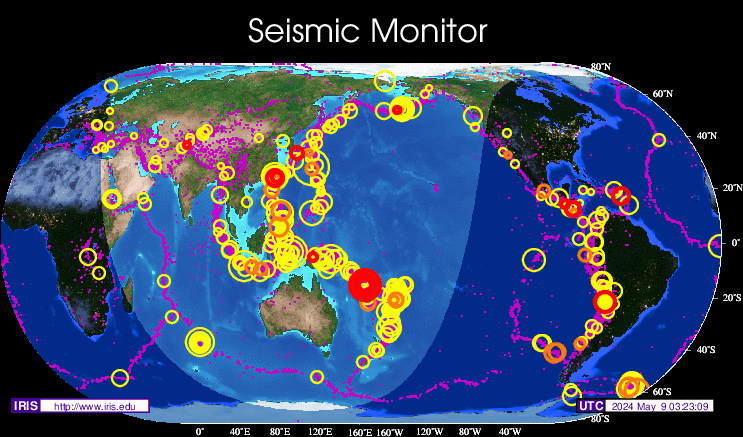
Seismic Map
What They Say About SDA
"Smalldeadanimals doesn't speak for the people of Saskatchewan" - Former Sask Premier Lorne Calvert
"I got so much traffic after your post my web host asked me to buy a larger traffic allowance." - Dr.Ross McKitrick
Holy hell, woman. When you send someone traffic, you send someone TRAFFIC.My hosting provider thought I was being DDoSed. - Sean McCormick
"The New York Times link to me yesterday [...] generated one-fifth of the traffic I normally get from a link from Small Dead Animals." - Kathy Shaidle
"You may be a nasty right winger, but you're not nasty all the time!" - Warren Kinsella
"Go back to collecting your welfare livelihood." - Michael E. Zilkowsky

Chief Walking Eagle in full flight…!
Cheers
Hans Rupprecht – Commander in Chief
Army Group “True North”
1st Saint Nicolaas Army
And we know how that name originated, don’t we?
Yes and it still makes me laugh… 🙂
Cheers
Hans Rupprecht – Commander in Chief
Army Group “True North”
1st Saint Nicolaas Army
Oh, that Poca Haunt Us!
And we still don’t know who actually won the Iowa Democrat Caucuses Monday. 1/3 of the voting results are unknown.
We knew the results of the Republican Primary in time for the early news at 9 pm Monday Night.
I heard the Democrats had an actual back up reporting system. It did not work because they were not smart enough to have enough phones and operators assigned to it. You would think they might be cautious and keep the old system in place as the backup, just in case. Nope. This was also the same app that Nevada was going to use in their caucus in two weeks. Boy did they dodge a bullet!
These clowns in the National and Iowa Democrat Party may destroy the hundreds of million dollars Industry that was the Iowa Caucus. Think of the hotels, apartments, car rentals, office supplies, printing, catering, advertising, even down to laundry and dry cleaning supported by the candidates and the news media. — Just make sure you get paid cash upfront, as political campaigns are notorious for skipping out on debts. I am sure that any of over forty states would love to steal the business.
Maybe Minnesota should switch back to a caucus system and poach the first in the nation caucus?
There’s no back up because the whole thing was fixed. The Dem elite don’t want Bernie. They can’t have Bernie win. As for Bernie, I think he’s just holding out for a better bribe that the lakehouse he got last time.
Just because somebody stayed at a motel with John Smith doesn’t make them an Indian princess.
Plymouth Colony is the true Founding colony of the United States.
Jamestown was a corporate colony peopled by layabouts and gold prospectors. And were a constant failure and disaster even with massive support and supply by the London Company and King. It’s a perfect example of “noble” incompetence, top-down management, and the political system they set up was to be expected; the King had all the authority, delegated to his appointed regents and governors.
The Pilgrims/Puritans were marooned by their ships in the wrong area, under threat by the Crown, persecuted by the Anglican Church, with no Royal charter or support from the King, and prospered in spite it all (or perhaps “because”) .
Needless to say, they created and elected the General Court (which unlike the House of Burgesses and British Parliament, were the ultimate authority to make and execute laws), which encompassed judicial, legislative, and executive power (governor was elected an part of the Court). They were self-governing without input from the Royals for generations – the British had no power to rule over them – a fact which enraged the British aristocracy and endangered their hold on authority over the New World’s development. Thus, the British allied themselves with the hostile Indians, falsely declaring one of the Indian chieftains a “King” over Plymouth lands (eye-roll) who destroyed and helped the British conquer a once prosperous Plymouth colony – and once the livestock and horses were stolen and massacres were done, the Indians had no use over the colony itself (savages can’t maintain machinery, civilized farms, mills, etc, can’t even read and write) they handed the remains to their British allies who happily “incorporated” Plymouth, slowly abolishing America’s first true democratic assembly, the General Court.
But the seeds of America’s independence had already been planted.
It was no mistake that the more independent, self-sufficient, and politically independent colonies and townships were naturally more prosperous throughout America, Plymouth colony being a guiding light. Whereas the Royal corporations and their King could only bungle their way into destitution, taxing away resources to keep their parasitic cities alive to siphon profits as in Jamestown (and New York).
The scattered denizens and descendants of Plymouth colony, kin and kindred spirits alike, conquered and oppressed by the British Crown, the Anglican Church and Indians, chafed always under their rule and thievery until their liberation nearly a century later.
It was no coincidence that the Revolution would find among its strongest adherents in the legacy of the Pilgrims, Massachusetts.
To put it another way:
Jamestown was where people went to make Profits.
Plymouth was where people went to make Home.
I never knew the two things were mutually exclusive. They aren’t in MY homestead.
Where “profit” is not a dirty word … it’s common sense.
It matters where your Home is, and therefore WHERE you “reinvest” your profits.
If you read the journals, you’ll find that the Jamestown colonists were planning to return to the British Isles and England once they found their gold and peddled furs. They were planning to ultimately “liquidate” their New World assets and send their profits back to the Old World. They never planned to invest in Jamestown itself which is why so many of the colonists themselves didn’t even have basic skills in weaving/looming, basic farming, carpentry, hunting, etc. Their pre-conceived notions of the kind of temporary colony they were building ensured that. Not to mention their ill-advised and naive embrace of the “noble savages”, which made them vulnerable and open to contempt from the Powhatan. They were still relying on shipped supplies long after John Smith left.
ie the Jamestown colonists were NOT homesteaders like you (actually they might be better homesteaders than you…).
The pilgrims had no plans to go back to the Old World; they even decided to colonize the “wrong” site without Royal sanction and against the Virginia Company contract (they were supposed to land along the Hudson – besides, long before this latest transgression, they were de facto renegades of the Crown and Anglican Church). They weren’t administrators, or metalworkers – but real old-fashioned homesteaders.
“Colonists”.
Plymouth was self sufficient within 3 years, and experiencing abundance by year 4, exporting and reinvesting profits back Home – in Plymouth Colony.
Which means the Pilgrims/Puritans aren’t homesteaders like you, either. They never had the modern roads to ferry supplies from the nearby general store, or access to the main line and power line and internet backbones (or satellite dish) under the road itself, or a local well-drilling service, or easy access markets to sell goods, or a fluid financial system for easy credit, or the local sheriff, etc.
Anybody who’s a homesteader knows how hard it is – but this is nothing compared to life in the New World in the early 17th century.
You and I are not better people than the Pilgrims/Puritans. Heck, we might not measure up to the Jamestown colonists.
Needless to say, “building up” wealth in Plymouth and “reinvesting” in the colony made it extremely valuable – and that invited the inevitable British envy – what we call today “corporate raiders”. Because if the Pilgrims weren’t willing to take the “profits” out of Plymouth, liquidate it, and send those profits back to England and into the King’s coffers….
Then the British Royals would do the same thing they do today; use savages to dispossess the “subjects” they presumed to rule.
Then, your betters used Indian savages.
These days, your betters use Muslim savages.
Old tricks, Different thugs.
Maybe you should get wise to it.
You spin a lovely yarn, replete with carefully selected and interpreted events to retroactively justify your notions of history.
That was a pleasant read, but…not sure I know enough about that history to agree, and other comments seem wary as well, but thanks for the info.
Yes, Jamestown and the Virginia Commonwealth were nothing but lackeys of the British Crown.
True patriots like George Washington, Thomas Jefferson, James Madison, James Monroe, and Patrick Henry were all the legacy of the Massachusetts Pilgrims.
None of those men aspired to be King, nor did they force their own people at the point of a musket and bayonet to swear Holy Oaths to them under Divine Right, like the Oaths of Supremacy and Allegiance (The antithesis of which the American Oath of Allegiance we swear today was meant to counter), nor to rule from behind financial curtains as the “invisible man” wielding power without accountability through proxies, nor to dispossess their people by allying with the uncivilized or semi-civilized thugs, etc, etc, etc.
The British Royalty did, and does all these things, always looking for other people to throw under their rule, using treacherous and immoral methods to extract resources from their denizens to expand their rule over more peoples – rather than simply govern the people actually sworn to them with whom they should have recognized as their kin…
Because it is the nature of all kinds of government – and centralized government most of all – to expand their power to usurp that of the People.
And there is no more centralized government than that which Arms, Economics, and Politics fall under the purview of a single Man, that of a King.
It is no surprise the British Royal history is replete with constant examples of them playing their own people off against each other unto this day.
I still thank the epiphany I received when I met a British Marine in Diego Garcia almost 2 decades ago when we discussed our political disagreements. The point went to discussing our Oaths. When I asked if he would arrest the Queen if “Westminster” voted on it, he made it clear that he was aghast and that it went against everything he stood for (Back then, I was dumb enough to give the British system a democratic benefit of the doubt, and didn’t know anything about Peerage and Royal prerogatives).
And when asked if he would arrest an elected Prime Minister if ordered by the Queen, the answer was just as prompt and obvious.
Every British soldier has either demurred or enthusiastically answered “Yes” to that last question.
Which gives American military men an idea of the kind spiritual enslavement our Founders freed us from. The British Oath is ghastly – it may not be as bad as the Oath of Supremacy or Allegiance, but any American who repeats or even types it is guilty of the highest Treason. It is the literal antithesis to everything the American Oath stands for, to “Preserve, Protect, and Defend the Constitution”, the procedural link that binds the Armed forces to the only source of legitimacy, The People under God (not a King or Queen under God), and through that Constitution obey its rightful Commander-in-Chief, a duly elected President.
There isn’t an American Marine, soldier, sailor or airmen who wouldn’t be repelled by hearing the British Oath – and in the same vein, the British Marine snarked at my recital of the American counterpoint (these people can’t even imagine their Royal betters have conflicting interests with their own).
Who has power in Britain?
And why does anybody in the UK pay attention to the dog-and-pony show that is the House of Commons when it’s nothing more than a “suggestion box” to provide political cover, when in reality the Queen can just make appointments and abolish the elected body, just as King George III did when he abolished every other elected body in America.
And the British Army and its allied savages were more than happy to oblige.
Just as the British Army and Muslim savages look more than happy to oblige today.
It’s been said before: “Westminster” is about as democratic as the Islamic Consultative Assembly.
It’s a farce.
Who owns the Sword of Damocles?
Because it’s not the British People or their elected representatives, which is why they’re always avoiding or hiding from the inconvenient truth – and I hate the leftist contrivance of this phrase. (Oh btw, Brexit hasn’t “happened” – in spite of the choreography, Britain is still in the EU regulatory framework).
In America, any official – elected or appointed – can be removed from Power, either by election or impeachment, even the “Most powerful man in the World”.
Those spiritual shackles on the Anglican soul were lifted a long time ago in America – Thank the Founders.
Thank God.
My goodness, you had such a tirade and totally missed the point.
Few Americans would debate the War of Independence from the British side, so most of your tirade was unnecessary.
But what you did was sing the paean of Massachusetts over Virginia, simply because the latter received a charter from the British. The former no less acknowledged British rule.
And philosophically, in general Massachusetts (Federalist papers, John Adams) wanted more of a replica of Britain without a king, that is, a strong central government, whereas Virginia (the gentlemen I mentioned) wanted a “United States of America.” And that is what we have.
If you are to pick the three men most responsible for our republic, they would be Thomas Jefferson and James Madison who were the architects, and George Washington who built it. And all three were Virginians, not heirs of the Pilgrims, physically or spiritually.
“Those spiritual shackles on the Anglican soul were lifted a long time ago in America – Thank the Founders.”
Well, there is little evidence that the casting off of “spiritual shackles” has achieved much good. Because modern-day Yanks are enslaved by the same tyrannies as their Brit and Canuck counterparts: power-hungry politicians, soulless bureaucrats, and an obsequious, uncurious press.
@OldBruin I can’t tell whether you’re lying or ignorant. I’ll assume good faith and general ignorance:
1) OldBruin: [Few Americans would debate the War of Independence from the British side, so most of your tirade was unnecessary. But what you did was sing the paean of Massachusetts over Virginia, simply because the latter received a charter from the British. The former no less acknowledged British rule.]
In Jamestown, the King and his court appointed, replaced, administrated and “governed” the colony through his Royal surrogates, interfering from thousands of miles away – in total and comfortable ignorance of their effects on the colony itself. The “delegates” had no power beyond “suggestiions” – whereas the Royal governor could make and unmake rules on a whim as Judge-Jury-and-Executioner – and all with the authority of his patron Divine King under God. The mismatch of centralized government with pre-conceived notions in England, the lag in time of trans-Atlantic travel, and implementation on the reality across the Atlantic in Jamestown has been written about ad nauseum, from replacing its leadership to replacing the types of stocks, to replacing Jamestown’s very people.
The results spoke for themselves.
Horrific starvation, destitution, and constant failure that needed constant re-supply (and re-population) from Britain. Jamestown was a supplicant to the Crown, a perfect reflection of its direct and indirect rule: dependent, poor, and necessarily parasitic to simply continue its existence.
Plymouth was a colony that existed in spite of the Crown, marooned by the Virginia Company that promised them passage to a stronghold site (present-day New York), and damned by the Church – the Puritans wanted no part of the Anglicans or its Divine King and his heresies. No, it was not simply a charter. The Puritans were heretics to the Crown, and could never actually “acknowledge” the Oath of Supremacy, Allegiance or even Abjuration. What you are claiming is similar to the conceit that Taiwan is under PRC rule, when it is de-facto independent – which is exactly what Plymouth colony was, whatever pronouncements you claim be damned.
The Pilgrims elected their own governor, their own legislature, wrote their own “Constitution” – and in effect their own “Judiciary” which was the combined “General Court”. And decisively, unlike the Jamestown’s House of Delegates, the Plymouth Assembly and later General Court had Power. They were not subject to Royal approval because the King didn’t have a British Army in the New World to stake his claim (and the Puritans, unlike English in Jamestown, were religious enemies of the Crown). They grew their own food and handled most of their own supplies – no Royal surrogate could rule over them spiritually or economically, and thus politically. That which they could not produce they traded for as equals (actually, with leveraged advantage), not supplicants to the Crown – the New World’s new arrivals had no choice but to trade with Plymouth lest they risk starvation and bankruptcy. The King had no say or substantive input for all the time that Plymouth prospered – indeed for a long time, most British didn’t know Plymouth still existed – the nature of trans-Atlantic communication at the time provided the Pilgrims a bulwark of autonomy. And even if the King’s men realized it beforehand, again, they had no leverage, because Plymouth was self-sufficient, self-governing, and thus independent, and not enough military strength to force Plymouth into submission –
– which was why the British allied with the Indians (of several tribes, their “King Philip” was a farce) and were so intent on their destruction and subjugation a half-century later.
In what meaningful way did the Pilgrims “acknowledge” the British King?
The Puritans wouldn’t acknowledge the idolatry that God gave the King the Divine Right to rule over them, that they had to pray to the King in order to pray to God.
Who’s philosophy do you think the American revolutionaries emulated?
The defiance and independence unto death of Plymouth?
Or the idolatry and dependence of Jamestown?
And when news spread, and follow-on colonies in New England and the rest of the New World were established, which model of colonization and administration do you think was emulated? If for no other reason than the practicalities of relying on supply and administration from a King thousands of miles away across the Atlantic was not simply unwise and against their religious beliefs – it was suicide.
So I ask you: who are the spiritual, the political, and yes, the temporal ancestors of the American way of life?
2) OldBruin: [And philosophically, in general Massachusetts (Federalist papers, John Adams) wanted more of a replica of Britain without a king, that is, a strong central government, whereas Virginia (the gentlemen I mentioned) wanted a “United States of America.” And that is what we have.]
This is gibberish.
Massachusetts wanted a replica of Britain without a King?
No.
Britain without a King completely changes the structure of Power in the governing system:
God -> King -> Aristocracy -> Peasantry
If you change it to this:
God -> Peasantry -> Aristocracy -> King
The names in the system no longer have their original meaning because their relationsihp in the power structure has been changed, which requires new names to reflect their new meaning:
God -> *The People -> *Congress -> *President
The original system has been completely supplanted by a different one – that you don’t seem to recognize the difference is instructive. It means you can’t possibly interpret what John Adams means when he uses words like “the Government” or “Jury of the Country” – you think they’re analogous to the British Crown and system, when in fact the American and British bodies completely different entities (and commensurately have different weights in legitimacy and thus arrogated Power).
Donald Trump on the one hand, and Ali Khamenei and Elizabeth II on the other, are all de facto “Head of State”, but that does NOT make the former’s position or his “Central Government” a replica of the latter. They are COMPLETELY different entities with respective to governing Power, especially with respect to their relationship with their People who occupy different presumed “levels of primacy” in their Political, Economic and Religious structure.
Example:
2a) Do the American People have the Right (under God) to disarm the President?
– Yes, absolutely. It happens every 4 or 8 years, if not sooner (a’la Nixon). He gets stripped of his title as Commander-in-Chief of the most powerful armaments in the World, though Donald Trump is free to retain his personal arms as an individual citizen when he leaves. And if there were a President who refused to leave in accordance to the Will of the American People, I don’t think he’d last long under the guns of millions of armed Americans.
2aa) Does the President have the Right (under God) to disarm the American People?
[Haha! Are you kidding me?]
2b) Do the British Queen or the Iranian Ayatollah have the Right (under God or Allah, no they are not the same) to disarm the British or Iranian People?
– Yes, of course. And they’ve exercised their “God-given” right to do just that.
2bb) Do the British or Iranian People have the Right (under God or Allah) to disarm the British Queen or the Iranian Ayatollah?
– With what? The British and Iranian People are disarmed.
3) OldBruin: [If you are to pick the three men most responsible for our republic, they would be Thomas Jefferson and James Madison who were the architects, and George Washington who built it. And all three were Virginians, not heirs of the Pilgrims, physically or spiritually].
Donald Trump is a scion of the American movement today; the fact that he comes from New York City and works in Washington DC has no bearing on whether or not those locales are American strongholds – and whether the Upstate New York or the Midwest is more or less American philosophically, religiously, politically, etc – those are separate Truths and have a separate set of considerations and factual thresholds altogether.
There is nothing contradictory in saying “Donald Trump is a great man of the American system in the 21st century” and “early 20th century century New York City is not the model of the American system.”
Similarly, there is nothing contradictory in saying “George Washington is a great man of the American system in the latter 18th century” and “early 17th century Jamestown is not the model of the American system.”
Nor are the fact that Virginia and Massachusetts in the latter 18th century both had strong American patriot leanings mutually exclusive as you imply. I never made such an implication – that is your straw man. At issue was Jamestown in the early 17th, a century removed, who’s Power structure always moved towards Plymouth’s – and away from the King – until finally King George removed all pretense and doubt, outlawing the elected bodies.
You are heaping red herring after misdirection, one on top of the other.
Whether there were Virginians who were instrumental to the Revolution, is not mutually exclusive to the fact that Plymouth colony was the framework on which success in Virginia was modeled, nor that New England was a hotbed for American Revolution as a result.
You imply exclusivity of these facts to Virginia’s contribution, intentionally or not, as a straw man. The people of Massachusetts and the wider American colonies did not want the Jamestown or British system. They wanted their own local systems, which had evolved along the model of the Plymouth system organically (actually, they simply recognized the pre-existing local governance in primacy ABOVE a Federal system which they detailed as inherently constrained and limited, NOT under/inferior to the Federal government). Whatever your opinion, both the pre-Revolution House of Burgesses and the post-revolution House of Delegates in Virginia were definitely NOT modeled along the Jamestown House of Delegates system – the Burgesses abolished by the King because it encroached on and “usurped” Royal power (which is heresy), and the Post-Revolution House of Delegates having done away with the King completely – again, words have meaning and the system changes if the power structure and relationships change.
(Note once again: while the Jamestown and Post Revolution elected bodies are both named “House of Delegates”, they are completely different entities because of their relationship with People and thus, structure of Power. You need to pay attention to power relationships, and ultimately economics and military structures, and stop following the magician’s misdirection of watching rebranded naming conventions with dog-and-pony shows).
Washington was a great man. That does not falsify the observation that Jamestown was not the model of the American system, nor that New England was where the Revolution was born and first fought because the political and economic system of its denizens, one hailing from the Plymouth colony, was under constant attack and repression by the British and their Indian allies.
It finally came to a head when the British sought to subjugate New England just as they subjugated Plymouth a century before – by force of arms and with surrogate Indian savages.
However, the New Englanders had grown too powerful and too numerous to be overwhelmed by savages alone. In order for Indian thugs, British tax-collectors and New York moneychangers to prevail, they needed to weaken the People, giving the British surrogates a decisive advantage;
The solution is timeless: the British resolved to strip New Englanders of their ability to defend themselves – to confiscate their arms.
“Gun Control”.
That confiscation effort ignited the Revolutionary War in the heart of New England, 50 miles north old Plymouth, when the British
came to Lexington and Concord to destroy the “American People’s” ability to defend themselves.
The destruction of Plymouth would not be repeated.
@Jamie MacMaster
As pessimistic as some Americans sometimes get in evaluating the future of their country, the truth is that America today is far stronger in all aspects compared to Britain and Canada, from Christianity to Personal Independence.
It is for good reason, and a matter of God and Consequence.
If you want to understand a People, read what they teach their children.
American children I know are inevitably taught about the Constitution and and the birth of the Nation at the Battles in New England. Eventually, they come face-to-face with questions of Power and its reasons.
Why does the Second Amendment exist?
Why did the Battle of Lexington and Concord happen? WHAT happened?
Inevitably, some of them come to the right conclusions – maybe not all, but enough.
Canadians and British citizens in my experience aren’t given to such questions or they are biased in their predilections to come to the wrong conclusions (the comfortable “un-American” conclusions).
Ultimately, this is why it is so hard to disarm Americans, whilst Canadians and British willingly disarm themselves, an act of self-immolation and lack of awareness before their betters – after all, it’s a very “Canadian” thing to do and we don’t want to follow the nasty Americans we were taught in school, now do we?
They don’t really understand Power or God, or perhaps they understand all too well and are they’re afraid of becoming Masters of their own Fate. People arenot born slaves, but many have a fear of the idea of Freedom because of the responsibilities and uncertainties it presents – only God is certain, and I doubt.
Such people follow false gods and idols (“Royalty” and “The Environment”) – the British and Canadians are not simply dominated by them, they are its time-honored adherents and proselytizers. Americans too, but far fewer and not enough to fall into the Old World malaise, because schism between America and Britain were deep, substantive, justified – and with hindsight, inevitable.
Lovely mashup of symbols in the cover cartoon. Thunderbird over Arizona – check, that is correct. Belt buckle on indian maiden, supposedly from Midwest, near a totem from the upper Northwest, blue square (no blue dye at the time)? Not sure what was being promoted here except maybe a Japanese idealized scenario. 😉
Iowa is what you get when factions within the party are at each other’s throats. Biden camp won’t allow Bernie camp to come out ahead and the Bernibros are within a hair of unregulated nuclear fission, not to mention whatever the DNC itself is trying to shape as end result. Interesting times ahead.
I’m wondering how many bottles of Pabst Blue Ribbon she got her hubby out of the galley fridge for the flight while she filled her bottomless glass with progressive Billionaire cave cooled vintage wine?
Rykehaven 6, 2020 at 10:04 am
“the truth is that America today is far stronger in all aspects compared to Britain and Canada”
Well, touted positions of strength on the world stage are often illusionary and invariably transient. But putting that aside, from 1945 till the late sixties, perhaps early seventies, Canada’s economic output per capita was as good as that in the US…and then it started a slow spiral downwards with the repeated election of turdo la first. But if for no other reason than the existence of those 25 years of boom, it would be difficult to make the argument that residue from Westminster or Buckingham Palace was, or is, “the” anchor. So I’ll choose circumstance and coincidence, instead.
In both the US and Canada politicians responded to spoiled baby-boomers entering the electorate by moving platforms and policies ever-leftward. But Canada got a double whacking: at the same time that the boomers were whining for state teats, Quebecers en masse were rejecting stifling Vatican paternalism and needed something to fill that void, and all levels of government happily expanded in size and scope to give everybody what they wanted.
And if 20 to 25 percent of the US had just as suddenly demanded a change of tyrants as Quebecers did, Washington would have happily obliged.