Why this blog?
Until this moment I have been forced to listen while media and politicians alike have told me "what Canadians think". In all that time they never once asked.
This is just the voice of an ordinary Canadian yelling back at the radio -
"You don't speak for me."
email Kate
Goes to a private
mailserver in Europe.
I can't answer or use every tip, but all are appreciated!


Katewerk Art
Support SDA
Paypal:
Etransfers:
katewerk(at)sasktel.net
Not a registered charity.
I cannot issue tax receipts
Favourites/Resources
Instapundit
The Federalist
Powerline Blog
Babylon Bee
American Thinker
Legal Insurrection
Mark Steyn
American Greatness
Google Newspaper Archive
Pipeline Online
David Thompson
Podcasts
Steve Bannon's War Room
Scott Adams
Dark Horse
Michael Malice
Timcast
@Social
@Andy Ngo
@Cernovich
@Jack Posobeic
@IanMilesCheong
@AlinaChan
@YuriDeigin
@GlenGreenwald
@MattTaibbi
Support Our Advertisers

Sweetwater

Don't Run

Polar Bear Evolution

Email the Author
Wind Rain Temp
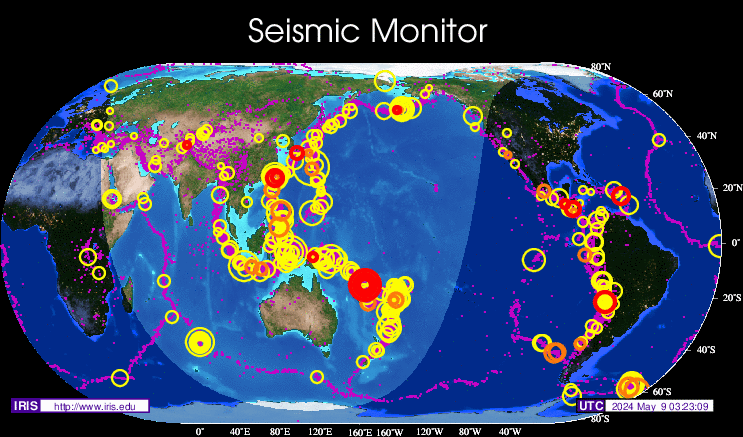
Seismic Map
What They Say About SDA
"Smalldeadanimals doesn't speak for the people of Saskatchewan" - Former Sask Premier Lorne Calvert
"I got so much traffic after your post my web host asked me to buy a larger traffic allowance." - Dr.Ross McKitrick
Holy hell, woman. When you send someone traffic, you send someone TRAFFIC.My hosting provider thought I was being DDoSed. - Sean McCormick
"The New York Times link to me yesterday [...] generated one-fifth of the traffic I normally get from a link from Small Dead Animals." - Kathy Shaidle
"You may be a nasty right winger, but you're not nasty all the time!" - Warren Kinsella
"Go back to collecting your welfare livelihood." - Michael E. Zilkowsky


I remain unconvinced that wind is a fraction of a cent more expensive than coal. Why does wind typically add nothing to a system?
Hydro seems to be absent?
So the cheapest to operate per kWh is the Natural Gas – Advanced Combined Cycle at 6.2¢/kWh and the most expensive is Solar Thermal at 30.6¢/kWh. Just to rub more salt in Ontario’s wound–there is a shale formation beginning at Windsor, ON and runs to Oshawa, ON (that’s a distance of over 400km) that resembles those which contain natural gas–and Wynne has closed down the possibility any company exploring its commercial viability and the resultant jobs that would go along with this sort of discovery. Enjoy the decline, Ontario!!
Hydro seems to be absent?
I do not see appropriate depreciation and (ongoing) repair and maintenance numbers for wind. The life of windmills is turning out to be quite limited, and the true r and m costs are horrendous (do not use the original estimated costs – they turned out to be wrong!). Finally, because both solar and wind are intermittent, the cost of the required 100% despatchable standby power does not seem to be factored into either of the two intermittent sources. Am I mistaken?
As evidence for my unease for claims of “cheap” wind and solar, I adduce the Danish and German actual experience, plus their actual customer level power rates, including subsidies. The real world costs are much higher than the quoted numbers in the original source document, I think.
When looking at claimed cheap “renewables”, watch for the pea under the thimble.
Tony.
I agree scar and wonder if subsidies somehow skew the calculation.
Wind’s capacity is low and transmission costs are high.
I’m having trouble swallowing the maintenance costs on wind as well.
Some of you are expressing some confusion over the chart. And you are right to be confused. Capital cost per kWh for example makes no sense unless you are provided the operating lifetime of the facility. It also makes no sense unless you know the cost of capital. Most LUEC (levelized unit energy costs) are calculated using overnight assumptions (meaning you ignore the interest rate and add it in afterwards) to ensure comparability.
This table came from Muller’s book, but he certainly is not the source. He borrowed it from somewhere else.
As to costs, the solar costs are ridiculous. Actual costs are about 2 1/2 times the quoted amount, all of it in capital cost.
Hydro is excluded because the range for new hydro is hugely variable. All the best sites have already been developed. What’s left is not very useful, either not enough water or not enough head, or both.
And finally, the CCS cost for coal is simply absurd. Actual experience is suggesting several times that amount assuming its technically possible at all on any significant scale. There’s good reasons why Alberta dropped its CCS project.
Skepticism that the numbers are correct “as is” aside, and I share the opinion that these costs might not entirely correct, even with these numbers it’s pretty damning that anyone thinks wind and solar are useful on an industrial scale.
You can’t look at the numbers and not go, whoa, I think I see a malinvestment.
Therefor, e supporters and enablers of deployment of that technology are one or more of
1. Innumerate
2. Crooked
3. Stupid.
4. Malicious
And then there’s this….
http://www.bloomberg.com/news/articles/2015-04-14/fossil-fuels-just-lost-the-race-against-renewables
It’s da’ mon-nay, as far as I am concerned.
Somebody is trying desperately to make lots and lots o’ da’ mon-nay from wind power and solar power, and they will use every and all means – ethical and unethical – to do so.
How ethical does anyone think that leftists, environmentalists, and their assorted ilk are?
Yeah well. Gas,coal,hydro,oil, and nuclear are CHEAP compared to the bird choppers and the farm land destroying solar. BUT….it kills off the brown people in developing/3rd world countries by not allowing them to improve. Agenda 21. Wake up, fools.
@jcl: Just want to point out that the BNEF (Bloomberg New Energy Finance) is a business and is in business to promote investment in “alternative” energy, i.e., solar, wind, etc. As such, the article is more promotional than factual and should be read with that in mind. I personally thought it was short on actual real world facts and long on wishful thinking.
As long as windturbines harm birds i’ll never ever support Wind Energy
The socialists know very well that if their system takes over fully, widespread deprivation will follow. Their constant attacks on “consumerism” are designed to make the populace feel guilty or unsettled by having a high standard of living, and thus to encourage them to become accustomed to deprivation. Flogging solar and wind energy that drain resources is another one of their tactics.
All progress comes from those who find ways to produce more or better or cheaper goods and services. By switching from lower-cost to higher-cost energy, the opposite will happen. Then everyone wonders why all the good high-paying jobs are disappearing. They’re being destroyed by bad government policies, and not just environmental ones.
Under socialism, everyone’s job will be “precarious”.