
 |
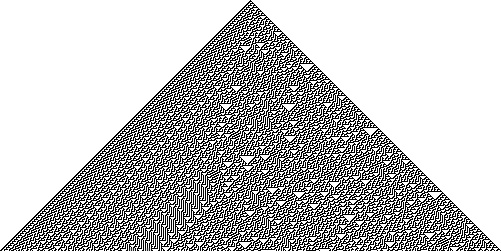
Good afternoon ladies and gentlemen, welcome to a special edition of SDA Late Nite Radio. This afternoon, for your delectation and pursuant to our distinguished lecture, documentary & interview series, here, at the Institute for Neural Computation and in the Frontiers of Knowledge lecture series from the University of California at San Diego, is Dr. Stephen Wolfram presenting his talk A New Kind of Science ¤ (1:26:42), for the 2003 H. Paul Rockwood memorial lecture. In this afternoon’s talk, the controversial Dr. Wolfram introduces the now famous Rule 30 and many of the other concepts that lead some of us to think that, at scales a dozen orders of magnitude smaller than anything ever before contemplated, it may be the case that all that actually exists is information. I would suggest that one can easily see why Mr. Wolfram’s ideas are at least interesting.
Please note that this is not Reader Tips, our regular
Reader Tips entry will appear tonight as scheduled.
Like turtles, it’s information all the way down. 🙂
A very pretty ontological problem…
I don’t think that turtles can be that small, Tenebris 😉 But seriously, if you haven’t already seen this afternoon’s talk, you, of all people, would, I think, find watching it to be a very interesting way to kill an hour and a half.
“it may be the case that all that actually exists is information”
Insofar as all “that actually exists” is all that we can interact with in our physical realm I, from a Christian perspective, would say I agree completely.
Long time ago I came to realize that “all actually exists” is the essence of the LOGOS person in YAHWEH.
Once again science labours up the mountain upon which theology rests.
nothing like string theory to bend the brain or bran.
With some people, you just can’t bring up metaphysics without them yapping on and on about some sort of god-concept or another, even though in the pantheon of philosophy theology is subordinate to metaphysics. And, “string theory”? Hello? Say, why don’t I just post random noise, like the output from some random generation i of Rule 30, and then y’all can just talk about whatever you want? What the hell’s the point of having a danm topic anyway? No, wait, I remember now, the point of having a topic is that if you get too far off topic then I get to delete your comment. What? Oh, sorry, apparently I wasn’t supposed to mention that. Please forgive me 😉
Vitruvius – “kill an hour and a half”? When I am done with time, there’s not even a second left.
cal2 – you dropped an “e”
joe – pearls need to be handled delicately, not used as ammo. Herewith, a theology lesson: scripture is a history of the redemptive process, necessary and sufficient to that purpose. Stop flailing about with the sword.
And, yes, Vitruvius – theology IS subordinate to metaphysics. But, reason is a “bottom-up” process. Would you plant your feet firmly in midair?
And now I shall take my lady to dinner…
Have a great dinner, Tenebris et Lady.
Joe – the fact that ‘it may be the case that all that actually exists is information’ (with which I agree) does NOT mean an Essentialist ‘Thing’, i.e., information as a ‘thing’.
That type of mysticism, whether found in Essentialist Postmodernists, such as Derrida, with his Logos, or Plato, with his Forms, or the notion of God, is not what Wolfram, and others, are talking about.
Wolfram is focusing on morphology, the emergence of structured realities that are existent in space and time. He is focusing, not on the traditional mass and energy of particle physics but on how mass/energy actually forms itself into, well, a form.
And, a form is ‘in-formed mass/energy’. So, the question is, how does these ‘in-formed masses’ come to be? Where do the rules of formation develop? How and why? And some of us feel that these rules are the primary nature of the universe, which has, as rules, developed as mass evolved..as Forms. (No, the Rules are not a priori; they don’t exist as Pure Mind floating around in a Platonic Utopian Purity).
I like his marginalization of Natural Selection, which I marginalize to a process called ‘weak anticipation’. Natural Selection only operates on actual organisms, and helps maintain one type as dominant. It has nothing to do with adaptation or evolution or the emergence of a new Form. For that, we need to go to a deeper informational process.
Wolfram’s cellular automata operate, not in isolation, as do Darwin’s random mutations, but in relation to ‘neighbours’. His rules (256, I think) all consider information about neighbours, both near and far.
What is interesting is where and how randomness operates in Wolfram’s processes. My own view, is that it operates in Strong Anticipation, where an organism is in informational contact with many parts of its neighbouring environment..and that envt with its envt..and so on..and it picks up information from near and far.
Some of the far information may be ‘new’ to the ‘near environment’ but can affect it. So, a type of organism that functions in a far envt can informationally affect one quite far from it…and cause it to change its morphology.
That is, there are numerous ‘initial conditions’ not just one, not just that single black square. Is there a phase where a system effectively reaches a critical threshold of morphological organization, i.e., a regular pattern, and starts a new set of initial conditions and so, changes its morphology?
Wolfram, to my knowledge, also doesn’t deal with the operations of the universal and the particular, and the different types of information in each process…though he does refer to predicate logic in his text (ch 12).
I can’t assume to fully understand Wolfram’s ouline and have therefore, remained locked into my own Four Modes of Space, Three Modes of Time and Six Relations. Oh well.
Thanks for putting this video up Vitruvius. I’m enjoying it immensely. I think I will download it though to spare myself the pauses caused by band width.
Tenebris… I do plant my feet firmly in mid air. It hasn’t worked for me so far but it’s too late to come up with another game plan.
“does NOT mean an Essentialist ‘Thing’, i.e., information as a ‘thing’.” ET
Agreed but your allegation does not disprove what I posited.
You choose to believe in mindless information. I choose to believe that information is the product of MIND.
You choose to believe in causeless existence. I choose to believe in Will above Reason. Co-eternal with Reason springing from Will. In other words our existence is both an act of Will and Reason.
The difficulty we have in acknowledging Will and Reason is that it requires us to humble ourselves and admit that now we see in part and know in part. It is as if we see through a glass darkly. My fervent prayer is that someday when perfection comes I will know fully even as I am fully known.
I’m glad you’re enjoying it, Gord. I think, ET, that what Dr. Wolfram is trying to approach is the question of infinite recursion. It’s all well and good to say that X causes Y, yet the questions remain, what causes X, what causes what causes X, ad infinitum. Wolfram’s fundamental truth may be, if it works out over time (and I’ll be dead before it is known one way or the other, for sure, if ever), that infinite recursion terminates in some sort of consistent initial state known as the information about what is. It’s a chicken and egg problem, and I’m voting for the recipe.
Um, Joe, you are using a different sense of the word
information, as a product of mind, than is being used in
the lecture, in the sense of as a prescription for existence.
That’s one of the funny things about natural
language words: they have multiple definitions.
Very interesting video Vitruvius, thanks for posting it.
joe, I certainly don’t believe in mindless information. That would be impossible. I believe that information is a product of ‘mind’..and that mind exists and functions as the organizational principles of the universe.
You have different definitions than I do; you seem to think that ‘mind’ is human. I don’t. As for ‘will’ and ‘reason’ – these are basic Aristotelian terms (and Pope Benedict, by the way, is an Aristotelian)..and I agree with them. BUT, my definition of ‘will’ is an Active Will to Exist as Form, and my definition of ‘Reason’ is the organizational principles of Form.
Vitruvius – what I’m wondering is whether a system, let’s say the WHOLE system (consider one of Wolfram’s computer ‘events’ as a whole universe)..well, I’m wondering if a whole system reaches a critical threshold of organizational complexity when it has developed a large critical mass of Formed Mass/Information..and cannot continue that recusrive pattern..and so, it, as you say, terminates but begins with a new initial state..one that is far more complex.
As for ‘basic cause’ I have a non-answer. My own view is that morphological processes exist to prevent entropic dissipation. That is, by keeping energy as mass (i.e., in-formed)and making these processes ever more complex, the universe is able to exist rather than entropically dissipate. Some would call this agenda..’Will’. Don’t beat me up.
“Say, why don’t I just post random noise, like the output from some random generation i of Rule 30”
Actually I think a Rule 30 blog would be cool but why stop there? Set your goals higher and create your own universe. 😉
I agree, ET, that given that there was no big bang and that space and time are infinite (always was, always will be, forever in every direction), there must be some sort of form of prevention of entropic dissipation, otherwise, it would all be dissipated by now. I mean, the odds that we are the unique moment in the history of time where entropy just happens to not be dissipated are unreasonable. There must be some sort of dissipation mitigation mechanism.
Please ET stop trying to pigeon hole everyone. I do not follow ancient Greek philosophers. That some of their ideas mirror my own are coincidental. I reached my conclusions by experience, observation and reading an ancient Jewish philosophy known as Christianity. Maybe the Jewish fisherman who wrote “In the beginning was Logos” studied ancient Greek philosophers but knowing that even in his own time he was viewed as being a bit of rural rube, I kind of doubt it. Of the Greek philosophies I hold that ‘even a blind squirrel finds an occasional acorn’. :-0
Actually Vit I used the word ‘information’ in the context that I did for a very good reason. John 1: 3. Dang there’s that Jewish fisherman again. 😉
Yes, but the topic here is Dr. Wolfram’s thesis, Joe, not John’s.
You’re reading from the wrong hymnal, dude 😉
ol’ Al’s general might apply here, in an undertow way. For me the special is more important.
vitruvius – OK and nice point about the ‘no big bang’…what about the supposition, to prevent entropy, that organizational processes reach a critical threshold capacity..where, at some point, they can no longer balance ‘formation’ vs ‘dissipation’.
Wouldn’t the system then ‘flip’ to a stronger organizational process, as shown in Wolfram’s charts, where suddenly, the regular pattern is no longer operative and a more complex organizational process emerges. This also suggests, as Wolfram posits, a basic Principle of Computational Intelligenc..where ‘even at the smallest scales the laws of physics will show the same computational sophistication that we normally associate with intelligence” (p.1191).
So, with regard to organizational complexity, you have the physical realm, then the more complex realm of chemistry and then..a real transformation..into life. And this is not reversible. We cannot, despite the apocalyptic shrieks of the AGW types, and threats of economic crisis from Obama, return back to either the pre-human era..or the pre-industrial era.
As Wolfram points out, the definition of life is difficult (ch 12). My own view is that the living systems have an advanced capacity for informational networking and self-organized adaptation of their Form or morphology. So, a bird can develop a new beak. I’m not aware that a hydrogen molecule can do much about its Form..except with a limited number of isotopes.
Well, not to put too fine a point on it, ET, but I’d go so
far as to say that life is negative entropy. But then, I think
that selfish is the definition of life, so what do I know?
No, I think that all morphologies function, in the mathematical sense, to prevent entropy. That includes the physico-chemical as well as the biological, realms.
As for life being ‘selfish’ and surely you don’t mean in Dawkin’s sense, I’d disagree. I think that morphologies try to reduce, up to a point, or at least, control, entropy. But I think that life-morphologies are best defined by their relatively rapid self-organizing capacities to transform their Forms.
It’s a fine line between a biotic and abiotic form, but I think that the biotic realm, like free enteprise and capitalism, is far more diverse and productive than the abiotic communist top-down totalitarian realm. Heh.
Yeah, sure, but if you don’t have some sort of
generic universal steady state, you have nothing.
If entropy is pulling one way, something must be
pulling the other way, to balance, or we wouldn’t
be here by now.
Of course – that’s why my ‘Cartesian quadrant’ has different spatial and temporal measurement values. Progressive time and non-local space measurements of mass reduce variation and change and ensure stability and continuity…Peirce’s ‘synchronicity’.
BUT, this measurement can’t exist except as actualized within particular, local space and time measurements.
Now, that’s a neat trick. To set up a universal measurement but disallow its existence except within individual actual realities. It’s a plot, by Zeus and Hera and Apollo and Aphrodite and all that gang…
What, you haven’t heard? The bouncers kicked them
all out for being petulant with malice aforethought.
I think that is a very thought provoking bit of video. Mr. Wolfram has been working pretty hard at this, I’d say.
Its a new way of thinking about the fundamentals of the universe. Even if its completely wrong it is still very useful scientifically, it’ll shake the tree. Something wonderful will come out while outraged scholars beaver away to prove Mr. Wolfram wrong.
I’m going to buy his book, I think. Looks like a beaut.
Incidentally, we still don’t get away from God here. Just pushes the question back to “so, who made up the wee little rule that governs it all?”
~:D Hee hee!
What is the rule that governs who
made up the rule that governs it all?
You see my point, about recursion termination?
You need a universal termination critera.
That criteria is: information ~ what is.
“It’s a chicken and egg problem, and I’m voting for the recipe.”
I’m in the kitchen thanking the cook.
(Marvelous meal tonight).
It’s been too long since I last reviewed Wolfram’s thesis, so I will refrain from mapping my poor recollection to his substance, since it is clear he has markedly advanced his thinking. I’ll flag the talk as a Christmas present (scholarship may come AFTER tenure…Alas, ET, weep for this present generation).
“…given that there was no big bang and that space and time are infinite… the odds that we are the unique moment … where entropy just happens to not be dissipated are unreasonable. There must be some sort of dissipation mitigation mechanism.”
What? Are you such a staunch Copernican that not even the weakest anthropic principle can be diffidently suggested? “[G]iven” indeed! Hoyle would be proud. If there “must be … some … mechanism”, I would love to see the list of candidates. Even Wolfram (I think) shies away, but I may be doing him an injustice.
But to return to the recipe: termination criteria are only necessary in purely linear causal treatments. Stop thinking about turtles.
G’night.
Is it possible that Rule 30 is merely a component of the Universal Theory?
“You see my point, about recursion termination?”
Indeed.
None the less, Vitruvius. one must admit a Prime Urge is not eliminated by the argument, merely changed in appearance. Furthermore, given the way he structures time, the Prime Urge doesn’t have to come at the beginning. It can come at the end. Or in the middle. Or 5/8ths of an inch from last Tuesday, if I may be utterly silly about it.
Non-computability may be the reason we have a universe at all. Is the square 12th from the end at the 111th iteration of Rule 30 black or white? Maybe someone needed to know? Quite Hitch Hiker’s Guide, and I don’t believe it
In my previous (layman’s) reading of Penrose, non-computability rather strengthens the case for Being with a capital “B”. I don’t see how Pernrose’s contentions are disproved by Wolfram, but then I haven’t read Wolfram’s book either.
Still, Mr. Wolfram says right in his speech toward the beginning that free will could be a requirement. If you can’t tell what Rule 30 is going to do, you can’t tell what a human is going to do. And hey, who’s watching to see how it turns out?
Reasonable suspicion is as good as we are going to get right now, eh?
phantom – I think that free will, or freedom (remove the ‘will’ which suggests a specific intentionality) IS a requirement. Freedom of relations.
What is interesting is that this freedom increases with complexity. So, in the physico-chemical realm, there is very little freedom of relations. A hydrogen molecule has very few options of relation, and almost nil ability to come up with any such options.
The biological realm, however, exploded in complex organization – and – freedom to develop novel relations and therefore, novel morphologies.
Constraints are always necessary and these constraints are made up, first, of the basic limited freedom of the physico-chemical mass which makes up the biological organism. Another constraint is that of type. Organisms exist within general typologies: species. These general morphologies impose a long term constraint on the expansion of novel aberrations. But because the type (duck)..is expressed within ‘tokens’ (individual birds)then, a channel for free variation exists – and a new type can become dominant.
The human species is the most complex and has the greatest capacity for variation and freedom. This, of course, means that humans also have trouble with the universality of constraints. What constitutes a valid constraint on freedom? Is there are universal morality? Is society the agent of constraints or religion or ethnicity or a cult or whatever? Very difficult.
Yeah, well, I still think that rule 30 is cool 😉