Why this blog?
Until this moment I have been forced to listen while media and politicians alike have told me "what Canadians think". In all that time they never once asked.
This is just the voice of an ordinary Canadian yelling back at the radio -
"You don't speak for me."
email Kate
Goes to a private
mailserver in Europe.
I can't answer or use every tip, but all are appreciated!


Katewerk Art
Support SDA
Paypal:
Etransfers:
katewerk(at)sasktel.net
Not a registered charity.
I cannot issue tax receipts
Favourites/Resources
Instapundit
The Federalist
Powerline Blog
Babylon Bee
American Thinker
Legal Insurrection
Mark Steyn
American Greatness
Google Newspaper Archive
Pipeline Online
David Thompson
Podcasts
Steve Bannon's War Room
Scott Adams
Dark Horse
Michael Malice
Timcast
@Social
@Andy Ngo
@Cernovich
@Jack Posobeic
@IanMilesCheong
@AlinaChan
@YuriDeigin
@GlenGreenwald
@MattTaibbi
Support Our Advertisers

Sweetwater

Don't Run

Polar Bear Evolution

Email the Author
Wind Rain Temp

Seismic Map
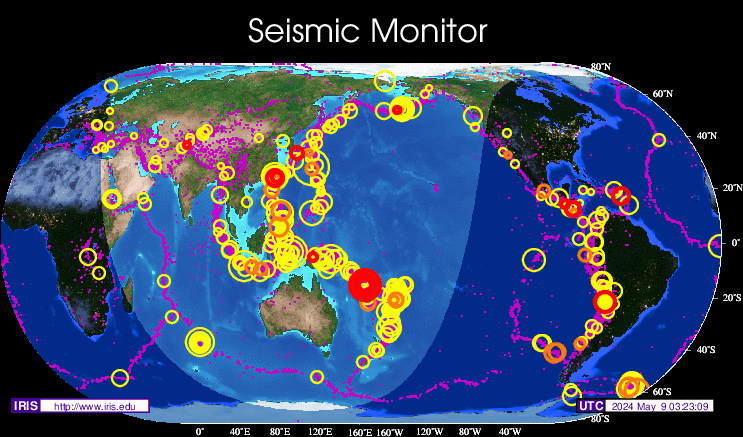
What They Say About SDA
"Smalldeadanimals doesn't speak for the people of Saskatchewan" - Former Sask Premier Lorne Calvert
"I got so much traffic after your post my web host asked me to buy a larger traffic allowance." - Dr.Ross McKitrick
Holy hell, woman. When you send someone traffic, you send someone TRAFFIC.My hosting provider thought I was being DDoSed. - Sean McCormick
"The New York Times link to me yesterday [...] generated one-fifth of the traffic I normally get from a link from Small Dead Animals." - Kathy Shaidle
"You may be a nasty right winger, but you're not nasty all the time!" - Warren Kinsella
"Go back to collecting your welfare livelihood." - Michael E. Zilkowsky

Heh, Captain the link has a ‘mail to’ designation causing a blank e-mail template to open, instead of taking the reader to your marvelous site. 🙂
Your link is messed up.
and religion has replaced science in the great global warming hysteria.
go figure.
Fred, mostly true.
Except the scientists sold out for grants, which is economics.
1 TIMOTHY 6:10
For the love of money is the ROOT OF ALL EVIL: which while some coveted after, they have erred from the faith, and pierced themselves through with many sorrows.
And now we’ve come full circle back to religion.
Religion is where people go when government and economics is kicking their butts, Captain. That’s because its a self-selected group instead of an imposed one, and people hang together for survival support in the face of hard times.
I guess the argument regarding religion hangs on whether or not religion describes something “real” or not. Opinions differ, and absent proof (which we are, and will most likely remain) opinion is all one is going to get. Not too fruitful a discussion, from a practical point of view.
And speaking of practicality, your contention as regards education in economics is probably too hopeful. Education in the germ theory of disease is 100%, yet the Five Second Rule remains in force.
But I think we are not having trouble right now because the citizenry are uneducated in economics. They certainly are, but that’s not the problem.
Numbers are confusing.
Yay Feed the Kitty! (I want those shoes.)
“Fred, mostly true.
Except the scientists sold out for grants, which is economics.”
You are right. Money + fame, trips to Bali and a chance to be featured in a Michael Moore Mockumentary.
Scientists. The New Rent Seekers.
” However, religion has one primary flaw; in order to give it teeth, and give its clergy “authority” or “legitimacy” to rule over the masses you had to create things like “hell” and deities and wrath, largely things that could not be proven until (conveniently) somebody died and went there.”
Repent or your seas will rise up, the earth will burn, the land will have droughts and floods at the same time. Bad things will happen to you unless you forfeit your lifestyle(room temperature) and money (green taxes) to the collection plate (Al Gore’s green offsets).
The comparison is so strikingly obvious it is pathetic in the extreme.
IMO, there are three ingredients that allowed the global warming fraud to get as far as it did.
1) A compliant media.
2) A desire to replace organized religion.
3) The hatred for Big Oil (which the media conveniently failed to inform the people that “Big Oil” is only about 10% free enterprise these days – OPEC, Russia, State owned the rest)
The reason most Christian denominations are unattractive is the fact it is unrecognizable from its historic origins.
A God of love who forgives as we grow closer to him has been changed into a wrathful punisher and portrayed as some kind of control freak (right, captain?) .
Who would want to follow a God like that? Not me.
Much of today’s Christianity is a hollow imitation of a liberating philosophy that swept the ancient world.
It’s attractiveness has been hollowed out, little by little.
It’s a shameful way to handle a legacy of love that has bonded humanity for thousands of years and has given an understanding other religions can only hope to achieve.
Ron, I must respectfully disagree with your 11:26am.
The media were not compliant. The word you’re looking for is “complicit”. Hyper-actively complicit, actually.
See, compliant is when you trustingly let the fraudsters lead you along by the hand. The real deal with global warming is the MSM is in front running flat out, the poor fraudsters are racing along in their wake trying to keep up. Algore and FruitflyGuy are on TV so much they’re getting tired from it.
“complicit” ! You are absolutely correct. thx
The Captain’s argument that religion is just a way for man to organize man is missing one important fact, and that is the very existence of anything – space, time, the universe, the earth, life, man, and intelligence (the latter being the only one still in some question).
Entropy requires that the universe started in some condition of high organization, and is gradually running down.
The whole concept of evolution, on which our society is based today, is in direct conflict to this fundamental scientific principle. Having studied advanced thermodynamics in university (what the Captain would call a real education), I believe I am as qualified as anyone to say there is no rational way to harmonize the two.
Kick-starting the whole process, and its continued maintenance via laws that we continue to strive to understand, requires a supreme intelligence, “person” if you will, of some sort.
Who that supreme being in, I leave to other studies. But given the necessity of such a supreme being, and given the capacity for deductive reasoning that we occasionally seem to have been equipped with, I for one cannot believe that he would not reveal himself in some way. If we call the quest for that revelation “religion”, then you could claim religion was created by man, but not the supreme being we strive to understand.
So, Captain, much as I enjoy your analyses, on this point your logic needs to be a bit more considered.
The problem with your entropy argument, Rick, is that classical thermodynamics only applies to closed systems at the macroscopic scale, yet as Mark Haw wrote in his From Steam Engines to Life? essay, at the American Scienist magazine, on the 100th anniversary of the death of Lord Kelvin:
“[This] brings us back to microscopic engines: the most interesting objects in which the two themes of modern thermodynamics — microscopic scales and open systems — join. Although studies of individual proteins are important foundation stones, the cell depends on millions of molecules in a complex network of machines, their functions interlocked across a range of scales. Such interplay is possible precisely because these living engines are open to fluctuations and not isolated from their environment. It may be that the complex functions of matter that we call life are nothing more than this multiscale interplay of engines, a network through which energy is transformed again and again, as microscopic machines swap and shift matter — manipulate entropy — in a thermodynamical cycle the likes of which Kelvin could hardly have imagined.
“If so, then the theory that accommodates living engines will require both a thermodynamics of microscopic matter, and a thermodynamics of open systems. Current research is providing progress in each of these, but the challenge may be to match them together, to join the palpable chemical reality of protein engines to the heady concepts of non-equilibrium thermodynamics and self-organization. That may lead us, finally, to the second revolution—the thermodynamics of life.”
mm over at Capt’s blog really nailed it right on:
Hey Capt, maybe if you had picked up some philosophy courses (or God forbid, theology courses!) in university, you’d be on the floor like the rest of us worthless philosophy majors laughing.
Do you honestly think that this has been discussed and resolved centuries ago? Do you really, really think that theologians are dumb enough to never have considered whether or not it’s ‘turtles all the way down?’
Look, Aquinas spent his whole career trying to disprove God. And really, he’s spent a lot more time than you doing so. Turns out God is a thinking thing that exists out of time and space (God is eternal & immaterial). And if anyone is gonna start bringing up Dawkins over and over again, please remember that Dawkins never actually disproved God, because he uses bad theology to make his points (he rips on the watchmaker argument, for instance, which is the single lamest excuse for a proof of God that nobody takes seriously). The reason that buses in Toronto couldn’t say “There is no God, now stop worrying & enjoy your life” is because the transit authority isn’t allowed to print ads that aren’t proven to be true.
Captain, it’s not always the best idea to assume that you’re the only one who is thinking really hard about ‘stuff’ and it’s also a misguided idea to think that religious scholars haven’t spent whole careers proving to themselves that they aren’t pulling God out of thin air. Even Hume falls short of disproving God, and if he can’t do it, nobody can.
Besides, if economics were to become a new religion, then we wouldn’t be able to teach it in schools anyway!
Leave economics to the economists — I parrot your figures an awful lot — one prof even referred to me as ‘captain capitalism’ without realizing where I was getting my info — and you can leave politics to politicians, and theology to theologians.
But, Tomax, the Captain said that economics will replace religion, not that economics will replace god. Religion and god are not the same thing. God is an open metaphysical question. Religion is a phenomenological property of a functioning human brain. It is that latter property that explains why the Captain is wrong; god doesn’t enter into it.
Vitruvius, a much more succinct statement than mine. Religion is indeed a constant in human society. Forms vary widely, wildly in some cases, but there is -always- religion.
Vit, I associated the reference to ‘god’ and religion as the same in his statements.
Initially the paragraph about the 10 commandments starts with reference to religion, but who gave the 10 commandments?
Whereas you do distinguish religion and ‘god’ as separate items, to which I agree.
But where we differ in the usage of a small “g” in reference to the one true “God”.
There are many small ‘g’ gods in this world, no doubt about that. Metaphysical, phenomenological or physical, per se, do exist.
In layman’s terms, the exists in the spiritual realm just as much in the physical realm many small g gods.
But thank God (no excuse needed on the pun) there is only One true God.
As well, thankfully He’s not a question in my functioning metaphysical matter.
tomax7’s 12:35 post reminds me of an economics paper I read 40 years ago – the author was a well known American economist of the day, I just can’t remember who – in which it is posited that aspiring saints could be better economists than bankers. The author noted that the aspiring saints may indeed be weighing carefully the marginal costs and utility of various spiritual goods and services, while the “frock-coated bankers” are simply following established processes. So, I agree with tomax7 that we shouldn’t be too quick to discount the learnings of religious scholars or too eager to uptake the reasoning of modern economists. God gave us critical faculties so we would apply them to both!
God is an open metaphysical question.
Posted by: Vitruvius at June 19, 2009 12:48 PM
Hmmm. Perhaps my memory is weak, but I thought you were an atheist. This appears to me to be an agnostic statement, and, perhaps even (if more information were given) a Deist statement.
No, Brent, I am not an a-theist, I’m an a-deist. That is, I don’t believe that god exists, but I do believe that theology exists. Nevertheless, I can’t prove that deities do not exist, so to accommodate the believers I leave the question open. Would that they could be so gracious in return. Meanwhile, I can prove that religion exists, independently, as a function of the human brain ~ I don’t need any sort of god-concept for that. Meanwhile, my point remains that economics will not replace religion, because each of them is a different and separate function of the brain.
I like what Winston Churchill said about his view of the the Christian Church:
I’m “not a pillar of the Church but more of a flying buttress — I support it from the outside.”
Vit, I’m interested in how to see religion as a function of the human brain. Which section/lobe?
…hey, while we talking about brain functions, don’t get me wrong, I’m not mocking or belittling your views Vit, but how does a adeist approach love?
Meaning, is it a biological function, or a phenomenological property?
Why I am asking is the same love I have for my wife and step-kids is the same love I feel from my Heavenly Father. God loves me, and God is love.
It’s gotta be more than metaphysical or phenomi…type thing.
It’s a knowing.
Chuck Jones:
http://en.wikipedia.org/wiki/Chuck_Jones
I posted that link before I watched the actual video. It is a beautiful story (I’ve seen it dozens of times on TV) and brought tears to my eyes.
Thanks for the clarification, Vitruvius.
I think you are using somewhat different definitions of Theism and Deism than what is generally accepted. However, you also defined how you were using your terms so I think I understand what you were saying.
I am not sure whether or not I qualify as someone who is “so gracious in return” 🙂 . My own belief is that there is much more to a “world view” than materialism and the natural world. As a former atheist, any critical statements that I make are more self-criticisms of the way I used to think as I now think of my former thought process as a poor thought process. Most current arguments seem to be ot the sort: absence of absolute evidence is evidence of absence.
On the other side of the debate, there are many different positions – as you well know. Some of us would like to be able to have more answers for our friends. Some of our friends ask reasonable questions – others do not – and the answers which prove satisfactory for some do not for others. Further, no one should be surprised that man cannot fully understand God; a god that can be fully understood by man has been manufactured by man.
Agreed on your economics point. Thanks once again for your clarification.
Set You Free, when I lived in South Korea I attended Mass with my grade-school students (who went on their own). I knew a student who attended three Masses on Sunday primarily for the language (Korean, English and French). I personally witnessed sixty people being baptised into the Catholic faith all at once. When Christianity was introduced to Korea, it was treated by scholars as a philosophy before it was willingly adopted by the populace. Now, about half of the South Korean population is Christian.
I don’t think religion is dead, despite very adamant attempts to make it so. I think it is the only thing that causes people to not teeter entirely one way or another.
Just my thoughts.
Thanks, Brent, that really was the only point I wanted to make: that independent of the existence of god, economics will not replace religion ~ economics may become, or may already be (at least for some) a kind of or type of or aspect of religion, but religion, one notes, has not been replaced.
Vit, 12:30, sorry I can’t spend all day reviewing the comments.
It always amazes me how the use of big words is seen to somehow give credence to the utter impossibility of the reversal of entropy on such a grand and continuing scale as to make evolution possible.
Again, there is no rational way to harmonize evolution and entropy.
Ok. If you like. Although, of course, it can and is
being argued by some that only information actually
exists, and that everything else is phenomenological.
Look, Rick, go back to your thermodynamics texts and review the very beginning stuff. There’s always a “disclaimer” to the effect that this stuff only works in macroscopic scale closed systems. Not everything that exists does so in a context of macroscopic scale closed systems.
Don’t ask classical thermodynamics to do something it
doesn’t do. That’s not fair to classical thermodynamics.
economics for religion could be used to halt the muzzies, but taken to the extreme=worldwidecommunism/
Did you all enjoy Feed the Kitty?
Point number one: The second Law of Thermodynamics does apply to closed systems. Point number two: the expression on the mouse’s face in “Feed the Kitty” is priceless.
That’s what I said, Tower. It applies only to closed
systems. It does not apply to open systems.
It applies only to macroscopic systems. It does not
apply to microscopic systems. Glad we agree.
There are many good reasons to study economics, but the idea that economics could (and should) replace religion (and presumably replace philosophy, including ethics and metaphysics, as the captain’s reasoning would imply) is just as much an unrealizable utopia as any leftist communist dream. And even if it were realizable, it would produce ignoble human beings, as Rousseau rightly observes and Nietzsche deplores, human beings defined by material self-interest, divided reason and inclination, a society of Tolstoyian Karenins.
Captain, you’re right on many points, but not this one.
Well, Vit, I see you’re still hanging around this thread, so you’d perhaps be interested in the fact that I took up your suggestion to find the disclaimer you claim is “always” made in every thermodynamics text.
I only have a couple thermo texts left, one graduate level, one undergrad. The grad level text “Equilibrium Termnodynamics” by Coull and Stuart (1964 ed) simply states that the second law applies to all human experience, making your open system universe belief to be an interesting, but totally unscientific concept. Believe it if you want, but there’s no way of testing it, so don’t call it science.
The undergrad text did have an interesting comment, that being “Fundamentals of Classical Thermodynamics” by Van Wylen and Sonntag, (1965 ed, sorry but that was hot off the press when I bought it, and the 2nd law hasn’t changed since). These two Ph.D. Engineers (one MIT, one U of Michigan) make the following interesting statement:
“The final point to be made is that the second law of thermodynamics and the principle of the increase of entropy have philosophical implications. Does the second law of tehrmodynamics apply to the universe as a whole? Are there processes unknown to us that occur somewhere in the universe, such as “continual creation”, that have a decrease in entropy associated with them, and thus offset the continual increease in entropy that is associated with the natural processes that are known to us? If the second law is valid for the universe (we of course do not know if the universe can be considered as an isolated system) how did it get in the state of low entropy? On the other end of the scale, if all processes known to us have an increase in entropy associated with them, what is the future of the natural world as we know it?
Quite obviously it is impossible to give conclusive answers to these questions on the basis of the second law of thermodynamics alone. However, the authors see the second law of thermodynamics as man’s description of the prior and continuing work of a creator, who also holds the answer to the future destiny of man and the universe.”
So Vit, old boy, I didn’t go as far as these two gents in my extrapolation, but I suggest they are in 100% agreement with my position as far as I stated it above. I suggest it’s maybe time for you to recognize that the conclusion they’ve come to is worth considering.
…the silence is deafening.
They’re covered in sections 2.1 and 2.2 of my
1972 edition of Van Wylen and Sonntag, Rick.
2.1 and 2.2 are the definitions, Vit. I think we all understand what is a macroscopic system. But go to 7.14, where they draw their conclusions. I expect neither Van Wylen nor Sonntag changed their world view between 1965 and 1972.
I do have to make a general comment. You know a heck of a lot more about music than I do, I enjoy what you have to say and wish I knew a fraction of what you do. And your mastery of the thesaurus is superb; I believe you could make Obama look like an ESL student. But when it comes to thermodynamics, the ramifications of the 2nd law to our understanding of life itelf are too significant for you to invest so heavily in speculation rather than true knowledge.
Rick, in section 2.2 of Van Wylen and Sonntag it says: “From the macroscopic point of view, we are always concerned with volumes that are very large compared to molecular dimension, and, therefore, with systems that contain many molecules. Since we are not concerned with the behaviour of individual molecules, we can treat the substance as being continuous, disregarding the action of individual molecules […]”. It is this sense that Mark Haw is referring to when he wrote, in his From Steam Engines to Life? essay, at the American Scienist magazine, on the 100th anniversary of the death of Lord Kelvin:
“[This] brings us back to microscopic engines: the most interesting objects in which the two themes of modern thermodynamics — microscopic scales and open systems — join. Although studies of individual proteins are important foundation stones, the cell depends on millions of molecules in a complex network of machines, their functions interlocked across a range of scales. Such interplay is possible precisely because these living engines are open to fluctuations and not isolated from their environment. It may be that the complex functions of matter that we call life are nothing more than this multiscale interplay of engines, a network through which energy is transformed again and again, as microscopic machines swap and shift matter — manipulate entropy — in a thermodynamical cycle the likes of which Kelvin could hardly have imagined.
“If so, then the theory that accommodates living engines will require both a thermodynamics of microscopic matter, and a thermodynamics of open systems. Current research is providing progress in each of these, but the challenge may be to match them together, to join the palpable chemical reality of protein engines to the heady concepts of non-equilibrium thermodynamics and self-organization. That may lead us, finally, to the second revolution—the thermodynamics of life.”
So, on the one hand, I completely agree with you on the ramifications of the second law in the macroscopic closed system classical sense. However, on the other hand, I won’t be prevented from speculating on what happens when classical thermodynamics does not apply. Surely, just as I may not be a master of thermodynamics, so I doubt that Van Wylen and Sonntag are masters of metaphysics. And one last thing, I know very little about music, other than what I like 😉