Commentary located here for those interested (martini approved commentary!)
30 Replies to “Happy Tax Stat of the Day”
Am I wrong in assuming that the 30% of the richest in France aren’t government employees ?
but do the 30% richest in france compare to the top 50% in the US of A.
I know that the Canadian contingent are far more than 5% lower than the US , without currency adjustment and without seasonal lieberal adjustment.
I wonder what it would look like to view this scaled for income. Of course the richest 30% pay 65% of the taxes – they likely earn 65% of the income. The real question is whether they produce more or less than that 65%. If they produce more, their relative tax burden (in percentage terms) is lower, and vice versa.
Seems the heart of successful Democratic Socialism taxes their rich the least?
I remember seeing for many years a railway bridge that crossed over Lagimodiere Boulevard in Winnipeg, which had been grafitti tagged with the saying, “Make the rich pay.” It always made my father’s and my head shake as we knew all along, the rich already do pay the freight. Good graphic illustration, Captain. Thanks for that post.
government must see this first big picture
x number of Canadian need minimum amount of money to live
wihtout consider they are working
then :
1)
divided thos wealth by government also can made some kind of deal with busines people too using broker in between or made tax from rich to pay poor up to 28000 or below consider rent sepearte than food cloth and TTC ticket and child tax get seperate these group pay no tax here
2) group of stuend who become mid claas and govermtn give tehm grant to becom educated and made money later and pay govmern tax back
for 10% these are employee from 55000 up to 300,000 yearly below pay lower of 10% tax
if they got grant from government they can pay 14% more tax back to goverment reatehr than take loan from them untill thier grant money back finish then they will back to 10% tax again
3) for business people who made small business or hight level mid size class employee by help of grow and paln and subsixeing to made them hihgeer level ahtm regular employee income
thesw group incole from 300,000 to 2 million salary they pay tax of 14% if they provide job their tax drop to 10%
4) for richer company above 2 million they pay 20% tax
if the company able to increase more job their taz can be drop to 15%
=======
for important put 12% tax and export put 6% tax
for company who suddently go under so much debt cut the tax for 2 years ratehr than apply for bankrupcy
provide more progrma for them
===
I am not specialis in tax but I am sure these can be helpfull for them
motiviation made people to like to go to ladder and come up not stay for every in subsidize for ever .
==
made progrma to pay the debt from increase export and import and devlopment
if part o country is uselss like Alsaka in north part pay them no tax to help busins people for 50 years come and help this area get change
====
too big or too small government will cause so many problmes
politican can get for sake of money sell their sole and teir power to misuse their power
rich can use money to get power from poltician in switch the deal
mid class can do conspiracy to get power
low income can do crime to steal money in fruad
therefor all above said can be get advantage of other
we all citizen must watch politican closely tehy can one day come and trick and lie to us to by used tehir power – watchdog needed for them
all is my idea I may be not correct I am not specialist in tax but I give some model
why should be all people pay he same tax taht is wrong to do so
Advantage and disadvantage of big government
politician used their power for sake of money
rich used thier money for sake of power
poor used fraud to steal for money
mid class to do conpiracy to mislead for power and money
In result watch politican carefully and do not trust them if they lie more than two times
+++
technorati.com/videos/youtube.com%2Fwatch%3Fv%3DWtzrqvPfnE0
+++
topblogarea.com/rss/Big-Government.htm
++++
youtube.com/watch?v=rmrTVsZWinY
If you really believe that that post is accurate I want tell you about a bridge and a national park I anm able to sell you at a real low price!
Google “off shore tax havens.” http://citizenscouncil.wordpress.com/
No matter how often these stats are brought up, you just cannot convince some people that the rich and large corps pay a huge amount of taxes.
It is like trying to convince a three year old that Santa, the Easter bunny and the tooth fairy are all fake.
When Obama says “middle class tax cuts” what he means is that he is going to write checks. 50% of wage earners pay no federal taxes.
Atlantic Jim: What do you mean Santa is a fake?
Bwaaaaaaaa
Sorry Tex………….. 🙁
But Saint Nic was a real person!! 🙂
AtlanticJim,
It doesn’t matter how much they pay, it’s not enough…..until they give enough to have their disposable income brought down to the “average” level, it’s never enough. Just like Jack wants to roll back corporate tax cuts in his disconnected economic world…..who does he think employs people…and does he believe they are all charitable, non-profit organizations….
…the Republican party has a quota of poor people you must oppress if you want to join the party, you get bonus points if they are of a minority race or religion…
Go Captain, go!!!!
And all that money going to the crinimals in the UN its time to boot out the whole UN
The real problem is that there are now more than 50% of Americans that pay no income tax. In a democracy this is the beginning of the end. There is now more than half the population that can vote themselves something for nothing. Is it any wonder that Obama has such high support?
I stand with Aaron on this – these statistics prove nothing, save for explicitly highlighting the apparent inability to think of posters such as the ones who state:
“No matter how often these stats are brought up, you just cannot convince some people that the rich and large corps pay a huge amount of taxes.”
or
“It doesn’t matter how much they pay, it’s not enough…..until they give enough to have their disposable income brought down to the “average” level”
These statistics are incomplete and do not provide enough information to draw such conclusions.
Theres a very simple rule here that is lost on these two posters – 20% of 4,000,000 (800,000) is a lot more than 20% of 40,000 (8,000). At the same time, both groups are being taxed the same percentage amount.
If you earn hundred times more, then your taxes will be a hundred times more. Shocking stuff, eh? I know being educated is not a virtue on this board, but this is high school math (provided you completed high school).
The only way to correct this imbalance and make both groups pay 50% is to overtax the bottom 70% or undertax the top 30%. In other words, if the average income of the top 30% is 500,000 and the bottom 70% is 50,000, then, for a 50% balance to be reached, the bottom 70% would have to pay its entire salary to match a 10% tax rate for the top 30%. In such a case, both groups would be contributing 50,000 in taxes making it a 50% divide.
Now I know things arent that simple – graded tax rates and all – but even if a single tax rate were to be applied to all earners (high and low), the rich would be contributing disproportionately, for the simple reason that a percentage slice of a larger cake yields a larger piece.
Think, people, think. These stats are baseless and pointless in this presentation – we need more information.
Fractured
What’s your point? That the percentage of taxes paid by the rich would be EVEN HIGHER if they were taxed on the hidden income?
The US, UNLIKE just about every other country on earth, taxes a US citizen on their WORLD-WIDE income. Tax havens are mostly illegal for individual citizens. US citizens must have their wealth in a BLIND trust (which means the beneficiary has ZERO control over their own money) to legally use a tax haven. When the money is repatriated, they pay full taxes on it.
This, of course, is on top of the fact that these percentages listed in the chart are of TAXES PAID. Not potential taxes or taxes owed.
Your point, insofar as you have one, is moot.
Warwick,
That is quite right. The percentage of taxes paid would be much higher if htey were taxed on hidden income. That is not a good or bad thing – it merely reflects the disparity between incomes. In a single tax system, it would take 100 $60,000 dollar earners to provide the same amount in absolute terms as 1 $6,000,000 earner. In absolute terms, yes, the 6 million earner is being taxed more, but in percentage terms (in a single tax system) he is not.
I would encourage you to read the July 17th, 2008 Senate subcommittee findings about tax evasion. The very first line states that nearly $100 Bn USD is lost through “offshore tax abuses”. Legal or illegal, it is happening.
This puts light on another fundamental issue regarding taxation – the government usually has a target in mind when it sets tax rates -they are not arbitrary. It seeks to raise a certain amount of money, not just as much as it can.
When 100 bn is taken out of the system, taxes have to be raised across the board to meet the target. Raising 100 bn from a 500 bn economy involves a 20% tax rate – take a 100bn out of that and it requires a 25% tax rate.
Incidentally, it is generally the rich, and almost definitely not the 5 figure income earners who send money offshore. They dont have to repatriate it – they also have homes elsewhere (the so-called transnational capitalist class), where it comes in handy.
What exactly is your point?
“Legal or illegal, it is happening.”
As is thieft, rape and murder.
My point is that tax evasion/avoidance is irrelevant to how much the “rich” already pay. How much more they may pay as a percentage of the total tax take doesn’t change that the US “rich” pay more than almost every other nation’s “rich” pay. If they paid even more, that number would be even higher.
You seem to whine that they aren’t paying more.
I’ll tell you who needs to pay their “fair share” and it’s the poor who are not pulling their weight. You may accept their reason, but it’s a fact that the “poor” cost the government more than they receive back in taxes. It’s a fact that the “rich” pay more than they get back in services from the government.
Fair, is paying for what you get. Charity is one cent more than that. The dole is paying one cent less.
“but even if a single tax rate were to be applied to all earners (high and low), the rich would be contributing disproportionately”
No, the rich would be paying “proportionately” look it up then think about it, you might try going back to your high school algebra text.
Then, to really crank the irony meter, “Taxmaster”, says:
“I know being educated is not a virtue on this board, but this is high school math (provided you completed high school).”
The rest of us got a laugh out of this, but I seriously think you might be too stupid to understand what I just wrote.
And I contend that tax evasion IS relevant to how much the ‘rich’ already pay. I am not ineterested in whining that the rich arent paying enough, nor am I discussing the merits or demerits of a welfare economy.
A government, regardless of how capitalist, or socialist it is, has an operating budget. The taxes are meant to fund this operating budget. Tax evasion involves removing money from the taxable income, forcing an INCREASE in tax rates. In other words, by not paying taxes through tax evasion, they are forcing the burden of funding government onto others, including the 70% who cannot send their money abroad. Whether the government needs to provide the services it does using this tax money is an issue for another day.
Tax evasion results in a higher tax rate than neccessary, and increases the burden across the board.
“How much more they may pay as a percentage of the total tax take doesn’t change that the US “rich” pay more than almost every other nation’s “rich” pay.”
Pointless statements are a dime a dozen here, but this one surely takes the cake. It has literally no meaning. You clearly arent talking about percentages, since the French and Irish top 30% pay more than the US. Ostensibly, you are talking about absolutes. IN which case this comparison doesnt hold since very few countries match the US demographic and political profile. America is one of the larger countries in the world and it stands to logic that a larger population segment will contsitue the top 30%, resulting in a larger absolute taxation income. If you are talking about it in individual cases, then, well, show me some proof that a million dollar earner in the US pays more in taxes than his equivalent in France. Furthermore, various countries operate on different scales- not all countries have a $500 bn dollar defence budget. You cannot compare the US to others when it has its own interests and prerogatives that underlie its taxation policies. Its hardly Ireland’s fault that they dont have a 500bn dollar defence budget. What this has to do with anything, only you know.
The rest of your argument is conjecture. The poor are poor because they are not working hard enough. Fair enough. But it doesnt take an economist to realise that income discrepancies will exist regardless – one of the more famous examples in this regard is Robert Nozicks example using Wilt Chamberlain. Suffice to say, Wilt will be paying more in absolute terms than those paying to watch him.
I do not wish to discuss the merits and demerits of the welfare system, but again, Rich people do get something out of their taxes (Roads to drive on, security from international threats, the same coverage from the fire department as a poor person). In a welfare state that offers more services such as universal healthcare, the rich are not ‘excluded’ from the system. Nor are they excluded from the welfare system. That they do not use these services does not mean that they do not have recourse to them.
What you are proposing, in effect, is a taxation system that is personalised, and this would be far too complicated to implement. For instance, you do not drive as much as a cross country trucker- does this mean that your taxes should be lower than his to reflect the fact that you contribute less to the wear and tear of the road, and therefore should not contribute more than a certain amount to its maintenance? Its all very logical, but its not very pragmatic. The other way of approaching this is by taxing you to maintain roads that you will likely never use in your life, but which you can if you want to. This is the current approach. Whehter these services are justified or not can be considered elsewhere.
“No, the rich would be paying “proportionately” look it up then think about it, you might try going back to your high school algebra text.”
Its a pity you never completed high school, Tim in Vermont. Your comprehension skills might have benefitted considerably.
Perhaps I am to blame. I was under the mistaken impression that you would, on account of my explanation, be able to surmise that I was talking about the problem of using absolute value in the manner that it has on this board.
Here, I shall spell it out:
10% of $500,000 = 50,000
10% of $ 50,000 = 5,000
If the total taxes collected by the government were $55,000 dollars then the 500,000 dollar earner would be paying 91% of the taxes collected. The $50,000 dollar earner would be paying 9%.
In a similar vein, this table states that the top 30% earners are paying 65% of the total taxes collected. If you draw a conclusion from this, like our two geniuses above, then you are focusing on the absolutes – which is akin to saying that the 500,000 dollar is being overtaxed because he is contributing 91% even though he is paying the same percentage rate as the 50,000 dollar earner. However, the single tax rate suggests that neither is being over or underburdened. If you use absolutes, like others here do, then the rich are ‘overburdened’. This is precisely what I was pointing out, though it appears that I erred in believing people like you might be able to comprehend it.
I notice you think I am stupid, to which I can only respond that people in glass houses should not throw stones at others. Till they buy stone-proof glass, anywya.
“And I contend that tax evasion IS relevant to how much the ‘rich’ already pay.”
This thread illustrates and contrasts how much the rich pay in this reality. Not in your preferred alternate reality. In this context, how much MORE the rich COULD be paying is entirely beside the point of the thread.
“The rest of your argument is conjecture. The poor are poor because they are not working hard enough.”
Actually, if you read what I wrote, I dismissed the argument. It’s irrelevant. WHY the poor don’t pay commensurate with their cost isn’t the point. THAT they don’t pay commensurate with their cost is the point I made.
“America is one of the larger countries in the world and it stands to logic that a larger population segment will contsitue the top 30%, resulting in a larger absolute taxation income.”
The figures above are in percent. Not dollars. Scale would not be effected.
“If you are talking about it in individual cases, then, well, show me some proof that a million dollar earner in the US pays more in taxes than his equivalent in France.”
They don’t. France’s tax rates are steeper than the US. France just has more deadbeats so the decreasing number of people with jobs are required to take on more of the burden and that includes the middle class as well as the rich.
There’s two ways to effect the stat in this thread: more wealth, and less wealth. More wealth (the US model) states that the richer the nation is, the less the tax rates have to be to raise the same amount of revenue. The less wealth model (France) states that the poorer the bottom 70% of income earners are, the more the other 30% have to bear. The rest of us have systems where the upper-middle and lower-middle take on MORE of the burden.
“What you are proposing, in effect, is a taxation system that is personalised, and this would be far too complicated to implement.”
No, what I did was comment on the systems in place. No where did I propose a sing thing.
taxmaster
If you were discussing nominal amounts, you don’t speak of proportionate amounts. It is you who erred and I don’t see why Tim should have to decipher your meaning by assuming you meant the opposite of your written words (although in pointing out your error, it’s clear that he did.)
In fact, that you describe one math concept and name it the opposite while condescendingly insulting the math skills/knowledge of the other people on the board is what you failed (and still fail) to “comprehend.”
When you talk of “absolutes” (which are “nominal amounts,”) you do not talk of percentages which are proportional amounts. A percentage is a measurement of the Proportion of the numerator in relation to the denominator. We have been discussing on this board the proportion (there’s that word again!) of total taxes paid by the top 30% of income earners not the absolute or nominal value of any individual’s taxes.
If you were to rewrite your sentence to be accurate, you would state that “even if the rich were paying only proportionately on an individual – or micro – level, they would still be paying a disproportional amount of taxes on a societal – or macro – level.” In other words, a description of two different equations. But that’s not what you said. You may have meant to, but the fault for lack of clarity is yours. As was the error in describing the correct mathematical terms.
“Your comprehension skills might have benefited considerably.”
Your communication skills may be a better place to start. Or perhaps you may begin with humility…
Something is clearly getting lost in translation. I am uninterested in “how much MORE the rich COULD be paying”. What I am saying is that tax rates for those who pay taxes are HIGHER because of tax evasion, and to this end, it is relevant. It seems to me that you are suggesting that the government simply taxes x% of everything whereas I contend that the government has a target in mind and the tax rates are set according to this target. In this case, tax evasion results in the tax rates being higher than they should be in order to achieve the target.
And yes, while you did not propose anything, a personalised tax system is implicit in your statement:
“THAT they don’t pay commensurate with their cost is the point I made.”
Correct me if I am wrong, but I understand that to mean that the poor should be paying taxes commensurate with what they cost the system? If correct, this neccessarily implies a personalisation according to services accesssed.
“What I am saying is that tax rates for those who pay taxes are HIGHER because of tax evasion, and to this end, it is relevant.”
It may be relevant to society but it isn’t relevant to the point of this thread. It is a completely separate and unrelated topic.
“And yes, while you did not propose anything, a personalised tax system is implicit in your statement:”
No it’s not. It was a statement that the poor are subsidized by the rich – which happens to be objective fact. It isn’t advocating anything. There is nothing “implicit” in stating fact but the facts. Your problem is that you assume things that do not exist and form your arguments as if they did.
One of the comments on the Captain’s site pithily, but inadvertently, identifies the central issue: “income share”.
Therein lies the fallacy. Incomes are earned, not shared. Thus, the rich bear the greatest burden. “Disproportionate” is a red herring, as is the ability to bear the burden.
The FACT is that the rich few carry the ungrateful many.
made
Liberal to made tax for rich high income people
Conservative for mid clas Canaidan tax
and NDp for poor low income
like ( university student, disabilitypeople, elderly low income, welfare, singlemom, mental health, children with no parents and etc..
and treat each seperte
rahter than fight in House let each parteis focus in one group more than others
I know tehy are not doing now but tehy can do mix and match sometimes
I get the point behind posting this, but, to re-iterate my comment and expand on it a bit more:
a. It is possible to have a regressive tax (taxes high income earners at a lower % than low income earners), that makes it appear that the top X% contribute greater than X% of the total.
b. This depends mainly on the income distribution. If the top 1% of income earners generate 99% of the income, they will likely generate at least 99% of the tax income.
c. Income is a flow variable, and this kind of analysis ignores the wealth factor. I don’t think this includes capital gains, stocks, investments offshore, etc. If I’m wrong, show me where. But I looked up the data source, and it is after-tax (disposable) income.
d. The data in the graph are absolute data disguised as percentages. I’d be more interested in seeing the marginal tax brackets by income level. Likely, this would reflect a progressive form of taxation, with high-income earners paying a higher percentage of their income as tax, which is in a similar spirit behind the intent of posting this chart.
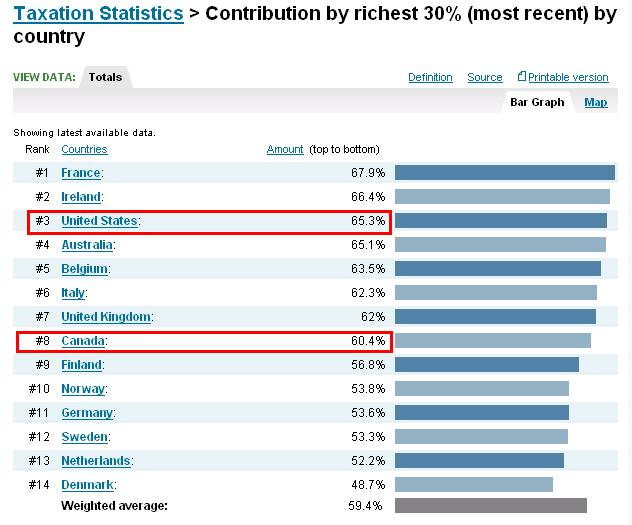

Am I wrong in assuming that the 30% of the richest in France aren’t government employees ?
but do the 30% richest in france compare to the top 50% in the US of A.
I know that the Canadian contingent are far more than 5% lower than the US , without currency adjustment and without seasonal lieberal adjustment.
I wonder what it would look like to view this scaled for income. Of course the richest 30% pay 65% of the taxes – they likely earn 65% of the income. The real question is whether they produce more or less than that 65%. If they produce more, their relative tax burden (in percentage terms) is lower, and vice versa.
Seems the heart of successful Democratic Socialism taxes their rich the least?
I remember seeing for many years a railway bridge that crossed over Lagimodiere Boulevard in Winnipeg, which had been grafitti tagged with the saying, “Make the rich pay.” It always made my father’s and my head shake as we knew all along, the rich already do pay the freight. Good graphic illustration, Captain. Thanks for that post.
government must see this first big picture
x number of Canadian need minimum amount of money to live
wihtout consider they are working
then :
1)
divided thos wealth by government also can made some kind of deal with busines people too using broker in between or made tax from rich to pay poor up to 28000 or below consider rent sepearte than food cloth and TTC ticket and child tax get seperate these group pay no tax here
2) group of stuend who become mid claas and govermtn give tehm grant to becom educated and made money later and pay govmern tax back
for 10% these are employee from 55000 up to 300,000 yearly below pay lower of 10% tax
if they got grant from government they can pay 14% more tax back to goverment reatehr than take loan from them untill thier grant money back finish then they will back to 10% tax again
3) for business people who made small business or hight level mid size class employee by help of grow and paln and subsixeing to made them hihgeer level ahtm regular employee income
thesw group incole from 300,000 to 2 million salary they pay tax of 14% if they provide job their tax drop to 10%
4) for richer company above 2 million they pay 20% tax
if the company able to increase more job their taz can be drop to 15%
=======
for important put 12% tax and export put 6% tax
for company who suddently go under so much debt cut the tax for 2 years ratehr than apply for bankrupcy
provide more progrma for them
===
I am not specialis in tax but I am sure these can be helpfull for them
motiviation made people to like to go to ladder and come up not stay for every in subsidize for ever .
==
made progrma to pay the debt from increase export and import and devlopment
if part o country is uselss like Alsaka in north part pay them no tax to help busins people for 50 years come and help this area get change
====
too big or too small government will cause so many problmes
politican can get for sake of money sell their sole and teir power to misuse their power
rich can use money to get power from poltician in switch the deal
mid class can do conspiracy to get power
low income can do crime to steal money in fruad
therefor all above said can be get advantage of other
we all citizen must watch politican closely tehy can one day come and trick and lie to us to by used tehir power – watchdog needed for them
all is my idea I may be not correct I am not specialist in tax but I give some model
why should be all people pay he same tax taht is wrong to do so
Advantage and disadvantage of big government
politician used their power for sake of money
rich used thier money for sake of power
poor used fraud to steal for money
mid class to do conpiracy to mislead for power and money
In result watch politican carefully and do not trust them if they lie more than two times
+++
technorati.com/videos/youtube.com%2Fwatch%3Fv%3DWtzrqvPfnE0
+++
topblogarea.com/rss/Big-Government.htm
++++
youtube.com/watch?v=rmrTVsZWinY
If you really believe that that post is accurate I want tell you about a bridge and a national park I anm able to sell you at a real low price!
Google “off shore tax havens.”
http://citizenscouncil.wordpress.com/
No matter how often these stats are brought up, you just cannot convince some people that the rich and large corps pay a huge amount of taxes.
It is like trying to convince a three year old that Santa, the Easter bunny and the tooth fairy are all fake.
When Obama says “middle class tax cuts” what he means is that he is going to write checks. 50% of wage earners pay no federal taxes.
Atlantic Jim: What do you mean Santa is a fake?
Bwaaaaaaaa
Sorry Tex………….. 🙁
But Saint Nic was a real person!! 🙂
AtlanticJim,
It doesn’t matter how much they pay, it’s not enough…..until they give enough to have their disposable income brought down to the “average” level, it’s never enough. Just like Jack wants to roll back corporate tax cuts in his disconnected economic world…..who does he think employs people…and does he believe they are all charitable, non-profit organizations….
…the Republican party has a quota of poor people you must oppress if you want to join the party, you get bonus points if they are of a minority race or religion…
Go Captain, go!!!!
And all that money going to the crinimals in the UN its time to boot out the whole UN
The real problem is that there are now more than 50% of Americans that pay no income tax. In a democracy this is the beginning of the end. There is now more than half the population that can vote themselves something for nothing. Is it any wonder that Obama has such high support?
I stand with Aaron on this – these statistics prove nothing, save for explicitly highlighting the apparent inability to think of posters such as the ones who state:
“No matter how often these stats are brought up, you just cannot convince some people that the rich and large corps pay a huge amount of taxes.”
or
“It doesn’t matter how much they pay, it’s not enough…..until they give enough to have their disposable income brought down to the “average” level”
These statistics are incomplete and do not provide enough information to draw such conclusions.
Theres a very simple rule here that is lost on these two posters – 20% of 4,000,000 (800,000) is a lot more than 20% of 40,000 (8,000). At the same time, both groups are being taxed the same percentage amount.
If you earn hundred times more, then your taxes will be a hundred times more. Shocking stuff, eh? I know being educated is not a virtue on this board, but this is high school math (provided you completed high school).
The only way to correct this imbalance and make both groups pay 50% is to overtax the bottom 70% or undertax the top 30%. In other words, if the average income of the top 30% is 500,000 and the bottom 70% is 50,000, then, for a 50% balance to be reached, the bottom 70% would have to pay its entire salary to match a 10% tax rate for the top 30%. In such a case, both groups would be contributing 50,000 in taxes making it a 50% divide.
Now I know things arent that simple – graded tax rates and all – but even if a single tax rate were to be applied to all earners (high and low), the rich would be contributing disproportionately, for the simple reason that a percentage slice of a larger cake yields a larger piece.
Think, people, think. These stats are baseless and pointless in this presentation – we need more information.
Fractured
What’s your point? That the percentage of taxes paid by the rich would be EVEN HIGHER if they were taxed on the hidden income?
The US, UNLIKE just about every other country on earth, taxes a US citizen on their WORLD-WIDE income. Tax havens are mostly illegal for individual citizens. US citizens must have their wealth in a BLIND trust (which means the beneficiary has ZERO control over their own money) to legally use a tax haven. When the money is repatriated, they pay full taxes on it.
This, of course, is on top of the fact that these percentages listed in the chart are of TAXES PAID. Not potential taxes or taxes owed.
Your point, insofar as you have one, is moot.
Warwick,
That is quite right. The percentage of taxes paid would be much higher if htey were taxed on hidden income. That is not a good or bad thing – it merely reflects the disparity between incomes. In a single tax system, it would take 100 $60,000 dollar earners to provide the same amount in absolute terms as 1 $6,000,000 earner. In absolute terms, yes, the 6 million earner is being taxed more, but in percentage terms (in a single tax system) he is not.
I would encourage you to read the July 17th, 2008 Senate subcommittee findings about tax evasion. The very first line states that nearly $100 Bn USD is lost through “offshore tax abuses”. Legal or illegal, it is happening.
This puts light on another fundamental issue regarding taxation – the government usually has a target in mind when it sets tax rates -they are not arbitrary. It seeks to raise a certain amount of money, not just as much as it can.
When 100 bn is taken out of the system, taxes have to be raised across the board to meet the target. Raising 100 bn from a 500 bn economy involves a 20% tax rate – take a 100bn out of that and it requires a 25% tax rate.
Incidentally, it is generally the rich, and almost definitely not the 5 figure income earners who send money offshore. They dont have to repatriate it – they also have homes elsewhere (the so-called transnational capitalist class), where it comes in handy.
What exactly is your point?
“Legal or illegal, it is happening.”
As is thieft, rape and murder.
My point is that tax evasion/avoidance is irrelevant to how much the “rich” already pay. How much more they may pay as a percentage of the total tax take doesn’t change that the US “rich” pay more than almost every other nation’s “rich” pay. If they paid even more, that number would be even higher.
You seem to whine that they aren’t paying more.
I’ll tell you who needs to pay their “fair share” and it’s the poor who are not pulling their weight. You may accept their reason, but it’s a fact that the “poor” cost the government more than they receive back in taxes. It’s a fact that the “rich” pay more than they get back in services from the government.
Fair, is paying for what you get. Charity is one cent more than that. The dole is paying one cent less.
No, the rich would be paying “proportionately” look it up then think about it, you might try going back to your high school algebra text.
Then, to really crank the irony meter, “Taxmaster”, says:
The rest of us got a laugh out of this, but I seriously think you might be too stupid to understand what I just wrote.
And I contend that tax evasion IS relevant to how much the ‘rich’ already pay. I am not ineterested in whining that the rich arent paying enough, nor am I discussing the merits or demerits of a welfare economy.
A government, regardless of how capitalist, or socialist it is, has an operating budget. The taxes are meant to fund this operating budget. Tax evasion involves removing money from the taxable income, forcing an INCREASE in tax rates. In other words, by not paying taxes through tax evasion, they are forcing the burden of funding government onto others, including the 70% who cannot send their money abroad. Whether the government needs to provide the services it does using this tax money is an issue for another day.
Tax evasion results in a higher tax rate than neccessary, and increases the burden across the board.
“How much more they may pay as a percentage of the total tax take doesn’t change that the US “rich” pay more than almost every other nation’s “rich” pay.”
Pointless statements are a dime a dozen here, but this one surely takes the cake. It has literally no meaning. You clearly arent talking about percentages, since the French and Irish top 30% pay more than the US. Ostensibly, you are talking about absolutes. IN which case this comparison doesnt hold since very few countries match the US demographic and political profile. America is one of the larger countries in the world and it stands to logic that a larger population segment will contsitue the top 30%, resulting in a larger absolute taxation income. If you are talking about it in individual cases, then, well, show me some proof that a million dollar earner in the US pays more in taxes than his equivalent in France. Furthermore, various countries operate on different scales- not all countries have a $500 bn dollar defence budget. You cannot compare the US to others when it has its own interests and prerogatives that underlie its taxation policies. Its hardly Ireland’s fault that they dont have a 500bn dollar defence budget. What this has to do with anything, only you know.
The rest of your argument is conjecture. The poor are poor because they are not working hard enough. Fair enough. But it doesnt take an economist to realise that income discrepancies will exist regardless – one of the more famous examples in this regard is Robert Nozicks example using Wilt Chamberlain. Suffice to say, Wilt will be paying more in absolute terms than those paying to watch him.
I do not wish to discuss the merits and demerits of the welfare system, but again, Rich people do get something out of their taxes (Roads to drive on, security from international threats, the same coverage from the fire department as a poor person). In a welfare state that offers more services such as universal healthcare, the rich are not ‘excluded’ from the system. Nor are they excluded from the welfare system. That they do not use these services does not mean that they do not have recourse to them.
What you are proposing, in effect, is a taxation system that is personalised, and this would be far too complicated to implement. For instance, you do not drive as much as a cross country trucker- does this mean that your taxes should be lower than his to reflect the fact that you contribute less to the wear and tear of the road, and therefore should not contribute more than a certain amount to its maintenance? Its all very logical, but its not very pragmatic. The other way of approaching this is by taxing you to maintain roads that you will likely never use in your life, but which you can if you want to. This is the current approach. Whehter these services are justified or not can be considered elsewhere.
“No, the rich would be paying “proportionately” look it up then think about it, you might try going back to your high school algebra text.”
Its a pity you never completed high school, Tim in Vermont. Your comprehension skills might have benefitted considerably.
Perhaps I am to blame. I was under the mistaken impression that you would, on account of my explanation, be able to surmise that I was talking about the problem of using absolute value in the manner that it has on this board.
Here, I shall spell it out:
10% of $500,000 = 50,000
10% of $ 50,000 = 5,000
If the total taxes collected by the government were $55,000 dollars then the 500,000 dollar earner would be paying 91% of the taxes collected. The $50,000 dollar earner would be paying 9%.
In a similar vein, this table states that the top 30% earners are paying 65% of the total taxes collected. If you draw a conclusion from this, like our two geniuses above, then you are focusing on the absolutes – which is akin to saying that the 500,000 dollar is being overtaxed because he is contributing 91% even though he is paying the same percentage rate as the 50,000 dollar earner. However, the single tax rate suggests that neither is being over or underburdened. If you use absolutes, like others here do, then the rich are ‘overburdened’. This is precisely what I was pointing out, though it appears that I erred in believing people like you might be able to comprehend it.
I notice you think I am stupid, to which I can only respond that people in glass houses should not throw stones at others. Till they buy stone-proof glass, anywya.
“And I contend that tax evasion IS relevant to how much the ‘rich’ already pay.”
This thread illustrates and contrasts how much the rich pay in this reality. Not in your preferred alternate reality. In this context, how much MORE the rich COULD be paying is entirely beside the point of the thread.
“The rest of your argument is conjecture. The poor are poor because they are not working hard enough.”
Actually, if you read what I wrote, I dismissed the argument. It’s irrelevant. WHY the poor don’t pay commensurate with their cost isn’t the point. THAT they don’t pay commensurate with their cost is the point I made.
“America is one of the larger countries in the world and it stands to logic that a larger population segment will contsitue the top 30%, resulting in a larger absolute taxation income.”
The figures above are in percent. Not dollars. Scale would not be effected.
“If you are talking about it in individual cases, then, well, show me some proof that a million dollar earner in the US pays more in taxes than his equivalent in France.”
They don’t. France’s tax rates are steeper than the US. France just has more deadbeats so the decreasing number of people with jobs are required to take on more of the burden and that includes the middle class as well as the rich.
There’s two ways to effect the stat in this thread: more wealth, and less wealth. More wealth (the US model) states that the richer the nation is, the less the tax rates have to be to raise the same amount of revenue. The less wealth model (France) states that the poorer the bottom 70% of income earners are, the more the other 30% have to bear. The rest of us have systems where the upper-middle and lower-middle take on MORE of the burden.
“What you are proposing, in effect, is a taxation system that is personalised, and this would be far too complicated to implement.”
No, what I did was comment on the systems in place. No where did I propose a sing thing.
taxmaster
If you were discussing nominal amounts, you don’t speak of proportionate amounts. It is you who erred and I don’t see why Tim should have to decipher your meaning by assuming you meant the opposite of your written words (although in pointing out your error, it’s clear that he did.)
In fact, that you describe one math concept and name it the opposite while condescendingly insulting the math skills/knowledge of the other people on the board is what you failed (and still fail) to “comprehend.”
When you talk of “absolutes” (which are “nominal amounts,”) you do not talk of percentages which are proportional amounts. A percentage is a measurement of the Proportion of the numerator in relation to the denominator. We have been discussing on this board the proportion (there’s that word again!) of total taxes paid by the top 30% of income earners not the absolute or nominal value of any individual’s taxes.
If you were to rewrite your sentence to be accurate, you would state that “even if the rich were paying only proportionately on an individual – or micro – level, they would still be paying a disproportional amount of taxes on a societal – or macro – level.” In other words, a description of two different equations. But that’s not what you said. You may have meant to, but the fault for lack of clarity is yours. As was the error in describing the correct mathematical terms.
“Your comprehension skills might have benefited considerably.”
Your communication skills may be a better place to start. Or perhaps you may begin with humility…
Something is clearly getting lost in translation. I am uninterested in “how much MORE the rich COULD be paying”. What I am saying is that tax rates for those who pay taxes are HIGHER because of tax evasion, and to this end, it is relevant. It seems to me that you are suggesting that the government simply taxes x% of everything whereas I contend that the government has a target in mind and the tax rates are set according to this target. In this case, tax evasion results in the tax rates being higher than they should be in order to achieve the target.
And yes, while you did not propose anything, a personalised tax system is implicit in your statement:
“THAT they don’t pay commensurate with their cost is the point I made.”
Correct me if I am wrong, but I understand that to mean that the poor should be paying taxes commensurate with what they cost the system? If correct, this neccessarily implies a personalisation according to services accesssed.
“What I am saying is that tax rates for those who pay taxes are HIGHER because of tax evasion, and to this end, it is relevant.”
It may be relevant to society but it isn’t relevant to the point of this thread. It is a completely separate and unrelated topic.
“And yes, while you did not propose anything, a personalised tax system is implicit in your statement:”
No it’s not. It was a statement that the poor are subsidized by the rich – which happens to be objective fact. It isn’t advocating anything. There is nothing “implicit” in stating fact but the facts. Your problem is that you assume things that do not exist and form your arguments as if they did.
One of the comments on the Captain’s site pithily, but inadvertently, identifies the central issue: “income share”.
Therein lies the fallacy. Incomes are earned, not shared. Thus, the rich bear the greatest burden. “Disproportionate” is a red herring, as is the ability to bear the burden.
The FACT is that the rich few carry the ungrateful many.
made
Liberal to made tax for rich high income people
Conservative for mid clas Canaidan tax
and NDp for poor low income
like ( university student, disabilitypeople, elderly low income, welfare, singlemom, mental health, children with no parents and etc..
and treat each seperte
rahter than fight in House let each parteis focus in one group more than others
I know tehy are not doing now but tehy can do mix and match sometimes
I get the point behind posting this, but, to re-iterate my comment and expand on it a bit more:
a. It is possible to have a regressive tax (taxes high income earners at a lower % than low income earners), that makes it appear that the top X% contribute greater than X% of the total.
b. This depends mainly on the income distribution. If the top 1% of income earners generate 99% of the income, they will likely generate at least 99% of the tax income.
c. Income is a flow variable, and this kind of analysis ignores the wealth factor. I don’t think this includes capital gains, stocks, investments offshore, etc. If I’m wrong, show me where. But I looked up the data source, and it is after-tax (disposable) income.
d. The data in the graph are absolute data disguised as percentages. I’d be more interested in seeing the marginal tax brackets by income level. Likely, this would reflect a progressive form of taxation, with high-income earners paying a higher percentage of their income as tax, which is in a similar spirit behind the intent of posting this chart.