Here’s the key thing: Other media are acting like this is a win – that the deadline has simply been punted to 2050. Well, I actually read through the regulations and realized it’s a bait and switch. In fact, the regulations include an impossible to meet emissions standard for anything that burns anything by 2035. Even if you put carbon capture on every single natural gas and coal power plant in Saskatchewan and Alberta, if the CCS behaves anything like Boundary Dam 3, you won’t get anywhere close to the new standard of 65 tonnes CO2 per gigawatt-hour. So the federal government slyly let people think they’ve punted, when really they haven’t punted at all. Like Lucy, they’re pulling the football away in 10 years and 12 days. (That’s the amount of time we have to build carbon capture on everything. And even if we do, it won’t be good enough. Good luck with that.)
A former Energy and Resources Minister for four years, Eyre is joining Pipeline Online as a regular contributor, both as a columnist and co-host in an upcoming regular podcast that is rapidly coming together. Watch for Eyre’s continuing contributions on Pipeline Online in the weeks and months ahead.
Also:
Alberta wind power generation falls to less than one per cent capacity, once again (Last Friday, it fell to zero. You read that right. Zero.)
And, what’s this Bluesky Social all about? In the interest of staking territory, Pipeline Online is now on this new social media at @pipelineonline.bsky.social. If you’re on there, be the first to follow, I guess?
Oh, and here’s a bonus: the federal government wants to now subsidize radio news as well. Why do I hear the Emperor from the Return of the Jedi cackling in my head?
Jim Warren:Could maximizing Canadian oil production and exports over the medium-term help reduce CO2 emissions for the long-term?
“There is a chasm of disagreement separating climate-concerned policy makers in Ottawa and supporters of the oil and gas sector on the prairies. Each side behaves like they’re playing a zero sum game.”
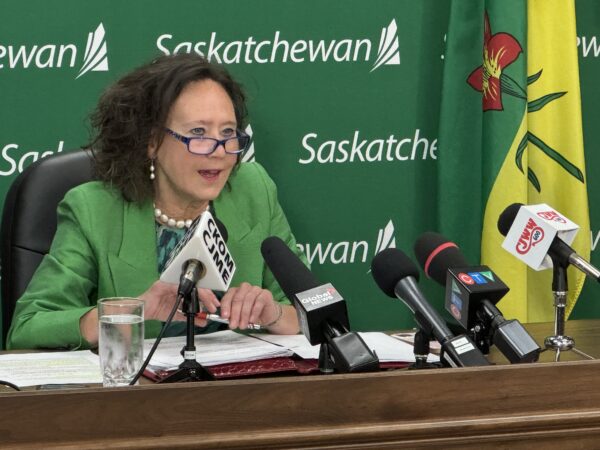
So yesterday I put over 800 km on my truck to attend a press conference in Saskatoon regarding the report of Saskatchewan’s Economic Impact Assessment Tribunal on the planned greenhouse gas emissions cap on oil and gas production, as well as “Methane 75.” That proposes cutting methane emissions by 75% by 2030.
This is the opening story in what will literally be dozens of pieces on this, as I will be publishing most of the submissions to the tribunal.
The key thing is the Saskatchewan government says an emissions cap is a de facto production cap, and this report bears that out. And for the record, oil and gas, principally oil, is the largest portion of Saskatchewan’s GDP, exceeding even agriculture and potash.
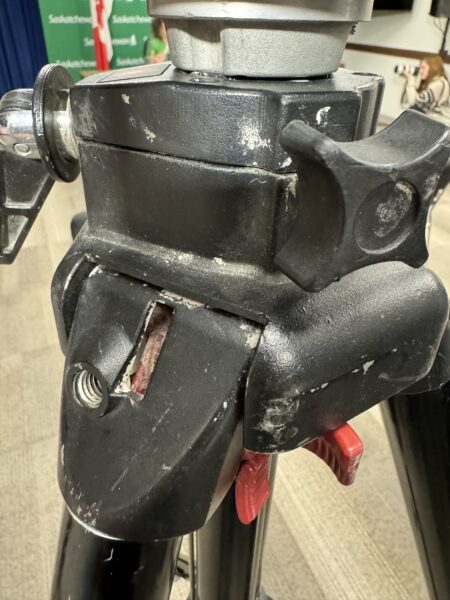
mud
Also, I looked down at my tripod while at the press conference and noticed it’s covered with grey specs of drilling mud from visiting various rigs over the summer. And then I looked around at the other media’s tripods – CTV, Global, CBC, CBC French, some I don’t know. No mud. I wonder why? Go figure.
The hollowing out of Canada’s industrial base continues. A few people said there’s been some new rigs built, but I’ve been told by the industry association those were retrofits.
Canada really has two significant competitors when it comes to providing heavy oil to the US Gulf Coast refinery complex – Venezuela and Mexico. Venezuela’s been driving its self off a cliff in its socialist paradise. And it looks like Mexico’s exports are likely going to collapse, too, according to Peter Zeihan. Gee, if only Keystone XL had been built to supply our heavy oil to their refineries built for that product…
Note: Goldboro was one the leading candidates for a Canadian East Coast liquefied natural gas export facility, the type German Chancellor Olaf Scholz basically begged Canada for. However, Prime Minister Justin Trudeau said there was “no business case,” for Canadian LNG in this context.
But apparently cutting trees to make “sustainable aviation fuel” is quite alright.
Meanwhile, companies keep growing in the oilpatch. I ran into Mike Rose a year ago. He did some work in the Weyburn area a long time ago. Now he’s running Canada’s largest gas producer, which just got bigger.
The last time, that didn’t work out so well for Saskatchewan oil and gas. The depths of the seven year oil downturn which devastated the Saskatchewan oil and gas industry included all four of the Trump years the last time around. While oil low prices benefited consumers and large portions of the economy, they also had a significant impact on Saskatchewan oil companies and particularly oilfield service companies. Activity levels, vendor rates, employment and employee remuneration were all deeply affected by the low energy price policies.
This is NOT an endorsement of Biden by any means, but simply a reflection on what did happen during the last Trump presidency.
The columnists with the Leader-Post and StarPhoenix were aghast that the oil and gas sector would have input into crafting a course. To hell with them. This is an opportunity.
Jim Reiter, Bronwyn Eyre, Michael Milani. Photo by Brian Zinchuk
For a long time, Premier Scott Moe has been saying it’s impossible to comply with federal regulations regarding getting rid of our fossil-fueled power generation, in the timeline the federal Liberal government wants.
It’s coming to a head.
This is the first action of this type thus far under the Saskatchewan First Act. This is what it was meant for.
If implemented in their current form, the Clean Electricity Regulations mean to all but eliminate the burning of fossil fuels for power generation in 10 years, six months and three days from now. Saskatchewan relies on natural gas and coal to produce the vast majority of its power, up to 88 per cent on some days. And if implemented, these regulations will fundamentally alter Canada and its economy, and affect all of its people in one form or another. It’s one of the most important policy pieces in generations, seeking to remake Canada.
The government released all the submissions to the tribunal. I will be reprinting many of them over the coming days, maybe weeks. There’s a lot. And there’s a lot to be said.
If carbon capture is supposed to be the future, why does it keep striking out? Last week, Capital Power in Alberta cancelled the $2.4 billion carbon capture project for the Genesee Power Station, which is currently being converted from coal to natural gas. It’s the last thermal coal power plant in Canada west of Coronach, Sask.
The proposed federal Clean Electricity Regulations say in 10 years, seven months and 15 days we won’t be able to use natural gas-fired power generation without carbon capture except for very short periods of time over a whole year.
This is a REALLY good discussion about CO2, its role in the world, and anthropogenic climate change. The call it “fake catastrophes.” Lots of talk about glaciation, which I love, because no one ever talks about that. I do.
It is worth your time to listen to this some time this weekend. I feel a lot smarter now, and I’m only 2/3 through it.
Province invokes Saskatchewan First Act, again, building its case against the federal government’s never-ending smothering greenhouse gas emissions rules, regulations and legislation.
I was up in Saskatoon Monday to cover this important announcement. Saskatchewan’s not going to take it, anymore. Kinda like Twisted Sister. For some reason, I keep referencing that song.