Why this blog?
Until this moment I have been forced to listen while media and politicians alike have told me "what Canadians think". In all that time they never once asked.
This is just the voice of an ordinary Canadian yelling back at the radio -
"You don't speak for me."
email Kate
Goes to a private
mailserver in Europe.
I can't answer or use every tip, but all are appreciated!


Katewerk Art
Support SDA
Paypal:
Etransfers:
katewerk(at)sasktel.net
Not a registered charity.
I cannot issue tax receipts
Favourites/Resources
Instapundit
The Federalist
Powerline Blog
Babylon Bee
American Thinker
Legal Insurrection
Mark Steyn
American Greatness
Google Newspaper Archive
Pipeline Online
David Thompson
Podcasts
Steve Bannon's War Room
Scott Adams
Dark Horse
Michael Malice
Timcast
@Social
@Andy Ngo
@Cernovich
@Jack Posobeic
@IanMilesCheong
@AlinaChan
@YuriDeigin
@GlenGreenwald
@MattTaibbi
Support Our Advertisers

Sweetwater

Don't Run

Polar Bear Evolution

Email the Author
Wind Rain Temp
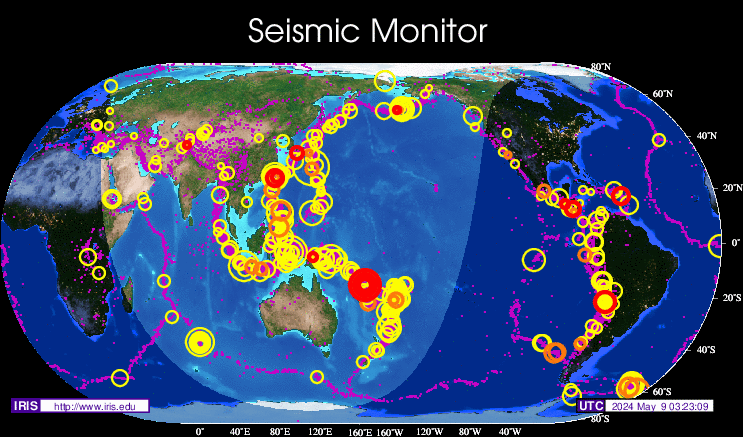
Seismic Map
What They Say About SDA
"Smalldeadanimals doesn't speak for the people of Saskatchewan" - Former Sask Premier Lorne Calvert
"I got so much traffic after your post my web host asked me to buy a larger traffic allowance." - Dr.Ross McKitrick
Holy hell, woman. When you send someone traffic, you send someone TRAFFIC.My hosting provider thought I was being DDoSed. - Sean McCormick
"The New York Times link to me yesterday [...] generated one-fifth of the traffic I normally get from a link from Small Dead Animals." - Kathy Shaidle
"You may be a nasty right winger, but you're not nasty all the time!" - Warren Kinsella
"Go back to collecting your welfare livelihood." - Michael E. Zilkowsky

That can’t possibly end badly for Ottawa. /s
Yay…more free money we don’t have. The sooner we shed ourselves of these morons running Ottawa…the better off we will be.
Instead of working to find an amicable solution, it’s direct to the subsidies, with money we don’t have after the covid debacle drained the country in the first place!
You can tell, they are just DYING for another crisis so they can implement UBI!!
God, I despise these mindeless idiots!!
ELECTION NOW!!
Justin could have used the money he will be wasting on free stuff to revitalize our military and to fight the opioid epidemic. But he thinks the Liberals will win by buying votes.
He may be right. It’s always worked before.
Liberal Party’s Deep Thoughts:
“American 25% tariffs will cause inflation and create job losses so the best thing to do is print and spend billions of dollars which will cause more inflation. That hyperinflation or, worse, stagflation plus high government debt and deficits will certainly not worsen the economic disruption and job losses caused by the tariffs. If we play this really smart, we can charge export taxes on Alberta and Saskatchewan energy and natural resources to help pay for the new vote buying cheques sent out to the rest of Canada. Can we also declare an economic emergency to delay the federal election?”
I hope everyone has their budget, investment and loans in order to prepare for Covid 2 economics, tariff edition – the central banker strikes back.
It’s the absolute worst option, so, of course, that’s the LIEberal way! Further debasing of the currency, further increasing overall national debt and carrying charges far into the future, further erosion of the GDP, actually a continuation of a long downward trend ever since the LIEberals took office.
Good Gawd.
And this is “financial expert” Mark Carney’s party?
So, this is the grand plan for the LIEberals, at least 4 years of WELFARE FOR ALL!!!! That is, until the Bad Orange Man is gone? Do they really thin’ that Trump will back down to the Twitchy Midget or Mr Bank of England, he of the 3 passports?
This is incredibly stupid, but just so LIEberal.
And there’s no escape it seems.
Buy Gold. It seems that is our only protection.
Well Dan, IMO the goal has always been to turn Canada into a WEF vassal state – but must be careful to not be too obvious. Libs are now positively thrilled they can now blame Trump while they create the otherwise entirely avoidable crisis, to double the speed towards their goal of the destruction of Canadas economy, soveriegnty and culture.
I’m invested in gold, about 10% of our holdings. But it sure looks like I need to re-evaluate, and increase that to about 33-40%. Or perhaps a mix of increase in gold and Am$ holdings in cash.
The Libs have no hesitation to crash the economy or trash the finances of this country.
I would suggest the same for others.
The rest of my investments are tied up in sheltered investments, and can’t be moved without taking a 40% tax hit. That’s too much to bear for now.
Hope Canadians will enjoy $3/litre gas, $2/pound bananas and $10 lettuce.
It’s coming, hard and fast, thanks to Liberals.
Liberals goal is to take the victimization approach to this dispute. It’s a weak, pathetic and of course a losing position.
Heh, and to think all Canada was asked to do was secure our border and pay up the military spending we promised and signed for.
It looks like the stupid little post national state deserves its third world status.
Study Bitcoin. Buy Bitcoin.
Easiest method is to buy spot Bitcoin ETF’s inside TFSA for the last tax free gains in our lives. It won’t be long before the government disqualifies investments in “cryptocurrencies” inside TFSA’s. With 1.26 trillion dollars of debt and the zest for “spend and print” (steal) , they will need all the tax money possible just to cash flow the interest.
You gotta realize, Dan, that the Liberals have no intention of negotiating some kind of deal with Trump. They want us to be hit with tariffs so they can portray themselves as a plucky little David vs mean bully Goliath. They’ll get more votes fighting the election against Trump than Poilievre. So what if it bankrupts the country, just as long as they win.
A dozen eggs … soon to cost > $100 Loonies in Canada. Brilliant move Canada. Yeah, suicide will SHOW Trump!
Just what we need. Another bloody “emergency” with a completely uninhibited spending spree. The next election will largely be a contest between which party can promise the quickest route to national bankruptcy.
Don’t expect the Tories to reject the idea either. They’ll happily join in with spending spree promises of their own. The current tariff “war” is sparking another one of those mass formations that Mattias Desmet wrote about during Covid.
During covid the Trudeau Liberal-NDP government spent 100s of billions of dollars and doubled the debt. Instead of 100s of billions more debt-financed spending to buy votes (it’s not really about tariffs anymore for the Liberals), the government could spend a fraction of that money to fix the border, vet/reduce immigration, increase NATO spending and crack down on the drug trade.
Now now LC, stop making sense.
We’re talking Liberal re-election here, and the Libs need AN ENEMY!
And there’s no escaping that the electorate simpletons need to be scared to bring them round.
Covid election strategy Part Deux.
Will 25% of the electorate bite the tainted fruit and switch preferences for 3 passport, Climey change, finance guy? Dumber things have happened.
Remember, the same people who voted for the Trudeau Liberals are still going to be voting. These three time Trudeau voters are not the best and brightest.
The Carbon Credit Crew.
“Got muh check”
Idiots.
Why oh why do the lenders continue to lend?
Doesn’t matter, last time they printed most of it, remember that inflation thing?
It better be a Kim Carney election!
It’s party time in quebekkie!
Federally the libranos are in 3rd place there. The PQ is poised to win the next provincial election and have promised yet another separation referendum. Like a scared animal librano shit is loose and runny but DJT just gave them wings.
Let ‘er buck! The rest of the country be damned.
I was a lot younger and more naive the last referendum, not so this time!
I posit that should the Quebecois want a separation referendum, that the west should run theirs, concurrently!
The rest of the country is damned and should be damned. Whoever makes it official is doing you nothing but a favour. If the frogs run a referendum, I’ll go door to door in Quebec telling anyone who will listen that English Canada is tired of your lazy French assess, GTFO!
We never had the money before for decades and thst didn’t stop people for voting for these Governments. So why shouldn’t the Government try it again?
You get what you vote for. I know Albertans (!) who will still vote Liberal or NDP.
“Jose can you see…..”
When the Corporate Media “report” on the WEF/Liberal/NDP Government that rules over us they refer to them as… “Ottawa”… isnt that deceptive… yes it is…
Comrade Turdhole and his biatch with man boobs.
https://gab.com/white_powerade/posts/113907629825715934/media/1?timeline=video-clips
These aholes want hyperinflation.
The plan is big borrowing and more Carneyflation.
Yeah, because there was no fraud or inflation the last time they did it.
Et tu, Pee-Pee?
Fix the problem at the border. Good grief, it’s not that difficult.
Wait, I’m guessing the Liberals haven’t doled out taxpayer monies to a few friends yet. So next emergency is slated.
When will this nightmare end?
So, if one puts on their WEF tinted glasses, this country’s response is akin to the Ukraine vs Russia battle/action/war/annexation.
David vs Goliath.
The Libs, in their twisted world view, sees courageous Uke as battling the monster Russians, saving the motherland, yadda, yadda, yadda. The Libs are jealous and think they will have overwhelming support in a similar battle.
Ukraine has been laid to waste, it is a barely functioning country at this point, its infrastructure held together with gum and baling wire. Meanwhile, Russia has hardly skipped a beat.
Oh, I see parallels alright. And all the parallels are bad for everyone in this country.
Trudeau appears like a Coke addict, like his cross dressing buddy Zelensky.
This is surreal. But this is the reality of where we stand, with an out of touch, sociopathic government. Dealing with Trump’s demands seem to far outweigh, the destruction of this country’s economy, but arrogance and incompetence seem to be preferred.
Excellent observation DanBC.
Liberals really really hate us, one and all.
Will Canada to become another Venezuela?
Question:
Canada’s Government is planning to support workers whose jobs are imperilled by US tariffs with pandemic like financial support and subsidies. Will this financial support result in hyperinflation in Canada?
Grok Answer:
To assess whether the proposed financial support for workers in Canada could lead to hyperinflation, several factors need to be considered:
1. **Scale of Support**: The amount of financial support and how it compares to the overall economy. If the support is substantial relative to GDP, it could increase money supply significantly.
2. **Duration of Support**: Temporary measures might not lead to hyperinflation if they are phased out once the specific economic pressure (like tariffs) subsides. Long-term support, however, might increase inflationary pressures over time.
3. **Monetary Policy**: The response of the Bank of Canada is crucial. If the central bank increases the money supply to fund these supports without corresponding economic growth, inflation could rise. However, if managed with careful monetary policy, including potentially raising interest rates, hyperinflation might be avoided.
4. **Economic Context**:
– **Supply Side**: If the support leads to increased production or consumption of goods without a corresponding increase in supply, prices will rise.
– **Demand Side**: If the economy is already at or near full employment, additional money in circulation would likely chase fewer goods, leading to inflation.
5. **International Factors**: Canada’s trade balance, the strength of the Canadian dollar, and global commodity prices (especially oil, given Canada’s economy) can influence inflation rates.
6. **Fiscal Policy**: How the government funds this support (borrowing, taxes, or more money printing) can also affect inflation. Borrowing might not immediately fuel inflation if it’s done sustainably, but high debt levels could lead to inflation expectations.
Given these considerations, while the financial support could contribute to inflationary pressures:
– **Hyperinflation**: This is an extreme scenario where inflation spirals out of control, typically seen in cases of severe economic mismanagement or collapse. For hyperinflation to occur from this policy, there would need to be a combination of very loose monetary policy, significant currency depreciation, and a collapse in public confidence in the currency.
– **Likely Outcome**: More likely, Canada might experience a rise in inflation but not necessarily hyperinflation if the government and central bank manage the situation with a balance of fiscal and monetary tools. Inflation could become a short to medium-term concern, especially if the support leads to a significant increase in demand without corresponding supply adjustments.
To conclude, while there’s a risk of increased inflation, hyperinflation is not an immediate or probable outcome unless the policy implementation is poorly managed on a massive scale. However, this would require further analysis of the specifics of the policy, the economic response, and the broader economic environment.
(Based on past performance with as the Governor of the Bank of England ifMark Carney becomes Liberal leader will the possibility of hyperinflation increase or decrease?)
Question:
Based on past performance with as the Governor of the Bank of England ifMark Carney becomes Liberal leader will the possibility of hyperinflation in Canada increase or decrease?
Grok Answer:
Analyzing Mark Carney’s tenure as Governor of the Bank of England (BoE) provides some context for predicting his potential impact on inflation in Canada if he were to become the Liberal leader.
**Performance at the Bank of England**: During Carney’s time at the BoE from 2013 to 2020, he navigated through significant economic events, including the Brexit referendum. His policies included quantitative easing (QE) and maintaining low interest rates to stimulate the economy. While these measures were aimed at economic recovery post-financial crisis, they coincided with periods of inflation above the BoE’s 2% target, particularly after Brexit. However, attributing inflation directly to his policies oversimplifies the complex global economic environment, including commodity price shocks and international trade dynamics.
– **Inflation Rates**: The UK experienced higher inflation rates during some periods of Carney’s governorship, which critics sometimes attribute to his monetary policies. However, inflation was also influenced by external factors like Brexit-induced uncertainty and commodity price changes.
– **Policy Continuity**: If Carney becomes Liberal leader, his approach to economic policy might reflect his past experiences. His advocacy for green finance and sustainable economic growth suggests a focus on long-term economic stability rather than short-term inflation spikes. However, his historical use of QE and low interest rates might raise concerns about potential inflationary pressures.
**Possibility of Hyperinflation in Canada**:
– **Increase**: Critics, as seen in posts on X, argue that Carney’s policies could lead to higher inflation, with some even suggesting his past actions might foreshadow economic disaster in Canada. They point to his association with QE and low interest rates, which, in extreme scenarios, could contribute to inflation if not managed properly. However, hyperinflation is an extreme economic condition typically resulting from a combination of factors including excessive money supply growth, significant currency devaluation, and loss of confidence in the currency, which are not direct outcomes of Carney’s known policy inclinations based solely on his BoE tenure.
– **Decrease**: On the other hand, Carney’s experience with managing inflation expectations in the UK and his international standing in economic policy could suggest he would be cautious about policies that might lead to uncontrolled inflation. His role in international finance and his understanding of global economic systems might equip him to mitigate risks of hyperinflation through balanced economic strategies. His emphasis on sustainable growth could also mean an approach that seeks economic stability over short-term inflationary measures.
**Conclusion**: While Carney’s past policies at the BoE were not without criticism regarding inflation management, the leap to hyperinflation in Canada would depend on numerous factors beyond his singular influence, including global economic conditions, government fiscal policy, and external economic shocks. His leadership could potentially either increase or decrease the risk of hyperinflation based on policy choices, but without more specific policy proposals or economic conditions at the time of leadership, it’s speculative to conclude definitively.
Therefore, based on his past performance, the possibility of hyperinflation in Canada could either be managed carefully, potentially decreasing the risk, or, if his policies lean heavily towards aggressive monetary easing without corresponding fiscal discipline, could increase inflationary pressures. However, hyperinflation is a rare and extreme outcome more influenced by a broader array of economic conditions than by the actions of one leader alone.
Analyzing Mark Carney’s tenure as Governor of the Bank of England (BoE) provides some context for predicting his potential impact on inflation in Canada if he were to become the Liberal leader.
**Performance at the Bank of England**: During Carney’s time at the BoE from 2013 to 2020, he navigated through significant economic events, including the Brexit referendum. His policies included quantitative easing (QE) and maintaining low interest rates to stimulate the economy. While these measures were aimed at economic recovery post-financial crisis, they coincided with periods of inflation above the BoE’s 2% target, particularly after Brexit. However, attributing inflation directly to his policies oversimplifies the complex global economic environment, including commodity price shocks and international trade dynamics.
– **Inflation Rates**: The UK experienced higher inflation rates during some periods of Carney’s governorship, which critics sometimes attribute to his monetary policies. However, inflation was also influenced by external factors like Brexit-induced uncertainty and commodity price changes.
– **Policy Continuity**: If Carney becomes Liberal leader, his approach to economic policy might reflect his past experiences. His advocacy for green finance and sustainable economic growth suggests a focus on long-term economic stability rather than short-term inflation spikes. However, his historical use of QE and low interest rates might raise concerns about potential inflationary pressures.
**Possibility of Hyperinflation in Canada**:
– **Increase**: Critics, as seen in posts on X, argue that Carney’s policies could lead to higher inflation, with some even suggesting his past actions might foreshadow economic disaster in Canada. They point to his association with QE and low interest rates, which, in extreme scenarios, could contribute to inflation if not managed properly. However, hyperinflation is an extreme economic condition typically resulting from a combination of factors including excessive money supply growth, significant currency devaluation, and loss of confidence in the currency, which are not direct outcomes of Carney’s known policy inclinations based solely on his BoE tenure.
– **Decrease**: On the other hand, Carney’s experience with managing inflation expectations in the UK and his international standing in economic policy could suggest he would be cautious about policies that might lead to uncontrolled inflation. His role in international finance and his understanding of global economic systems might equip him to mitigate risks of hyperinflation through balanced economic strategies. His emphasis on sustainable growth could also mean an approach that seeks economic stability over short-term inflationary measures.
**Conclusion**: While Carney’s past policies at the BoE were not without criticism regarding inflation management, the leap to hyperinflation in Canada would depend on numerous factors beyond his singular influence, including global economic conditions, government fiscal policy, and external economic shocks. His leadership could potentially either increase or decrease the risk of hyperinflation based on policy choices, but without more specific policy proposals or economic conditions at the time of leadership, it’s speculative to conclude definitively.
Therefore, based on his past performance, the possibility of hyperinflation in Canada could either be managed carefully, potentially decreasing the risk, or, if his policies lean heavily towards aggressive monetary easing without corresponding fiscal discipline, could increase inflationary pressures. However, hyperinflation is a rare and extreme outcome more influenced by a broader array of economic conditions than by the actions of one leader alone. Analyzing Mark Carney’s tenure as Governor of the Bank of England (BoE) provides some context for predicting his potential impact on inflation in Canada if he were to become the Liberal leader.
**Performance at the Bank of England**: During Carney’s time at the BoE from 2013 to 2020, he navigated through significant economic events, including the Brexit referendum. His policies included quantitative easing (QE) and maintaining low interest rates to stimulate the economy. While these measures were aimed at economic recovery post-financial crisis, they coincided with periods of inflation above the BoE’s 2% target, particularly after Brexit. However, attributing inflation directly to his policies oversimplifies the complex global economic environment, including commodity price shocks and international trade dynamics.
– **Inflation Rates**: The UK experienced higher inflation rates during some periods of Carney’s governorship, which critics sometimes attribute to his monetary policies. However, inflation was also influenced by external factors like Brexit-induced uncertainty and commodity price changes.
– **Policy Continuity**: If Carney becomes Liberal leader, his approach to economic policy might reflect his past experiences. His advocacy for green finance and sustainable economic growth suggests a focus on long-term economic stability rather than short-term inflation spikes. However, his historical use of QE and low interest rates might raise concerns about potential inflationary pressures.
**Possibility of Hyperinflation in Canada**:
– **Increase**: Critics, as seen in posts on X, argue that Carney’s policies could lead to higher inflation, with some even suggesting his past actions might foreshadow economic disaster in Canada. They point to his association with QE and low interest rates, which, in extreme scenarios, could contribute to inflation if not managed properly. However, hyperinflation is an extreme economic condition typically resulting from a combination of factors including excessive money supply growth, significant currency devaluation, and loss of confidence in the currency, which are not direct outcomes of Carney’s known policy inclinations based solely on his BoE tenure.
– **Decrease**: On the other hand, Carney’s experience with managing inflation expectations in the UK and his international standing in economic policy could suggest he would be cautious about policies that might lead to uncontrolled inflation. His role in international finance and his understanding of global economic systems might equip him to mitigate risks of hyperinflation through balanced economic strategies. His emphasis on sustainable growth could also mean an approach that seeks economic stability over short-term inflationary measures.
**Conclusion**: While Carney’s past policies at the BoE were not without criticism regarding inflation management, the leap to hyperinflation in Canada would depend on numerous factors beyond his singular influence, including global economic conditions, government fiscal policy, and external economic shocks. His leadership could potentially either increase or decrease the risk of hyperinflation based on policy choices, but without more specific policy proposals or economic conditions at the time of leadership, it’s speculative to conclude definitively.
Therefore, based on his past performance, the possibility of hyperinflation in Canada could either be managed carefully, potentially decreasing the risk, or, if his policies lean heavily towards aggressive monetary easing without corresponding fiscal discipline, could increase inflationary pressures. However, hyperinflation is a rare and extreme outcome more influenced by a broader array of economic conditions than by the actions of one leader alone.
No offence Jim, but that’s a big load of horseshit.
It’s most certainly a big load.
Sorry, but “managed carefully” can never be associated with the LPC.
L- Put a high fence around the Ottawa Circus and charge tourists admission.
“Watch Canada’s version of the ancient Rome’s Nero, who fiddled while Rome burned.
Prime Minister for Life(circus life) can’t fiddle, so he fuddle duddles, while the Canadian economy is razed to the ground. After nine years of playing with matches, the petulant tyrant of Canuckistan has only burnt bridges to show for it.
See P.M. Justin Trudeau’s Minister of Finance, Anti Chrysta freeze bank accounts with a hex
and a wave of her wand. Affectionately known as the Purple Perogie, when not shrinking the
Canadian dollar; she appears on the stock exchange stage as one of the witches in Macbeth.
Her version of “boil and bubble, toil and trouble” is so real. It frightens investors all over the
globe.
Buy your tickets online through the Chinese embassy. For a small upcharge you may be able
to play the role of a Canadian Senator in the Ottawa circus!”
Larry: “For a small upcharge you may be able
to play the role of a Canadian Senator in the Ottawa circus!”
Do we get to stab
TrudeauCaesar or is that an extra charge?Asking for my friend, Brutus.
CBC news happily reports that Jagmeet is all in favor Trudeau’s insane free money scheme:
https://www.cbc.ca/news/politics/singh-liberal-tariff-relief-1.7443908
We’ve just reached insanity. Full insanity.
They could just use the EI fund. That’s what it’s there for. If it gets low, they can top it up as needed.
And $200B spent over 5 years would bring us to our 2% NATO spend commitment.
Here’s a thought.
Ever think that Trump’s strategy is to force Canada into insolvency so it can be bought at a discount?
Seems the strategy is plausible if the clowns in Ottawa are even thinking of doing this.
The kicker is that he won’t have to buy all of it, just Alberta and Saskatchewan.
And the liberals would go for it because of all the conservative seats in those provinces
If they were intentionally out to destroy Canada.?
What would Ottawa do differently?
John, they have been working real hard at it for decades now. We must be getting close to the finish line. It will be over for everyone when those of us who planned and retired on our own dime have nothing left.
Trump put a gun to Canada’s head to wake “leadership” up and do adult things to run the country:
– fix the border which needs to be done urgently.
– get the military in shape by meeting spending goals set out by NATO.
The incompetent Liberals want to pull the trigger as I am sure as they see tariffs as their only option to stay in power. Blame Trump. Forget the past 10 years of incompetence and corruption, we will save you from Trump.
They are throwing the country and people under the bus and while doing that will probably rob the CPP blind while they are at it.
THEY NEED TO BE IN JAIL!!
ELECTION NOW!!!