Why this blog?
Until this moment I have been forced to listen while media and politicians alike have told me "what Canadians think". In all that time they never once asked.
This is just the voice of an ordinary Canadian yelling back at the radio -
"You don't speak for me."
email Kate
Goes to a private
mailserver in Europe.
I can't answer or use every tip, but all are appreciated!


Katewerk Art
Support SDA
Paypal:
Etransfers:
katewerk(at)sasktel.net
Not a registered charity.
I cannot issue tax receipts
Favourites/Resources
Instapundit
The Federalist
Powerline Blog
Babylon Bee
American Thinker
Legal Insurrection
Mark Steyn
American Greatness
Google Newspaper Archive
Pipeline Online
David Thompson
Podcasts
Steve Bannon's War Room
Scott Adams
Dark Horse
Michael Malice
Timcast
@Social
@Andy Ngo
@Cernovich
@Jack Posobeic
@IanMilesCheong
@AlinaChan
@YuriDeigin
@GlenGreenwald
@MattTaibbi
Support Our Advertisers

Sweetwater

Don't Run

Polar Bear Evolution

Email the Author
Wind Rain Temp
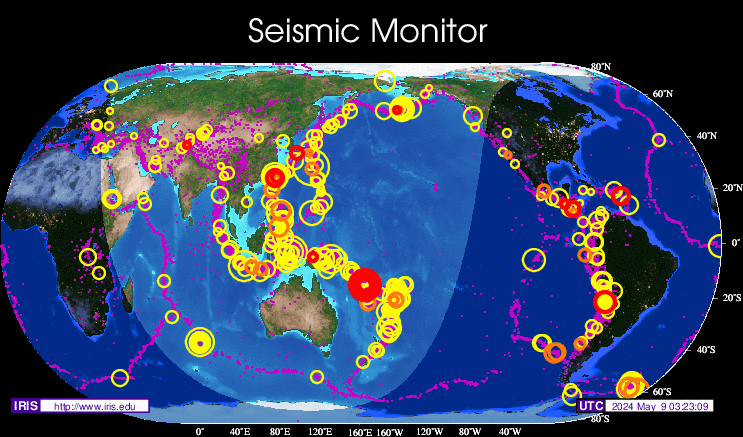
Seismic Map
What They Say About SDA
"Smalldeadanimals doesn't speak for the people of Saskatchewan" - Former Sask Premier Lorne Calvert
"I got so much traffic after your post my web host asked me to buy a larger traffic allowance." - Dr.Ross McKitrick
Holy hell, woman. When you send someone traffic, you send someone TRAFFIC.My hosting provider thought I was being DDoSed. - Sean McCormick
"The New York Times link to me yesterday [...] generated one-fifth of the traffic I normally get from a link from Small Dead Animals." - Kathy Shaidle
"You may be a nasty right winger, but you're not nasty all the time!" - Warren Kinsella
"Go back to collecting your welfare livelihood." - Michael E. Zilkowsky

All of which will require vastly more processing power, which we are already short of, let alone the Netzero, buy an EV crap. I read recently that each individual NVIDIA chip being used for AI etc uses the same power per year as 3 passenger EV’s. Each chip, and millions are required. The tech giants Microsoft, Google etc are the ones now needing all this extra power. Will they back off from promoting Netzero?
The most power-hungry chips in the world use less than 500 watts.
An EV needs dozens of kW.
“The most power-hungry chips in the world use less than 500 watts.”
I would hope it would be a lot less….you would have to water cool them (at least) at that power level.
https://wattsupwiththat.com/2024/05/26/the-energy-transition-wont-happen-big-tech-embraces-energy-guzzling-ai/
This is where I got the 3 EVs per new AI data chip
Lets do some math:
A 500 Watt chip maxed out for a year uses around just under 4.4 MWhrs of energy.
Lets assume that an EV uses only 20 horsepower for 1 hour a day for 200 days a year.
1 horsepower is about 745 watts, so say about 15 000 kWhrs day.
That makes an EV use about 3 KWhrs/year, when only used to commute on workdays.
Its pretty obvious that the website is lying, or maybe he includes golf carts and mobility scooters in his calculation.
Opps, an EV as described uses about 3 MWhrs a year.
A single nvidia 8 gpu node for doing AI will use about 90 MWh in a year according to their energy efficiency calculator.
Tesla claims they get 4.1 miles per KWh on the model 3, so with the same energy, the Model 3 can go 369,000 miles.
Which is going to need more power?
Biometrics is not a security measure.
It is a means to track people’s movements.
Security measures are flexible enough to allow for change. If my password or digital certificate is compromised, I can change it. With tracking measures, you don’t WANT the thing being tracked to be capable of change. You want to be able to track the object no matter what happens to the object.
Biometrics is a tracking technology, not a security technology.
And why do they want to track you? In order to control you.
Yes.
Its for both tracking and security.
The State’s security.
Big Government exists for Big Government.
Full-time real-time knowledge of every citizen’s movement/whereabouts takes a lot of energy, but wields tremendous power.
If you think that you’re not already being tracked by your car and your phone, you are sorely mistaken.
According to my ancient flip-phone, I stay home a lot. According to my odometer… no I don’t.
I have an older car that doesn’t connect to anything cell or satellite. Yeah, every car gets captured by the ubiquitous snoop-snoop-snoopy-cameras nowadays. Can’t avoid that. I think there is still some slop in traffic cam data sharing, so I’m OK… sometimes.
I’m not particularly motivated to change my current phone and mode of transport. Let ’em hunt me down the old-fashioned way.
also, you can change a password but you cannot change a biometric. that is a risk if you get hacked
Rather than criminals trying to gain your password, they’ll just hack off the body part needed for the scanner.
Once again, the movie Demolition Man demonstrates uncanny prognostication accuracy.
I was at a venue over the weekend where the taps in the bathroom were motion activated horizontal bars. It took me several seconds to figure out how to turn them on and adjust the temperature, during which I muttered “JFC, I feel like I’m trying to use the three shells”. Someone else in the bathroom laughed.
Knightly’s tin foil hat is a bit tight in the opening, though. Captchas are hard to use because computerized pattern recognition is getting better all the time, and we don’t currenlty have any better way of distinguishing between a scraper bot and a human. MFA is becoming the standard because passwords have long ceased to be effective safeguards. MFA is hard to use because all the standardization is in the hands of people who hate you.
Biometrics are worse than passwords, because when they get compromised, they cannot be changed.
Oh, and the US government can search your phone without a warrant if you use biometrics to “secure” it.