Why this blog?
Until this moment I have been forced to listen while media and politicians alike have told me "what Canadians think". In all that time they never once asked.
This is just the voice of an ordinary Canadian yelling back at the radio -
"You don't speak for me."
email Kate
Goes to a private
mailserver in Europe.
I can't answer or use every tip, but all are appreciated!


Katewerk Art
Support SDA
Paypal:
Etransfers:
katewerk(at)sasktel.net
Not a registered charity.
I cannot issue tax receipts
Favourites/Resources
Instapundit
The Federalist
Powerline Blog
Babylon Bee
American Thinker
Legal Insurrection
Mark Steyn
American Greatness
Google Newspaper Archive
Pipeline Online
David Thompson
Podcasts
Steve Bannon's War Room
Scott Adams
Dark Horse
Michael Malice
Timcast
@Social
@Andy Ngo
@Cernovich
@Jack Posobeic
@IanMilesCheong
@AlinaChan
@YuriDeigin
@GlenGreenwald
@MattTaibbi
Support Our Advertisers

Sweetwater

Don't Run

Polar Bear Evolution

Email the Author
Wind Rain Temp
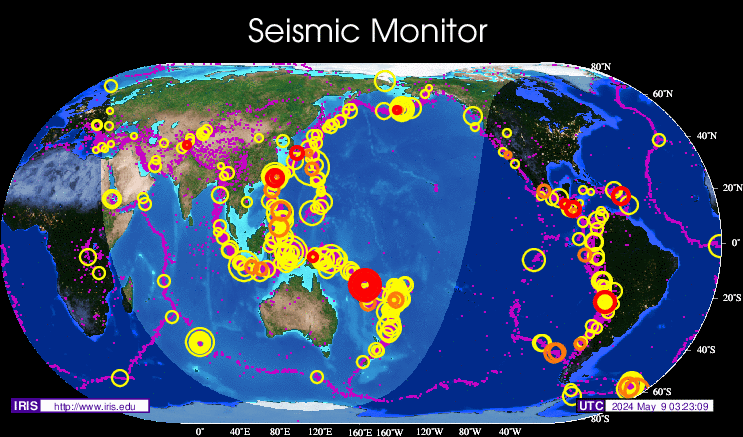
Seismic Map
What They Say About SDA
"Smalldeadanimals doesn't speak for the people of Saskatchewan" - Former Sask Premier Lorne Calvert
"I got so much traffic after your post my web host asked me to buy a larger traffic allowance." - Dr.Ross McKitrick
Holy hell, woman. When you send someone traffic, you send someone TRAFFIC.My hosting provider thought I was being DDoSed. - Sean McCormick
"The New York Times link to me yesterday [...] generated one-fifth of the traffic I normally get from a link from Small Dead Animals." - Kathy Shaidle
"You may be a nasty right winger, but you're not nasty all the time!" - Warren Kinsella
"Go back to collecting your welfare livelihood." - Michael E. Zilkowsky

Watched that a few days back. Interesting stuff. With a 30 mph wind that thing could probably hover.
Sure can hover. I like to do a trick like that with a student in a glider: point the nose into wind and slow down to near stall (around 35mph in our basic trainer). If the wind is strong enough we are hovering.
I have even flown backwards over our airfield in a strong wind.
I did notice there was quite a strong wind in that video, so the “helicopter landing” is very doable.
When he is describing the levers and knobs he says ” that is the throttle, the choke , and the mags”
does anyone know what he means by mags?
And why there is a lever or knob for that?
Magnetos. Ignition system.
Levers and knobs might adjust spark timing or could just be for selecting between primary and backup system
thanks
well sda, this is a first.
speaking of internet, this is my 1st posting from a cell ph capable because l have start.ca provider with wifi connexion which a tenant set up in a matter of moments.
carry on!
There are two separate ignition systems on aircraft piston engines. There are two spark plugs per cylinder, typically the bottom plug on every cylinder is connected to the right magneto, the top plug to the left magneto. Normally both mags are switched on as starting the flame from both sides of the combustion chamber gives more efficient combustion. During the preflight check, the pilot will always turn off one mag at a time to make sure both are working. There should be a ‘mag drop’ of 50-70 rpm when running on only one mag. If there is a bad lead or plug you will discover it while running on one mag. In the ’20s and ’30s many fire trucks had dual magneto ignition systems to ensure reliable starting.
Aircraft engines only run at three speeds – idle, takeoff and cruise so their carburetors and ignitions are simpler than cars. The older Lycomings, Continentals and Pratt & Whitneys I worked on have fixed ignition timing. Engines are started and idled with the mixture control in the ‘rich’ position which slows the flame propagation in the cylinder. Too much idling at low rpm and rich mixtures can foul the plugs but leaning the mixture too much can cause pre-ignition. I have had occasion to change all 28 plugs on a DC-3 because I had the mixture too rich on #1 engine.
From the schematics I can find on line the Rotax engines do not use traditional magnetos. Instead there is a small shaft driven generator providing DC and a timing signal to two CDI (Capacitance Discharge Ignition) black boxes each of which provides spark to one plug per cylinder. Ignition timing is 4deg BTC below 650rpm and 26deg BTC above, changed electronically.
Mags are magnetos, they provide the spark. This is standard on any airplane. Typically you have two, to provide redundancy. I don’t know about his snowmobile engine, but on my real airplane engine, I have two driving separate spark plugs so if one mag fails, the other keeps the engine running.
The other point of a magneto is that it will always produce a spark if the engine is turning, so even if I have complete electrical failure in flight, the engine will keep running.
Early 20th century tech.
Takes beating and still Keeps on ticking.
Sometimes the old ways are the best. Sometimes.
Thanks
Had many “tough” contests with a mag. (Non-aviation type of course.) One holds the wire while the other turns the flywheel. When it goes “pop” the armpit hairs light up.
I was told my paternal grandfather would check for a miss on his old McCormick Deering tractor that way. Grab hold of the plug wire at the spark plug end, if it kicked like a mule, that wire was good. On to the next one.
We used to play with the electric fence in a similar fashion. Pick a blade of grass, lick it, lay it on the wire, the winner was the one who got closer to the wire with his fingers.
This isn’t unique at all. There are plenty of airplanes that can be slowed to high 20s mph with slats and flaps, and enough wing area. The wind is blowing 15-20, so the ground speed is 5-10. To get controlled flight under 25 mph requires huge wings that make it too difficult to handle in any kind of gusty conditions, so there is a practical limit to how big you can make the wings.
STOL great for bush country.
The Gossamer Albatross had a top speed of 18 mph, and averaged less than 8 mph in the Channel crossing.