Why this blog?
Until this moment I have been forced to listen while media and politicians alike have told me "what Canadians think". In all that time they never once asked.
This is just the voice of an ordinary Canadian yelling back at the radio -
"You don't speak for me."
email Kate
Goes to a private
mailserver in Europe.
I can't answer or use every tip, but all are appreciated!


Katewerk Art
Support SDA
Paypal:
Etransfers:
katewerk(at)sasktel.net
Not a registered charity.
I cannot issue tax receipts
Favourites/Resources
Instapundit
The Federalist
Powerline Blog
Babylon Bee
American Thinker
Legal Insurrection
Mark Steyn
American Greatness
Google Newspaper Archive
Pipeline Online
David Thompson
Podcasts
Steve Bannon's War Room
Scott Adams
Dark Horse
Michael Malice
Timcast
@Social
@Andy Ngo
@Cernovich
@Jack Posobeic
@IanMilesCheong
@AlinaChan
@YuriDeigin
@GlenGreenwald
@MattTaibbi
Support Our Advertisers

Sweetwater

Don't Run

Polar Bear Evolution

Email the Author
Wind Rain Temp

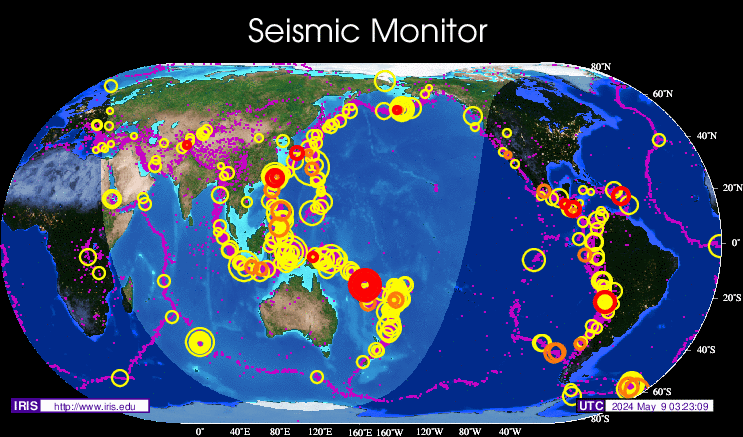
Seismic Map
What They Say About SDA
"Smalldeadanimals doesn't speak for the people of Saskatchewan" - Former Sask Premier Lorne Calvert
"I got so much traffic after your post my web host asked me to buy a larger traffic allowance." - Dr.Ross McKitrick
Holy hell, woman. When you send someone traffic, you send someone TRAFFIC.My hosting provider thought I was being DDoSed. - Sean McCormick
"The New York Times link to me yesterday [...] generated one-fifth of the traffic I normally get from a link from Small Dead Animals." - Kathy Shaidle
"You may be a nasty right winger, but you're not nasty all the time!" - Warren Kinsella
"Go back to collecting your welfare livelihood." - Michael E. Zilkowsky

Excellent. Thanks for linking to that, Kate.
As a young electronics hobbyist starting from shortly after that era, some random comments:
– Patty Duke’s father did a great job on the “commercials”.
– the bespectacled engineer would look perfect in a DEVO video.
– those 8- and 16-pin DIPs were just so amazing. They did incredible tasks in both the digital and linear worlds.
– something tells me that if you were to suggest to the gents in the video that, in 50 years, ICs would hold 4 billion transistors, they’d say “um, yeah, probably”.
– I didn’t know that Fairchild Semiconductor still exists: https://en.wikipedia.org/wiki/Fairchild_Semiconductor
A great glimpse into the past. Thanks again.
Excellent. Thanks for linking to that, Kate.
As a young electronics hobbyist starting from shortly after that era, some random comments:
– Patty Duke’s father did a great job on the “commercials”.
– the bespectacled engineer would look perfect in a DEVO video.
– those 8- and 16-pin DIPs were just so amazing. They did incredible tasks in both the digital and linear worlds.
– something tells me that if you were to suggest to the gents in the video that, in 50 years, ICs would hold 4 billion transistors, they’d say “um, yeah, probably”.
– I didn’t know that Fairchild Semiconductor still exists: https://en.wikipedia.org/wiki/Fairchild_Semiconductor
A great glimpse into the past. Thanks again.
While it is dated, this would be quite useful to electrical engineering students in showing them the principles of ICs.
When I began my master’s in electrical, I took a course in electronic devices and very little time was spent in explaining how they were built. Then again, there wasn’t much emphasis on their practical aspects.
if you were to suggest to the gents in the video that, in 50 years, ICs would hold 4 billion transistors, they’d say “um, yeah, probably”.
It might be interesting to find out what their reaction would be to surface mount technology. There’s hardly any electronic device nowadays that doesn’t make use of it.
Not only is Fairchild still operating, a lot of those original ICs are still in production. The 555 timer and 741 opamp are ubiquitous.
That was one of the better industrial videos I’ve seen. The best one however remains this German forklift safety video:
https://www.youtube.com/watch?v=-oB6DN5dYWo
The Fairchild video brought back memories
1.Wire Wrap was used before Mother Boards. It was a nightmare to update/modify a system with wire wrap (I still have my field tools) RCA built a computer that failed in the Market, it was a wire wrap disaster… Using a MB for interconnect advanced all devices….
2.The Keyboard they used was called an “interrogator” in the video… I used that word to describe a Computer Interface status sampling circuit that I had designed… The group of guys included some who had served in Vietnam….. I scrubbed the word from my vocabulary
3.I have one of the first Analog RCA design Programs, 5 ½ Disk… Ran on DOS 2.1. It was neat at the Time in the 70’s…
4.We came a long way in a short period of Time, in the 90’s the yield was better than 99% and hardware failure was lost to History… Bell labs designed the first Transistor, but Bell Telephones continued using Mechanical Relays in their Phone switching systems into the 80’s. The old timers didn’t trust solid State..
5.The old RCA Wave solder Machine looked like a huge Bale Loader. On the output side the belt had gutters on each side and they would be full of Parts that had fallen OFF.. All the boards had to go through QC, or be fixed in the field…
6. SMT from the 90’s have problems, Leaking SMD Capacitors & Trace damage.. It was a manufacturing advancement, not better technically…System Modules a better solution.
I rebuild & Calibrate 400MHZ Tektronix analog Oscilloscopes as a Hobby, the same component problems exist with today devices.. We have yet to master large Capacitors.
Regards,
This was my bread and butter back in 1967. I was a ‘field engineer’ for one of the major computer companies at the time. (Honeywell – the H part of the BUNCH – some of you may remember) My job was to install and maintain mainframe computer systems. I would carry an oscilloscope under one arm and a big leather toolcase in the other. Most of the computer boards were still built with discrete components, but we began to see more integrated circuits with each new model coming on. If a computer failed, we would trouble shoot it down to the failed circuit board, and in some cases down to a failed part on a board if there was no spare on site.
In later years, (mid 1970s) I built two personal computers from parts using ICs. I still have quite an assortment of oddball parts lying around somewhere, but have given up building things. (eyesight not up to it anymore)
Interesting- that one circuit board would have cost several thousand dollars.
My first computer cost $7,750.00 dollars and they were having a nerd SALE.
Your iphone has more technology in the button that turns it on-
Wal-Mart $49.95
And after 6 months I finally hooked up to a local bulletin board.
My 1,200 bit/s 600 Baud modem could download a Golden Netscape Navigator Browser in just 4 days.
If my wife picked up the computer phone it had to start all over again.
Those were the good old days of wait and see.
Now people complain about having to type in Captcha. Ha.
If some nerd sent you a virus you could go over and cut his phone lines.
William Schockley, English born and American educated physicist co-invented the transistor in 1947 and moved from New Jersey to California in 1956 to form Schockley Semiconductor Laboratory. None of his colleagues at Bell Labs would work for him so he recruited several promising graduates from local universities in what was the early beginnings of Silicon Valley.
Turns out there was a reason none of Schockley’s coworkers would work for him and eight of his brightest engineers (later dubbed the hateful eight) quit and went to Fairchild Camera and Instrument within a year.
One of the eight, Robert Noyce, made an impassioned presentation to Fairchild owner Sherman Fairchild claiming that in the future all appliances would feature electronic components and would be disposable because it would cheaper to throw them out than repair them (this was in 1957). Noyce’s claim was based on the possible development of silicon-based electronic components that could literally made from sand. At the time transistors were made from rare and expensive Germanium.
During the next 8 years Fairchild was a world leader in the development of transistor-based components including the first operational amplifier. It turns out, however, that Sherman Fairchild wasn’t much better at managing engineers than Schockley and starting in 1968 the hateful eight were again making their way for the exits with new start-ups or to better managed companies.
One of the hateful eight, a man named Gordon Moore, was asked in 1965 by an electronics magazine what to expect over the next 10 years in the electronics industry. Moore responded that the number of components in an integrated circuit would roughly double every year for at least the next ten years. Moore would later modify that claim into what is now known as Moore’s Law.
In 1968 the much impassioned but now disillusioned Peter Noyce left Fairchild and with Gordon Moore founded Intel.
By 1979, with Fairchild operating at a loss, the company was sold to Schlumberger.
Engineers made it, but we sold it.
Customers would ask: “Why do we need a computer?”
My response: “You can write a best selling book with the word processor.” Millions of dollars.
“You can see where your wife/husband spends all your money out of the checking account.” Thousands of dollars.
The worst business response: “You can eliminate three jobs in your office.” Thousands of dollars saved.
Now with Artificial Intelligence,
Millions of jobs are going to be gone, but we can always blame it on the Engineers.
Interesting coincidence: Last week I sold a rebuilt 2465B Oscilloscope (Hi-End Analog) to a retired Fairchild (Japan) Engineer.. It would be Interesting to get some in the trench feed back..
I can feel that the articles contained in this blog is so interesting. I also get a variety informasin, thanks.
I can feel that the articles contained in this blog is so interesting. I also get a variety informasin, thanks.