Why this blog?
Until this moment I have been forced to listen while media and politicians alike have told me "what Canadians think". In all that time they never once asked.
This is just the voice of an ordinary Canadian yelling back at the radio -
"You don't speak for me."
email Kate
Goes to a private
mailserver in Europe.
I can't answer or use every tip, but all are appreciated!


Katewerk Art
Support SDA
Paypal:
Etransfers:
katewerk(at)sasktel.net
Not a registered charity.
I cannot issue tax receipts
Favourites/Resources
Instapundit
The Federalist
Powerline Blog
Babylon Bee
American Thinker
Legal Insurrection
Mark Steyn
American Greatness
Google Newspaper Archive
Pipeline Online
David Thompson
Podcasts
Steve Bannon's War Room
Scott Adams
Dark Horse
Michael Malice
Timcast
@Social
@Andy Ngo
@Cernovich
@Jack Posobeic
@IanMilesCheong
@AlinaChan
@YuriDeigin
@GlenGreenwald
@MattTaibbi
Support Our Advertisers

Sweetwater

Don't Run

Polar Bear Evolution

Email the Author
Wind Rain Temp
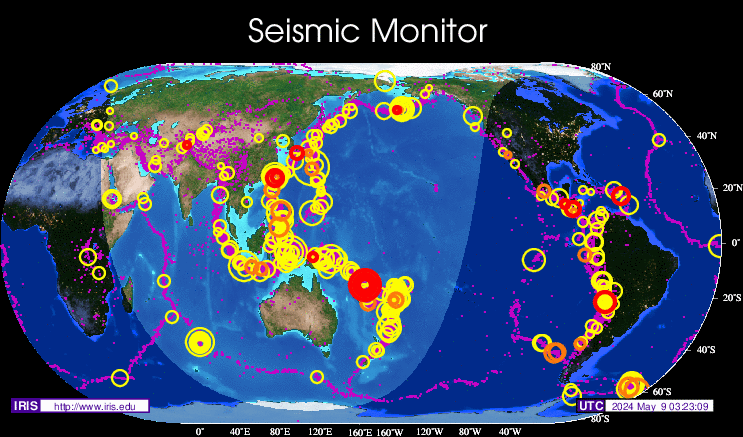
Seismic Map
What They Say About SDA
"Smalldeadanimals doesn't speak for the people of Saskatchewan" - Former Sask Premier Lorne Calvert
"I got so much traffic after your post my web host asked me to buy a larger traffic allowance." - Dr.Ross McKitrick
Holy hell, woman. When you send someone traffic, you send someone TRAFFIC.My hosting provider thought I was being DDoSed. - Sean McCormick
"The New York Times link to me yesterday [...] generated one-fifth of the traffic I normally get from a link from Small Dead Animals." - Kathy Shaidle
"You may be a nasty right winger, but you're not nasty all the time!" - Warren Kinsella
"Go back to collecting your welfare livelihood." - Michael E. Zilkowsky

Now, that is creepy.
The mouthpieces in the Press have their marching orders.
Computer.
How to do it. JSON messages back and forth.
There are tens if not hundreds of ways of doing it depending on how the data is stored, but:
open database;
get twitter users;
for each twitter user;
get headline;
get media;
fancy character count trim code;
compose JSON object;
post JSON message;
decompose JSON response;
error check;
update database ‘twittered’ flag;
commit database transaction
done
close database;
I guess that’s how you recognize cutbacks in the press. Plays well with the “reduce, reuse, recycle” narrative.
Particularly prescient Eskimo. As today the last print edition of the Leader Post was printed in Regina. It will be printed out of the Saskatoon Star Phoenix from now on.
And I know for a fact there are no press jobs for the Regina pressmen to go to.
Unfortunately, print is dying. Gutenberg would weep. The Internet is _not_ forever.
The secret word today kids is so-called. Whenever you hear it make sure to scream.
‘Our so-called media…’
Getting the news in Costco club-pack format.
Maybe this is like “Peer Review” for journalists?
“Gutenberg would weep.” He would smile at our house, as we have gone back to books and only use the E-books while flying. Speaking for myself, I like to open a new book and smell the print. Kind of like versus our current PM Selfie Fluff that likes to smell maryjane.
No weeping here for the Leader Post or any other leftist mouthpiece that bites the dust.
anybody remember the time Bill Gates wrote a, wait for it, hardcover BOOK describing how his suite of operating systems and other s/w were the ‘thing’ to provide instant access to information?
I still find that uniquely ironic.
The real killer here would be if each article has a local highway name swapped in for the photo caption.
Calgary: “This driver stopped on Highway 201…”
Ottawa: “This driver stopped on Highway 416…”
Windsor: “This driver stopped on Highway 401…”
Toronto: “This driver stopped on the ISIS Memorial Highway of Martyrs…”
They’re all owned by PostMedia Group. Centralization and economies of scale are a thing. There’s no scandal here.
The point Daniel is the story is bs entirely made up out of thin air with certain local facts thrown in to lend credence.
Inform? Do they mean to something like a “snitch line”?
Hey Lance, a news paper and a printing facility are two totally different entities. I used to work for a printing firm, they printed for competing companies. So a move to print else were could be just and economic move. Replacing, updating or just extensive maintenance may be what is behind you “example”
Which “local facts” in this story were “thrown in”? It’s a generic Canadian driving story.
Driving.ca is an online magazine owned by Postmedia, and their newspaper twitter feeds drive traffic (no pun intended) to the site. http://driving.ca/about-us
Most (all?) of Postmedia’s stories are edited from a central location, and their new look revealed today was designed to help ensure consistency across the brand. There’s no reason to think that their social media feeds aren’t done the same way.
Whatever enemy. Of course it’s a cost-cutting move. Of course the papers do contract work.
My ‘example’? I don’t even know what you mean, not that that is surprising. Are you questioning my pseudo code, my statement on print dying or that I said there weren’t any press jobs?
Instead of doubting me, you could, I dunno. Use your superior intellect and do a bloody search.
When CanWest picked up the LP and the SP in 2k they did due diligence. They bought a new press for the SP. When Post Media picked them up they ran the same numbers, looked at subscriptions and decided (rightly) that they can easily run both papers off the same press.
It remains to be seen if PostMedia suffers workflow issues that the FreePress and Metro dailies did with regard to moving prepress data to a single location on time and hard copy back. (See below)
CTP (that would be direct to plate), as you know, because how did you say it? Oh yes, you “used to work for a printing firm” can use a lot of band-width moving the layouts. This obviously causes problems if say, internet goes out, power failures, SaskTel has a router problem, etc.
You wonder why every paper looks exactly the same except for local K pages? This is why, a central database of content, pull from the database, script the per-page layout, dump it into a PDF, sep the PDF into CMYK and dump to DTP. There, you’ve eliminated the pre-press problems that plagued early adopters of remote printing of newspapers.
What nothing will solve is moving a couple of truckloads of newspapers to Regina in the middle of the night in a blizzard, or the inevitable hardware failure. (Wpg. or Cal. is probably the backup in the latter case) I earnestly wish them luck.
But, hey, I’m sure that you know more about printing and in particular web presses in Saskatchewan than I do.
We have thousands of books in my house. Literally.
The Calgary Public Library used to have discard books sales for a string of years at an arena in SW Calgary.
We’d(wife and I) put on our largest mountain backpacks and only leave when we couldn’t carry any more. Now we buy books through Amazon and get about 2 deliveries every week.
I would be so rudely distracted if I were to ever visit your home. I love snooping through people’s bookshelves. I was just at a lovely B&B in Guelph, Ont. they had an eclectic selection of titles that I enjoyed perusing. I discovered a Canadian quarterly called Arabella that I went home and promptly subscribed to.
All of our books are inventoried. We have lists because we lend them to acquaintances, plus we have so many books that we have had to store many of them in empty wine cases which are listed/labelled with the contents and stored in the basement.(so many books that we ran out of shelf space long ago) We have many rare and out of print books(hard cover originals) with authors such as Richard Nixon, J. Edgar Hoover, plus a plethora of paperbacks both non-fiction and fiction.
Some of our rarest books are Christian books which are long out of print and some of them have been illegal in certain places for decades.
I should say that many of the books we bought at these Calgary public library discard book sales were sold because the CPL didn’t want people to be able to just walk into their library and access the ideas that many of the books we bought contain. These are purged books full of ideas that the progressives in charge of the libraries wanted gone from public access and public discourse.