Why this blog?
Until this moment I have been forced to listen while media and politicians alike have told me "what Canadians think". In all that time they never once asked.
This is just the voice of an ordinary Canadian yelling back at the radio -
"You don't speak for me."
email Kate
Goes to a private
mailserver in Europe.
I can't answer or use every tip, but all are appreciated!

Katewerk Art
Support SDA
Paypal:
Etransfers:
katewerk(at)sasktel.net
Not a registered charity.
I cannot issue tax receipts
Favourites/Resources
Instapundit
The Federalist
Powerline Blog
Babylon Bee
American Thinker
Legal Insurrection
Mark Steyn
American Greatness
Google Newspaper Archive
Pipeline Online
David Thompson
Podcasts
Steve Bannon's War Room
Scott Adams
Dark Horse
Michael Malice
Timcast
@Social
@Andy Ngo
@Cernovich
@Jack Posobeic
@IanMilesCheong
@AlinaChan
@YuriDeigin
@GlenGreenwald
@MattTaibbi
Support Our Advertisers

Sweetwater

Don't Run

Polar Bear Evolution
Email the Author
Wind Rain Temp

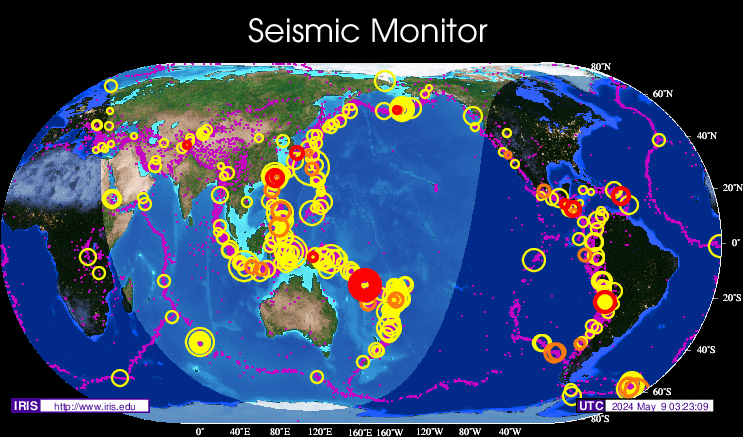
Seismic Map
What They Say About SDA
"Smalldeadanimals doesn't speak for the people of Saskatchewan" - Former Sask Premier Lorne Calvert
"I got so much traffic after your post my web host asked me to buy a larger traffic allowance." - Dr.Ross McKitrick
Holy hell, woman. When you send someone traffic, you send someone TRAFFIC.My hosting provider thought I was being DDoSed. - Sean McCormick
"The New York Times link to me yesterday [...] generated one-fifth of the traffic I normally get from a link from Small Dead Animals." - Kathy Shaidle
"You may be a nasty right winger, but you're not nasty all the time!" - Warren Kinsella
"Go back to collecting your welfare livelihood." - Michael E. Zilkowsky


The only benefit to this, is that this, gives an new insight into the early stages of evolution….
Now if we could just get a critical mass of “scientists” to realize the observed warming of the 20th century is Urban Heat Island Effect.
COOL! Molluscs are pretty interesting…they represent an ‘in-between’ stage in embryonic evolution where the ‘mouth’ and ‘anus’ end are in the midst of changing ‘poles’, and so are beside each other (not a very good design for obvious reasons!)..their basic body plan is a ‘U’.
“Now if we could just get a critical mass of “scientists” to realize the observed warming of the 20th century is Urban Heat Island Effect.”
If that’s fact then please explain warming in the Arctic. Where’s the urban heat island?
Wait wait wait! Earlier weren’t you guys saying that there were too many philosophers? Cripes there’s too many scientists too!
There hasn’t been any observed warming in the arctic, at least nothing out of the ordinary.
BTJ;The observed warming in the Arctic eh,one of the worlds largest deposits of coal is in Antactica.How did it get there,by truck? Use your head.
BTJ – read:
Climategate timeline.
The report on the inquiries into the Climategate whitewash job performed by the British Government.
In case you missed it all this time, they’ve been lying all along. Kay? All clear now? Sorry that it’s going to take some actual effort to read these things, but that’s how we become informed in this society.
What this shows is that organisms are informationally active with their environments. They pick up informational data and incorporate it into their morphological nature.
That is, the gene isn’t the sole or even the dominant deterministic cause of the phenomenological nature of the organism – there’s something else going on besides this ‘hereditary linear force’. That’s lateral information exchange with the current environment – and this exchange plays a significant role in the nature of the organism.
The next thing to explore would be the stability of this new form; does it become hereditary or does it instead, move to function as one ‘form’ of several possible ‘forms’ of this species?
This is a rather nice poke in the eye to Intelligent Design as well. How -did- organisms develop an internal skeleton?
Little heavy metal in the water and SHAZAM! Internal skeleton. Shift in environment favoring the survival of the messed up mollusc’s, pretty soon you have a fish. “Pretty Soon” being a couple million years, but still.
BTJ
[…..If that’s fact then please explain warming in the Arctic.
What warming? The same clown who alleged this alleged Antarctica was melting at -30C.
[….Where’s the urban heat island?…..]
Those urban areas which surround all the weather stations that NOAA and GISS rely on.
finally, a scientific explanation why Liberals are so spineless. Too many silver spoons in infancy, not enough platinum.
Have any of these wise guys looked into the creature living on a golf course mudholes?
Would they find some sophisticated critters powered by the chemical soup that the mudholes are?
From the article:
“The molluscs are not genetically modified by platinum — they are no mutants.”
Sorry Phantom, not a new species, so I don’t think this harms nor helps the intelligent design theory.
Bah! Call that science? In Ontario we’ve taken a common arse-hole and turned it into a Premier!
Banachek, that’s my point. They are -not- mutants, rather their gross morphology can be changed by altering a single element in the environment. If selection favors the altered ones, they will continue on, spread out from their little niche and be successful.
In other words, internal skeletons do not require a complex mutation as claimed by Intelligent Design. The machinery is much more complex than people give it credit for.
Another favorite ID example is the eyeball. What do you want to bet there’s some chemical interaction that will take a photosensitive spot and turn it inside out like the mollusks’ shells? Presto, eyeball. And indeed, some mollusks do have excellent eyeballs.
Octopi and cuttlefish are examples of inside-out mollusks with shell on the inside, and eyeballs too. Kewl, eh?
“There hasn’t been any observed warming in the arctic, at least nothing out of the ordinary.”
Lies..complete and utter BS.
“BTJ;The observed warming in the Arctic eh,one of the worlds largest deposits of coal is in Antactica.How did it get there,by truck? Use your head.”
HUH? What the hell does that have to do with ANYTHING?!
“What this shows is that organisms are informationally active with their environments. They pick up informational data and incorporate it into their morphological nature.”
Please ET, if you don’t have an understanding of a topic..in this case BIOLOGY…then don’t attempt to make yourself sound as if you do. This is not philosophy.
Of course organisms are ‘informationally active with their environments’…or a less ‘smarty pants’ way of saying it…organisms interact with their environment. Wow, what a revelation…give this person a medal.
“That is, the gene isn’t the sole or even the dominant deterministic cause of the phenomenological nature of the organism”
Yes it is.
“Little heavy metal in the water and SHAZAM! Internal skeleton. Shift in environment favoring the survival of the messed up mollusc’s, pretty soon you have a fish. “Pretty Soon” being a couple million years, but still.”
Uh, no.
“What warming? The same clown who alleged this alleged Antarctica was melting at -30C.”
The ARCTIC and ANTARCTICA are on opposite ends of the earth genius.
“Those urban areas which surround all the weather stations that NOAA and GISS rely on.”
Ya, so where is the urban areas IN THE ARCTIC?
“They are -not- mutants, rather their gross morphology can be changed by altering a single element in the environment. If selection favors the altered ones, they will continue on, spread out from their little niche and be successful.”
Wow..clearly you DON’T GET IT! ‘Selection’ is the process by which certain environmentally favored GENES are transferred to the next generation. This internal shell is NOT GENETIC, so how will is ‘continue on, spread from their niche and be successful’? The niche is what made the shell go internal..the platinum in their ‘niche’, nothing to do with genetics.
BTJ, the qustion is, what the hell is YOUR point? Are you gonna read those docs I sent you or are you just going to keep trolling and throwing your complete ignorance into sharp relief? And how about today’s news re: the Royal Society fudging basic math to exaggerate the effects of CO2? SCHMUCK!
BTJ – I don’t think you understand biological processes of adaptation. So, before you start with your usual insults, I suggest you do a bit of research. You have a tendency to spout empty opinions.
It is NOT ‘all in the genes’; that’s the deterministic ‘selfish gene’ theory and is greatly disputed by many biologists. For example, work by Griffiths, on ‘Organisms-Environment Systems as Units of Evolution’. Work by Susan Oyama in developmental systems in biology. Work by Stu Kauffman in complex adaptive systems. Work in BioSemiotics. All of these and others (and I work in the field of biological information) reject the reductionist gene theme.
Read up a bit; read in the journal Science about what is going on, read what’s going on in such journals as the Journal of Theoretical Biology, in the journal BioSystems.
And no, the phrase ‘informationally active with their environments’ does NOT mean that organisms interact with their environment. That’s an external view; what is meant by that phrase is that the physical matter and chemical matter of both the organism and the environment are intimately networked and work together as a complex system. I suggest you read up on complex adaptive networks in these areas.
No, there is more than one process of adaptation and evolution, and genetic mutation is only the simplest and most unreliable. The more robust process is correlation of two information systems within a complex network. Nothing to do with the DNA but with RNA and proteins.
Again, before you switch into your automatic default nature of insults, I suggest you do a bit of research.
ET, that was a very fine riposte, but, well – don’t expect much. BTJ, like all his ilk, is not interested in new information. His brain is set in concrete, ossified, able to respond only to tape-loop biases inculcated by propganda years ago. New information is not desirable, if there’s the slightest possiblity it offers a countervailing explanation.
cheers,
MHA
BTJ – do you understand the distinction between “genotype” and “phenotype”? That might be a place to start.
BJT is a prototypical Liberal troll whose sole aim is to annoy and start flame wars.
Clearly BJ you didn’t understand what I wrote. Not surprising I suppose, as you’re not smart enough to hold my coat. Pearls cast before swine, I fear.
Incidentally, you should read up on what ET said, it might fill in some of the shocking gaps in your gourd there. God forbid you should learn something.
Phantom @10:04 – don’t know much about octopi, but cuttlefish are way kewl. 3 years ago I dove/dived at Whyalla in Southern Oz to watch them breed – a frustratingly shallow dive with horrible scary currents but well worth it; the cuttlefish are everywhere during the short period when they breed (in early July if I remember); you dip down and there they are, carpeting everything, undulating with neon colour like downtown Vegas. You wouldn’t believe it if you hadn’t seen it.
I’ve seen dead ones; they have nasty talon-beaks and spew ink like squids. I love cuttlefish.
You dived to watch cuttlefish screwing? Woo! 🙂
I’ve only seen them on TV, with their skin changing colors in flashing bands. Must look awesome in real life. Worth getting wet for.
But kinda like an inside-out oyster, right? The beaky part is (roughly!) the shell, inside. Some powerful advantages to being able to blast around by jet propulsion and bite pieces off things, eh?
Did you get to see a Nautilus? They’re a jet propelled squid-y looking thing with a shell on the -outside-. I don’t know if they have beaks as well. If they do, then they’re inside-out and rightside-in simultaneously. ~:D
ET, this is an interesting thing. Do you know of anything that has both an internal skeleton -and- an external shell/carapace? I can’t think of one off-hand. Could it be one of them there basic rules of morphology?
ET:
What education (including self directed) do you have in the area of biology, evolution, and ecology? What do you do in biological information?
“before you start with your usual insults,”
What insults? Quote me.
“It is NOT ‘all in the genes'”
I didn’t say it was, quote me. You said ‘the gene isn’t…the dominant deterministic cause of the phenomenological nature of the organism”
That’s a lie…genes sure as hell are the dominant determinant of phenomenology.
Susan Oyama is a PSYCHOLOGIST and PHILOSOPHER.
They do not REJECT genetic selection, they are concerned with EXPANDING our understanding of evolution…not to replace genetic selection.
“what is meant by that phrase is that the physical matter and chemical matter of both the organism and the environment are intimately networked and work together as a complex system.”
In other words, organisms interact with their environment, and in turn, the environment interacts with the organism…what I said in plain english. Wow..profound..again, we must get you a medal. How does this dispute genetic selection whatsoever?
“I suggest you read up on complex adaptive networks in these areas.”
I have read about complex systems…the ‘adaptive’ is redundant..a complex system is inherently adaptive..that’s what makes it complex.
“there is more than one process of adaptation and evolution”
I didn’t say there wasn’t..quote me.
“genetic mutation is only the simplest and most unreliable.”
There is more to genetic selection than just ‘mutations’.
“The more robust process is correlation of two information systems within a complex network. Nothing to do with the DNA but with RNA and proteins.”
Right…and RNA and proteins have nothing to do with DNA right! :S
Answer me this…how is anything passed from one generation to the next? How does a new trait in an individual organism that comes about through the interaction between said organism and the environment get passed to the next generation? Does each individual develop this new trait independently through it’s own interactions?
“do you understand the distinction between “genotype” and “phenotype”? ”
DUH..no I don’t…what is phenotype? /SARC
“BJT is a prototypical Liberal troll whose sole aim is to annoy and start flame wars.”
We’re talking about biology..what does politics have to do with anything?! You my friend have a very simple mind…anything that clashes with you is ‘liberal’.
“but cuttlefish are way kewl”
Cuttlefish are awesome.
” Do you know of anything that has both an internal skeleton -and- an external shell/carapace?”
A turtle
I don’t think I ever saw a nautilus.
Cuttlefish are very aggressive (and apparently hard of sight) and will try to mate with/attack, say, your flashlight, even well out of season. Which can be quite unnerving.
Dood – if you need to write: “/SARC” – then you ain’t doin’ “sarc” right. But at least we agree on cuttlefish.
BTJ – your snide comments about the intelligence of anyone who disagrees with you – is insulting.
With regard to Susan Oyama, kindly read her peer-reviewed publications list; she works with people in biology, eg, Bruce Weber, David Depew, Paul Griffiths, Mae-Won Ho, etc.
As I suggested, why don’t you read some science and biological professional journals.
You don’t understand about the RNA and proteins; your comment is merely the linear outline of DNA to RNA to protein. That’s not what I’m talking about; I’m referring to evolutionary processes taking place in the RNA/protein informational area, not in the DNA.
Don’t be snide; the term ‘complex adaptive system’ (CAS) and ‘complex adaptive network’ are key phrases in the literature and the term ‘adaptive’ is an important component because it defines the system as a dynamic process rather than a state. A complex system can be understood as static (eg, a chemical, a machine) while a CAS, on the other hand, is dynamic. That’s the reason for the use of the term. Again, don’t be snide.
I am under no obligation to inform you of my publications in the field, my research, the colleagues in the biological and physical sciences with whom I work.
I looked that one up. Turtle shells are keratin, not calcified like shell or bone. Its a modified epidermal layer on top of the internal skeleton. Good try though.
Oh, and you’re still a troll.
“You don’t understand about the RNA and proteins;”
I assure you I do know about RNA and proteins. What I don’t understand is where you’re going with them.
“I’m referring to evolutionary processes taking place in the RNA/protein informational area, not in the DNA.”
“I’m referring to evolutionary processes taking place in the RNA/protein informational area, not in the DNA.”
And just how are these processes passed on to the next generation?
“A complex system can be understood as static (eg, a chemical, a machine)”
A machine is NOT a complex system..it is complicated..in that it has many parts…but it is not complex as it has no feedback mechanisms and it is not dynamic.
“I am under no obligation to inform you of my publications in the field, my research, the colleagues in the biological and physical sciences with whom I work.”
Of course you aren’t, that would just ruin your argument.
What do you mean ‘informational area’? Sounds like you don’t have a strong grasp on the subject, pretty general and uninformative statement. How are RNA and proteins…which RELY ON DNA…involved in the evolution of organisms?
If you take a high concentration of platinum and it makes genes control the growth of a snail differently, but doesn’t change the genetics of the snail itself, won’t the progeny develop as regular snails in the absence of platinum (assuming the platinum snail is still able to reproduce)?
I can’t see how this does anything to support evolution and/or refute intelligent design.
BTJ – I’m not going to give, here, a basic course on biological evolution and adaptation. Read some articles by the authors I suggested, and read the journals I suggested. You might learn something. Again, try the Journal of Theoretical Biology, BioSystems, Biosemiotics, and Biochemistry. Don’t go to Wikipedia; go to your local university library and check out some of the journals.
You are trapped in an out-of-date linear mode of thinking where DNA is the deterministic ‘all’; that’s not true. The RNA and proteins are an active and mobile, not merely transference, part of the system.
Banachek – what it shows is that the basic genetic ‘template’ of an organism is general rather than specific and that an organism therefore has the capacity to alter its particular current development, based on the informational data it receives from its environment. The next question is whether this adaptation becomes ‘normative’ and the answer has to be that it is normative IF the environment stays in that new form.
Again, the basic genetic template (DNA) is general and requires ‘reading’ and above all, networked interpretation by the RNA, introns, exons and proteins – which add data from the environment. The point of Complex Adaptive Systems, which is what biological organisms are, is that they have the self-organized capacity to adapt to environmental information. The location of that adaptive capacity is the various forms of RNA, introns, exons, proteins…The reason for this complex process (rather than a simple iconic copying of the DNA)..is to enable that adaptive capacity.
“I’m not going to give, here, a basic course on biological evolution and adaptation.”
Quote me…where did I ask you for one…in fact, I said I DON’T NEED ONE!! I’ve been through a number of courses on the subject, thanks. Why you insist on creating straw men to argue with I don’t know.
“Read some articles by the authors I suggested, and read the journals I suggested. ”
If you’re so sure of your position, why don’t you just give a brief explanation, rather than simply making uninformative statements.
“You are trapped in an out-of-date linear mode of thinking where DNA is the deterministic ‘all’; that’s not true. The RNA and proteins are an active and mobile, not merely transference, part of the system.”
Where did I say otherwise…again…NO ONE IS ARGUING THAT DNA IS THE ONLY DETERMINANT. No one is arguing that RNA/proteins are not active and mobile! THEY HAVE TO BE TO INTERACT WITH DNA AND WILL THE REST OF THE CELL. How does that explain their role in evolution though?
“The point of Complex Adaptive Systems, which is what biological organisms are, is that they have the self-organized capacity to adapt to environmental information.”
Yes, of course, I’m not arguing otherwise…I’ve never said that genetic mutations are the sole means of evolution.
“The location of that adaptive capacity is the various forms of RNA, introns, exons, proteins…The reason for this complex process (rather than a simple iconic copying of the DNA)..is to enable that adaptive capacity.”
Here’s where you stop short…HOW DO ADAPTATIONS GET PASSED TO THE NEXT GENERATION?!
“HOW DO ADAPTATIONS GET PASSED TO THE NEXT GENERATION?!”
This is where you look it up, BJ. Because regardless of your objections, the existence of cuttlefish is a strong argument that adaptations like this do get passed on. Not proof of course, but a strong argument.
Maybe you can report back on your findings, like I did with your turtle suggestion.
You wonder why we call you a troll?
Banachek: “I can’t see how this does anything to support evolution and/or refute intelligent design.” Maybe you should go do some of that reading ET set for BJ. Possibly she knows a little something about the subject, eh?
ID is one of those manufactured issues that doesn’t stand up under informed scrutiny too well. Its mostly people trying to prove they are right, and science doesn’t really work that way. Evolutionary theory, in contrast, was built by people who were trying to prove it -wrong- and couldn’t.
“This is where you look it up, BJ.”
Are you dull or what? I’m not asking it as a general inquiry…I’m asking ET how, in the process he/she has described, adaptations get passed along.
“Because regardless of your objections, the existence of cuttlefish is a strong argument that adaptations like this do get passed on.”
Phantom, please, you’re clearly in over your head. Leave this one alone my friend.
We are arguing about HOW adaptations occur, not IF they do. Adaptations like what? What do cuttlefish have to do with anything?
“Maybe you can report back on your findings, like I did with your turtle suggestion.”
In regards to that, in your original question you did not specify that the ‘shell/carapace’ had to be calcified. A turtle’s shell is a carapace.
Evolutionary theory, in contrast, was built by people who were trying to prove it -wrong- and couldn’t.
Hard to prove it wrong when the theory is used to interpret fossils, and the, thus interpreted, fossils are used to prove the theory.
It’s a fixed game, just like AGW.
BTJ- you are ‘stuck’ in an outdated view of evolution and adaptation. That is why I recommended some leading-edge biological and chemical journals.
Read my answer to Banachek; it’s a clear outline of how adaptations, IF the environment remains the same, become normative in the next generation. Your error is that you think that all replicative processing is determined solely by the DNA. You say that you don’t ‘say’ this, but your comments show that you believe this to be the case.
It isn’t. The DNA is general and the various RNAs, introns, exons, proteins, must interact with the current environment and adapt to produce a functional phenotype for that current environment. Again, do some reading beyond high school texts and see what is going on in the research world of bioadaptation and bioinformatics.
“you are ‘stuck’ in an outdated view of evolution and adaptation. That is why I recommended some leading-edge biological and chemical journals.”
I assure you I am not, it would seem that you would prefer to attempt to create a strawman, by claiming that I’ve stated that only genetic mutations can be responsible for adaptation.
“it’s a clear outline of how adaptations, IF the environment remains the same, become normative in the next generation. ”
No it is not, you stopped short of explaining how those adaptations become normative IN THE NEXT GENERATION. Does each successive generation go through this adaptive process? If so, would it not be quite limiting in how far these adaptations can venture?
“Your error is that you think that all replicative processing is determined solely by the DNA. ”
It is…from generation to generation. That’s my question, which you refuse to answer, likely because the answer is DNA. HOW DO ADAPTATIONS GET PASSED TO THE NEXT GENERATION…OR, DO THESE ADAPTATIONS OCCUR IN EACH GENERATION, INDEPENDENTLY FROM THE PREVIOUS.
I fully understand the concept of interaction between environment and ‘cellular machinery’ (RNA, proteins, etc), and I agree that this machinery is capable of interacting with external/environmental stimuli, and interacting within the cell accordingly. However, DNA still plays a central role, and is the basis for which information is passed from generation to generation, and because of this I see there being a limit to the extent to which these interactions can adapt.
Major adaptations occur within DNA (ie. from ape to human, from wolf to dog)
ET said“an organism therefore has the capacity to alter its particular current development, based on the informational data it receives from its environment.”
True, but I’m not sure what that has to do the price of tea in China. Bringing up the mechanisms of adaptation is irrelevant. My point was that the genetic makeup (DNA) of the organism is not changed, therefore it does nothing to explain the theory of evolutions assertion that one species will change into another over time. If the DNA blueprint doesn’t change, then it is logical to assume that if the progeny develop in a normal (low-platinum) environment, that it would develop as a normal snail. This just shows the adaptability of an existing organism to differing environmental conditions. If the snails environment suddenly became high in platinum, then all snails would look like the slug in the picture, but they would still be genetically identical to regular snails. Exactly the same species, although living with platinum poisoning.
This no more proves evolutionary theory than human foetal exposure to thalidomide did in the early 60s.
banachek – but I’m not attempting to prove neoDarwinism, which is what I presume you mean by ‘evolutionary theory’ – because I reject neodarwinism and its reduction of evolution to a mechanical process, i.e., genetic mutation and natural selection.
I also reject gradual evolution and opt, instead, for ‘punctuated equilibrium’ (Eldredge, Gould).
And, I repeat, the DNA of complex organisms is general rather than specific and relies a great deal on the RNAs, intron/exon, protein informational data-network process with the environment, to produce a particular organism that is functional in that particular environment.
Therefore, the particular, eg, bird beak or mollusc shell, exists because of that informational network in that particular environment. Change the environment and you’ll get a different bird beak and shell. This is well-documented in various scientific journals. I’ve suggested to BTJ to read some of them.
What you and BTJ don’t seem to understand is that these new adaptations are not moved into the general DNA for that would nullify the species’ capacity to adapt. Again, an adaptation does not and must not upset the general capacity of the DNA. The RNAs, introns, exons, proteins play a vital role in the more complex organisms.
When does a species become a totally new species? I suggest that a critical threshold of adaptive changes plus, importantly, isolation as a population in a stable environment, will move an organism into a ‘far-from-equilibrium’ phase and its DNA plus RNA etc processing will become stable.
BUT, I also suggest that IF that same environment changes, that organism still retains the capacity to adapt and thus, could change yet again. This also is well documented in the literature. Will it become similar to its original ‘parent’ type? Probably not. It will diversify yet again – and that is shown by the great diversification of biological species.
Biology is a fascinating area, far more complex than the reductionism of ‘the selfish gene’ and ‘natural selection’ themes.
“What you and BTJ don’t seem to understand is that these new adaptations are not moved into the general DNA for that would nullify the species’ capacity to adapt.”
How so? It would simply shift the bounds within which it could adapt. RNA and proteins can only adapt so far without requiring a new template.
“because I reject neodarwinism and its reduction of evolution to a mechanical process, i.e., genetic mutation and natural selection.”
A perfectly logical and intelligent stance, however, natural selection remains a powerful process by which genetic are selectively passed on to future generations. That being said, it would be interesting to explore how often natural selection tends towards genetic stability rather than change.
“Again, an adaptation does not and must not upset the general capacity of the DNA. ”
I don’t think one can make such a statement. A shift in the general capacity of DNA is the process by which significant adaptations occur. The theory of punctuated equilibrium includes natural selection as a significant process.
“Change the environment and you’ll get a different bird beak and shell. This is well-documented in various scientific journals. I’ve suggested to BTJ to read some of them.”
I never rejected this assertion, what I questioned was your apparent rejection of all forms of genetic selection/adaptation.
I also reject gradual evolution and opt, instead, for ‘punctuated equilibrium’ (Eldredge, Gould).
I understand this subset of evolutionary theory and its arising from the lack of gradual changes found in the fossil record, but it doesn’t really apply to the article presented. Even if you accept that this “platinum snail” is a new phenotype reacting to the high platinum environment, it is genetically still a snail.
BJtroll said: “Adaptations like what? What do cuttlefish have to do with anything?”
Proof, dear friends, that the troll’s entire aim is to annoy.
We are done here, I do believe.
“Proof, dear friends, that the troll’s entire aim is to annoy.
We are done here, I do believe.”
It would seem we are indeed done, you refuse, as usual, to answer simple questions in regards to your illogical posts. You could have just answered the question…what do cuttlefish have to do with the platinum induced snail phenotype? What do cuttlefish have to do with the discussion ET and I were having?
If you’re not willing to clarify your random statements, don’t make them.
I think I have the answer..you’re just in over your head.
“Proof, dear friends, that the troll’s entire aim is to annoy.
We are done here, I do believe.”
Are you going to answer the question? What did your post have to do with the snail-platinum experiment? What did your post have to do with ET and I’s discussion? What adaptations like what get passed on? Passed on how? What in hell are you talking about. I’m afraid I know the answer..you don’t have a clue. You’re in way over your head.