
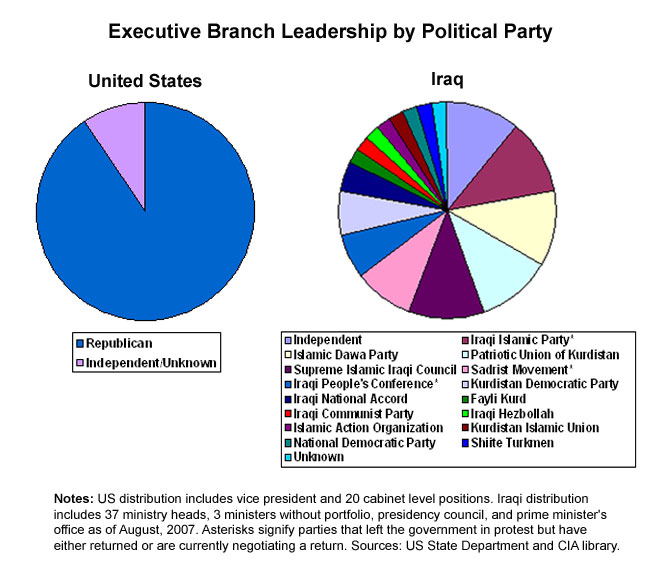
At The Long War Journal – An examination of the political structures and internal conflicts within the Iraqi government;
Colonel Martin M. Stanton, Chief of Reconciliation and Engagement for Multinational Corps–Iraq, is quick to praise the remarkable progress in ground-up reconciliation he’s seen in his job coordinating Iraqis who want to engage with the Coalition and Iraqi government. But he is also candidly skeptical about the willingness of the “Shia [federal] government” to reconcile with Sunnis, in light of sectarian hostility.
“What haunts me is the prospect of wasting all these opportunities,” said Stanton. “It’s encouraging at the bottom, at the tactical level, and then you deal with the people in the Iraqi government who are so paranoid and so reticent, and it’s a real emotional rollercoaster.”
But while most officials acknowledge a heavy atmosphere of mistrust stoked by sectarian carnage that peaked in 2006, many cite other elements that impede action on key political benchmarks. This Long War Journal series on Iraqi politics – involving more than a dozen interviews with American and Iraqi officials – will attempt to examine the factors, including but beyond sectarianism, that have affected political progress by the Iraqi federal government.
Part Two is also up.
No wonder you never hear about what Maliki is up to, he is busy in the trenches…
Hmm — they must have MMP in Iraq.
i don’t see how things can change in iraq. with islam and sharia as the base for all government there will never be true freedom or democracy.
o/t. the muzzies are drawing welfare in to for multile wives. what a great group/
multiple
I think that Maliki is doing an outstanding job and as the article says, he is developing and getting better as a leader.
I read another analysis earlier that stated that it would take another election or two before the best people and leaders start coming forward to stand up for election (and start to see the amalgamation of parties and interest groups).
I’ve been trying to follow their battles and woes to get the budget through for 2008. It’s going to take longer than we think but it is going to get done and it will be a major milestone achieved in having the Iraqis take charge of building their country.
It takes time; I admit that I’m stunned by those of us in the West who think that the people of Iraq can move in the space of a month, from a thousand years of a political system operating within tribalism – to one based on a civic structure.
That would be like asking us to, in the space of a month, reject elections, reject parliament, reject a constitution and have instead a set of ‘leaders’ from one hereditary family.
It takes time, a lot of time, to move from one structure to another. The tribal system is based on loyalties to kin, obligations to blood relatives, duty to family. These are not merely deeply emotional bonds, they are moral obligations. You can’t make these vanish with the flick of an electoral switch.
It takes time. How about giving them some time, all the while urging and helping them to make this transition?
et. islam has to go, tribalism or not.
Government by kaleidoscope. Wonder how well that works.
A few things regarding comments:
1. Many of the players in Iraqi politics are only nominally influenced by Islam, much like Hillary Clinton is influenced by being a Christian, for example. Other players are.
2. Islam will never “go,” so the unrealism of that idea is antithetical to changing the ME, in terms of political development or deradicalizing Islam.
3. Sharia means many things beyond “head chopping,” and the influence of Sharia on the Constitution is far less important than its compelled structure of the government that forces people from various sects to work together and respect human rights.
4. As an example regarding points 1-3, the Iraqi parliament has a greater percentage of women who are representative than the US Congress.
5. I wouldn’t say Maliki is doing a good job, but I would say he’s doing a better job.
bill from INDC – thanks; good comments.