Category: Tech

Social Disease

Sebastian Kaleta – Why I Decided To Regulate Big Tech in Poland

In Poland, we have watched with alarm as a consortium of ever more powerful, monopolistic Big Tech companies have done what was once unthinkable: de-platforming a sitting U.S. president. For us, this example—which has alarmed presidents and prime ministers across Europe and, indeed, the world—is merely the straw that broke the camel’s back. The debate about who and what social media companies should be able to ban is now firmly in the public eye.
 
For the citizens of Poland and other countries that value true democratic accountability, we have concluded that this situation can go on no longer. As media across the world have noted, Poland has proposed a law establishing a “Freedom of Speech Council” to guarantee that Polish citizens are not arbitrarily manipulated by Big Tech companies.
 
At the heart of our proposal is an effort to guarantee Polish citizens their constitutional right to freedom of speech on major internet platforms. The Freedom of Speech Council we propose will decide what Big Tech can and cannot remove from its platforms, lest they attempt to impose restrictions beyond the laws that govern and protect speech in Poland. Far from a partisan or factional initiative, the Freedom of Speech Council will convoke members for six-year terms after they have been nominated by a three-fifths majority in Parliament.
 
The remedy befits the magnitude of the problem. Two thousand years ago, the Roman comedian Juvenal asked, “Who will watch the watchers?” In the case of Big Tech, I believe that the answer lies with the people—not nameless moderators operating with no transparency and no ability for recourse. The Freedom Act I have proposed in Poland is not only a law that would guarantee Polish citizens their constitutional right to freedom of speech, but it provides a blueprint for how to confront the problem of unaccountable speech regulation by Silicon Valley oligarchs.
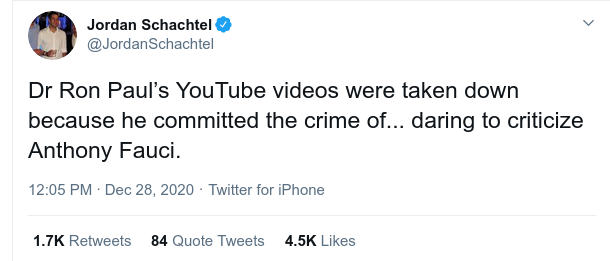

Social Disease

Daily Mail: Twitter saw its shares drop by 12 per cent Monday as the company braced for pro-Trump protesters outside its San Francisco headquarters.

It rebounded, but is still down 5+ and shaky.

More at Marketwatch;

Twitter shares are off 6.6% in Monday morning trading, while Facebook shares are down 3%. Shares of Apple Inc. AAPL, -1.92% and Alphabet Inc. GOOG, -1.52% GOOGL, -1.50%, both of which pulled right-wing social-media app Parler from their app stores citing lax moderation policies, are off 2.2% and 1.7%, respectively. Shares of Amazon.com Inc. AMZN, -1.03%, which booted Parler from its AWS web-hosting platform, are down 1.4%.

Declaration Of War

Amazon Is Booting Parler Off Of Its Web Hosting Service.

In case you haven’t figured it out, the end game is to wall off access to social media tools by conservatives, even those they develop independently, so that the technology can be exploited exclusively by the left for political organizing and message control, in a repeat of their capture of the mainstream press.

So, that’s all that’s happening.

Social Disease

The 1996 Law That Ruined the Internet;

In 1996, Congress passed the Communications Decency Act, a law meant to crack down on digital smut. From a decency perspective, the legal standard that had emerged from the CompuServe and Prodigy lawsuits seemed, well, perverse. Prodigy was liable because it had tried to do the right thing; CompuServe was immune because it had not. So Section 230 of the act stipulated that providers of internet forums would not be liable for user-posted speech, even if they selectively censored some material.
 
Much of the Communications Decency Act was quickly struck down by the Supreme Court, but Section 230 survived. It quietly reshaped our world. Courts interpreted the law as giving internet services a so-called safe harbor from liability for almost anything involving user-generated material. The Electronic Frontier Foundation describes Section 230 as “one of the most valuable tools for protecting freedom of expression and innovation on the Internet.” The internet predated the law. Yet the legal scholar Jeff Kosseff describes the core of Section 230 as “the twenty-six words that created the internet,” because without it, the firms that dominate the internet as we have come to know it could not exist. Maybe that would be a good thing.

Solarwinds

@KimZetter Someone asked me to provide a simple description of what this SolarWinds hack is all about. So for anyone who is confused by the technical details, here’s a thread with a simplified explanation of what happened and what it means.

In a demonstration of corporate integrity, Solarwinds has pulled the page listing their customers.

Oh, and…

Social Disease

Federalist;

Google-owned YouTube shut down Dilbert Comic strip creator Scott Adams on Friday, stripping a video off the platform from the podcaster’s channel without warning.
 
“Google (YouTube) just shut me down,” Adams wrote on Twitter featuring a screenshot of the message from YouTube. “The video they deleted is no different from all of my other content. I assume they’ll come for the other videos soon.” […]
 
YouTube’s censorship of Adams follows a recent company announcement that it would be removing any content critical of the 2020 election process alleging widespread voter fraud tipped the outcome of the November contest.
 
After preemptively declaring Republican claims of deceptive voter fraud as a conspiracy remaining to be proven in court, YouTube is still host to a wide range of other dangerous conspiracies across its platform, from ideas that President Donald Trump is a Kremlin agent to the idea that aliens build the Egyptian pyramids.

Margin Of Fraud

On the same day as Youtube announces it will disappear all 2020 election fraud content as misinformation:

Seventeen states, led by Missouri, are backing Texas in its bid to have the Supreme Court hear a challenge to the presidential election in four battleground states.
 
Texas sued Pennsylvania, Michigan, Wisconsin and Georgia on Tuesday, saying the four states altered election laws for the November contest without authorization from state legislatures, violating the Constitution.
 
In addition to Missouri, the other red states pushing for Texas’s court fight are Arkansas, Florida, Kansas, Mississippi, Alabama, Indiana, Louisiana, North Dakota, Montana, Nebraska, South Dakota, Oklahoma, South Carolina, Utah, Tennessee and West Virginia.

You can download it here (pdf)

Your Sniveling And Cowering Superiors

Via Instapundit;

The Times let itself become hopelessly slanted. Captive to organized feedback on social media. Beholden to irredeemably conflicted staff members. Consumed by internal demons.
 
Make no mistake: other media outlets are taking note. In this way, they are motivated to self-censor news and information, lest they draw the wrath of the mobs. One editorial figure at a major international publication who did not want to be identified recounted numerous pieces he has recently killed for fear of the organized backlash.
 
“They can bankrupt me,” he tells me. “Facebook, Twitter, Google — they can ruin you in a matter of hours. For somebody like us, they can destroy you. So what do we do? We pull our punches. To raise certain issues is to cut your own throat.” He continues, “The newsman in me says, ‘Tell the truth,’ and that sounds great. But if I do that and destroy [my publication] in the process, what kind of pyrrhic victory is that?”

Margin Of Fraud

BINGO! Edward Solomon has figured out the voting machine Algorithm in Philly, explained in this video. Brilliant work.

Dominion uses a set of several different integer ratios, assigns each, such as 1:18 (1 T vote for 18 B), to two, three or four precincts. Then every time the citywide system has a global update, each of those ratios transfer to a different set of precincts, where the vote counts conform to the assigned ratios until the next global update, when the ratios transfer again to a new set of precincts. Then the votes from the new set conform to the assigned ratios until the next reset- and so on. Hard to catch but dominion is clearly applying an algorithm to adjust the votes, and is doing it by sliding the ratios from precinct to precinct over time.

Keep reading.

Related: What law firm is representing Dominion voting systems?

At Rebel News — Dominion Voting Systems shared office is INCUBATOR for radical left-wing organizations

Unconfirmed: Dominion may have vacated their Toronto offices.

Navigation