
 |
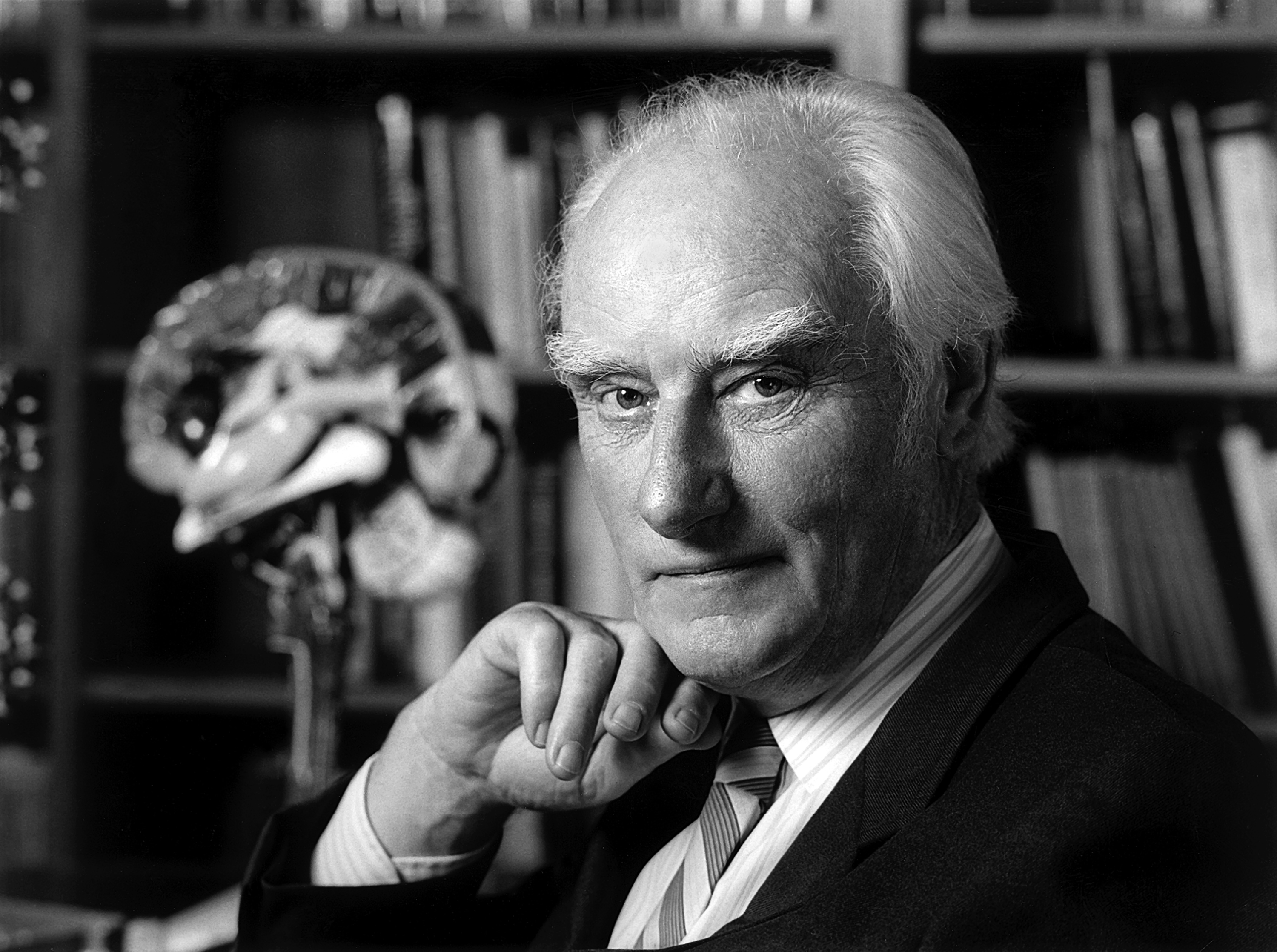
Good afternoon ladies and gentlemen, welcome to the return of our ongoing series of SDA distinguished lecture, documentary & interview symposia. This afternoon, for your delectation and to restart our series, here from the University of California at San Diego’s GuestBook productions is Francis Harry Compton Crick, OM, FRS & 1962 Nobel Laureate in Medicine, in conversation with Nick Spitzer, Professor of Biology at UCSD, on the matter of Investigations of Human Consciousness ¤, in 1999 (26:10). Dr. Crick was, at the time of this conversation, the J. W. Kieckhefer Distinguished Research Professor at the Salk Institute for Biological Studies. Today’s conversation re-establishes a number of the topics we intend to continue exploring in future symposia.
The video, “UCSD Guestbook: Francis Crick” was informative and enjoyable, Thank you.
hmm – maybe I missed something but was there at any time, a definition of the term ‘consciousness’?
Is consciousness the physical awareness of the other, of the stimuli of the envt – and Crick’s talk seemed to focus on this – or does it have anything to do with COGNITION?
To me, any and all living entities are conscious, i.e., physically aware of the physical and chemical stimuli/input of their envt. Plants are certainly ‘conscious’ of the sun, of nutrients, of their roots searching for water.
Consciousness does require a differentiation between the Self and the Other – and this is achieved in all living entities, including plants, insects etc.
But cognition is something else. It requires the ability of that same mind that can be physically aware (and..before anyone says you have to have a brain to do this…I’ll say that a plant’s cells act as its brain)….well, cognition requires the ability of that mind to MODEL the nature of the input stimuli.
That means, cognition requires that the organism can develop a non-actual or abstract Model of ‘something to eat’..and then, can recognize that the actual particular mouse flitting about in the bushes is a particular example of ‘something to eat’.
Humans then move on to the capacity to symbolism or language, where they can see, with an eye to nutrition and taste…’that mouse would make an excellent and nutritious meal’..and you can violently disagree with their cognitive logic.
I’d like to see more work done on the nature of the brain OUTSIDE the brain…i.e., the nature of ‘consciousness’ or awareness of the environment in the ‘simpler organisms’ such as plants. And then, move up to a qualitatively different function of cognition, which requires the capacity for that abstract model. That’s the giant leap between the two realms of life.
I think, ET, that Dr. Crick went to some trouble to make clear that he thinks that we do not at this time actually have a scientifically valid denotative sense of what human consciousness is, and so to define it would be premature; rather, I think that (and I must admit I’ve seen the next show in our series) what’s interesting about Dr. Crick’s latter work is just that he’s not trying to convince you what consciousness is, he’s not trying to explain what it is, he’s trying to figure out what it is! It’s one of the last frontiers, I think, and so I set up today’s symposium, via the venerable Dr. Crick, to prepare the stage for some other symposia I’ve got in the queue.
Are people considered conscious when they’re asleep or something else?
Francis talks about that question in the above video/conversation, Reg. Indeed, one way to look at the question(s) of consciousness is, as he explains, and I’m paraphrasing here, “what is the difference between what is going on in our brains when we think we’re conscious, and what is going on in our brains when we don’t think we’re conscious”. If we knew what that difference is, if it is, then we would, I think Francis is arguing, have a much better understanding of what human consciousness is in the first place. Ergo: what experiments can we conduct to better understand what said difference is!
Sleepwalking seems to be a mechanical thing done in familiar surroundings, so I guess conscious might mean able to choose.
It’s not just sleepwalking, itself rather a special case, but what about dreams, intuition, experience, memory, skills, &c? I think that it’s becoming more and more clear that there’s less and less choosing going on in consciousness than we previously thought. I think it’s more complex than choose, or if you prefer, choose is an oversimplification. Choose is a piece of the consiousness puzzle, I think. The big question is: is the puzzle bigger than the sum of its pieces, and if so: how and why?
Vit – I listened to the Human Conciousness video b4 I posted a comment that was in part a reader tip. I noticed my post has been deleted after only appeaaring briefly and I am wondering why.
[ Reader Tips go here, this is “Investigations of Human Consciousness”. ~Vitruvius ]
I don’t think it’s a matter of skill or brainpower at play but inate or instinct, Vitruvius. Only someone familiar with their envt can function semi-conscious, like sleepwalking or in a state of fear.
Agreed, Reg, Francis talks about how experiments show that it’s not only not about skill or brainpower per se, or even about inate or instinct either, the point (at least as I understand it) is that we do know about a lot of things that appear to explain, correlate, or even cause conscious phenomenon, but we don’t understand what it actually itself is. Maybe we can’t. Some of us are curious. Maybe you, dear reader, don’t care about what we care about. Thus the question remains, under said circumstances, why should we care about what you care about?
The Brain may be weird…That is that it must process “some” information in reverse. The first word of a sentence can’t be spoken until we have formed the construct…
Deja vu (IMHE) is actually a detailed “memory sequence” of an absolute “point in time”. How do we dream of a future event 5 years before the event….
I don’t belive in a defined destiny, or we would’t be able to screwup as much as we do….
I think that weird undersells, Phillip, I’d prefer spectacular 😉
Yet it seems pretty clear that consciousness comes after reality.
Are drugs a heightened state of consciousness or a figment of their imagination? Or does it matter?
I guess i should reread EKAT
Drugs are a heightened figment of their imagination 😉
I wonder if reality, as a whole, requires the consciousness of the whole – be it located in a micro-organism, a plant, an insect, an owl, a racoon..oh…and a primate…in order for that reality to exist. As a reality.
Imagine a world without interaction; that is, with no output becoming input. Imagine further, a world where IF, IF that output of that micro-organism becomes input of another micro-organism, or of a plant…that there is No Effect! That is, the output and input are symmetrical in type and tone and affect and effect. Could the world, this teeming network of chemicals and cells and..could it exist?
Is consciousness an asymmetrical interaction between matter that is morphologically discrete and necessarily interactive?
Sounds batty?
Personally, ET, I don’t think that reality gives a tinker’s damn about consciousness. Galaxys of nuclear stars are, I think, quite happy to exist independent of any notion of consciousness, human or otherwise. But that’s not relevant here, because you see, ET, the topic here is human consciousness, that’s what Dr. Crick is talking about, as one may have noticed was particularly elucidated in the title of this afternoon’s production.
This is not about an abstract concept. It is about us.
How much does one think one knows about oneself?
Oh really? Why?
But, vitruvius, my point is that Us, that’s we who are human so to speak, might, just might, require that other consciousness…that of micro-organisms and plants and….in order for our own consciousness to exist.
IF our own consciousness is one that operates by models or ‘units-of-understanding’..and our particular brain is capable of creating such abstract forms…this is obviously a complex action. Does it rest on more basic and much simpler interactions that set up that output-input relation…and might it be the case that our complex interaction (with models) might require the existence of a massive, seething universe of informational interactions that are NOT ‘conscious’ (i.e., do not use models).
Am I making any sense? It’s difficult to explain. I do not feel comfortable with an isolate homo sapiens who alone is ‘conscious’ and separate from the rest of the teeming biological and chemical world.
Well I do feel comfortable isolating homo sapiens, ET, at least to some degree on this matter, as Francis discusses. I agree with you, if I may put it this way, that we require the other suchness of microrganisms and plants and things like that ~ remember, I’m the guy who thinks that only information exists; however, if you’re going to conflate that plant stuff with human consciousness, then I think you owe us a replacement word for use in the case of humans. It’s only fair 😉
I think that human consciousness requires that abstract conceptual model..and I doubt that non-human brains and microorganic modes of informational reality have the networking capacity for abstract models.
So – I’ll agree that human consciousness is unique, as is the human requirement for symbolic information processing.
BUT – and yes, of course I agree that ‘only information exists’ – I’m only suggesting that this unique human consciousness which is a highly complex form of information processing rests within a universe of less complex information processing. AND, that the less complex information processing actually requires the complex..as well as vice versa.
So..heh..the micro-organic mode of information processing might, just might, require the homo sapiens mode of information processing. I know that the former obviously existed millions and hundreds of thousands of years before homo sapiens but I don’t see our species; i.e., complex information processing..as random but as part of the whole universe of information processing. So, the simple requires the complex and vice versa.
Dr. Julian Jaynes, author of the ‘The Origin of Consciousness in the Breakdown of the Bicameral Mind’, defines human consciousness as an analog of that defined as the ‘real’ world.
“It is built up with a vocabulary or lexical field whose terms are all metaphors or analogs of behavior in the physical world. Its reality is of the same order as mathematics. It allows us to short-cut behavioral processes and arrive at more adequate decisions. Like mathematics, it is an operator rather than a thing or a repository. And it is intimately bound with volition and decision.”
Further he outlines what consciousness is not.
“First, consciousness is not all of mentality. All the variety of perceptual constancies
— for example, size, brightness, color, shape, which our nervous systems preserve under widely
varying environmental changes of light, distance, angle of regard, or even our own moving about
in which objects retain their same position, called location constancy — all done without any help from introspective consciousness.
…consciousness does not copy experience.
…consciousness is not necessary for learning
…consciousness is not necessary for thinking or reasoning.
And finally, the phenomenal location of consciousness is arbitrary.”
Darwin believed that without language there was no thought.
“As the voice was used more and more, the vocal organs would have been strengthened and perfected through the principle of the inherited effects of use; and this would have reacted on the power of speech. But the relation between the continued use of language and the development of the brain, has no doubt been far more important. The mental powers in some early progenitor of man must have been more highly developed than in any existing ape, before even the most imperfect form of speech could have come into use; but we may
confidently believe that the continued use and advancement of this power would have reacted on the mind itself, by enabling and encouraging it to carry on long trains of thought. A complex train of thought can no more be carried on without the aid of words, whether spoken or silent, than a long calculation without the use of figures or algebra.”
ET – way out of my depth and all, but is this something to do with Teillard de Chardin?
Vitruvius @9:13 pm- ‘Personally, ET, I don’t think that reality gives a tinker’s damn about consciousness…’. Interesting philosophic debate, very deep, but my comfort zone is more in the shallows, shall we say.
However Vit, wordsmith and knower of all, I wonder about your usage of ‘tinker’s damn’. (And I’ll make this comment off the top of my head without referencing Wiki or any other source, just what I heard once, so it’s possible I’m out to lunch).
In years long since passed, a tinker was an artisan repairing pots and pans. To repair a hole, he would use a solder, but to confine it around the hole he would make a dam of putty or something, around it to contain the solder. Hence the term tinker’s dam.
Do I get an A?
black mamba – no, though I can well understand your comparison, and I always have admired de Chardin’s spiritual bonding of the ‘realms’ of reality because it was such a ‘gentle and loving’ attempt at understanding the universe.
Where we differ is that although I fully agree that increasing complexity is ‘the way’ – and de Chardin is hardly unique in observing this as a reality – I don’t think that the reason is for a more ‘sublime’ consciousness (that Omega point) but to prevent entropic dissipation of mass.
More complex morphologies prevent dissipation of the less complex morphologies. That’s what it’s all about..not some vast spiritual agenda.
That is, de Chardin – again, I admire his spirituality – emphasized that the universe is a kind of ‘mind of increasing consciousness’. I agree with that but his reason is that this is a spiritual mind..and my reason is the more mundane that such prevents the entropic dissipation of matter.
DJ – I start to froth and fume at the mention of Jaynes. Can’t stand him or that book…which is somewhere in my library or maybe, hopefully, I threw it out. And ‘consciousness’ does not mean merely ‘introspection’.
Equally, I disagree with the comment ‘Darwin’s saying that without language there is no thought’. Algebra, by the way, is a train of thought; so is geometry. Without the symbolic re-presentation of the abstract concepts formed within the brain (and these can be images and colours as well as words)..then, there is no capacity for the critical analysis of reality.
yes, tinker’s dam it is . something easily broken.
several animals are self aware, some whales, dolphins, chimps, gorillers, humans, orangatangs, and I believe parrots and magpies. they can recognize themselves in a mirror and determine if their appearance is correct or altered ( the basis of the test) Is self awareness an indication of conciousness rather than just reactionary instinct?
the ability to identify oneself in the mirror starts at about 2 for humans. but there is a feeling of being before that.
“I start to froth and fume at the mention of Jaynes.”
Why? What, then, is consciousness?
Unless you believe the great apes possess the
“capacity for [a] critical analysis of reality” without language, then the position is nonsensical. Where’s the evidence that high primates carry on long trains of thought?
“The “supply” is the world around us. You gather info, the brain stores it”
If that were true, how the numbers on your telephone relate to letters should be committed to memory, but they’re not. Or how you see yourself walking. Many people possess a bird’s eye view or that of a third person, yet they have never seen themselves this way. Consciousness does not gather info and store it. It’s an illusion.
This being the hour of the terminus of our scheduled interregnum for this week’s symposium, I should like to take this opportunity to thank all those who have enjoyed participating in this week’s show. I look forward to seeing you all again during our next symposium, and as always, thanks for this space-time, Kate.
This symposium is now closed.