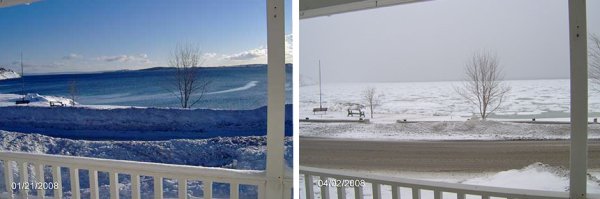
Spotted at the Weather Network, and sent along by a reader who notes, that ” Al Gore must be visiting Newfoundland. The first of two pictures from Bay Roberts shows no ice in the harbour on 21 January 2008, while the second shows the harbour full on 2 April 2008.”

Greg: while it is not ad infinitum, if you consider that the actual translation of ad hominem is “against the man”, then it may fall under certain strict definitions of ad hominem. But I digress.
Regards,
John
I don’t care how many times you say a body “receives back…”, a cooler body cannot add heat to a warmer body without added work. Therefore the cooler atmosphere does not add heat to the warmer earth.
The key is that there can not be a net transfer of heat from a cooler body to a warmer one. However every object above absolute zero emits thermal radiation. If an object is in the way it will receive that thermal radiation. The thermal radiation does not know if the object that emits is warmer than the object that receives, it just goes from point A to point B.
Sorry John. But unless you can provide some sort of reference of an instance where this alleged phenonomen has been scientificly observed and quantitatively measured, then I must regard your claim as conjecture. (you are afterall arguing against the 2nd law of thermodynamics) If, by thermal radiation you are referring to IR radiation, then I must point out that IR radiation is subject to wave mechanics analysis. And I would posit that IR radiation from a cooler body would be cancelled out by out of phase radiation emitted by the warmer body before it could hit the warmer body.
However every object above absolute zero emits thermal radiation
I do not believe this to be true. You are again sliding into perpetual motionism. Spectral emissions(of which IR is one) are caused by atoms transitioning from an excited state to a lower energy state. The excess energy appears in the form of photons with characteristic frequencies. For this to all happen, energy must first be applied to the atoms to excite them. Atoms that are in their lowest energy state thus do not produce spectral emissions.
If I may, the “flaw” in your thinking seems to be that you place an inordinate significance on radiative energy transfer. I would maintain that the predominant mechanism is convection (ie energy transfer through molecular collision) Think in terms of how a vacuum flask works – and how it wouldn’t work at all if radiative transfer was the prime mechanism of heat transfer.
Pd: OK, a couple of comments in reply. First, there is nothing in what I said that would violate the second law and using what I have described you can not make a perpetual motion machine.
In regards to the idea of radiative heat transfer, how about a page from MIT – they are usually pretty good at physics:
http://web.mit.edu/16.unified/www/SPRING/propulsion/notes/node136.html
Read through it and you can see that energy is indeed transfered from a cooler body to a warmer one (but more energy is transfered from a warmer one to a cooler one). If you find equation 19..3 you will see an equation for net heat transfer. Note that it involves the 4th power of both objects. If your argument was true – that the incoming radiation from the cold object was canceled by the out of phase radiation from the hot object then it would not matter what the temperature of the cold object was and there would only be a need for the hot temperature in the equation.
In regards to every object above absolute zero emitting thermal radiation, I would ask you to look up something called Wien’s Law. As you can see, it is temperature dependent and as long as T > 0 then there will be electromagnetic radiation emitted.
I am not sure what your final statement is in reference to. Certainly radiation is the only significant way that the earth loses energy so I think it is important.
Regards,
John
Read through it and you can see that energy is indeed transfered from a cooler body to a warmer one (but more energy is transfered from a warmer one to a cooler one). If you find equation 19..3 you will see an equation for net heat transfer.
Wonderful, there’s a mathmatical equation. But that wasn’t the question. You need to provide examples of this being observed and measured in the atmosphere. (In relation to the different layers you talk about) Until you provide proof, you’re just blowing smoke.
1. First, there is nothing in what I said that would violate the second law
How about:
I agree completely that a cooler body can not warm up a warmer body, but it can add heat to a warmer body.
2. The MIT paper says nothing to support your contention that heat can be transfered to a warmer body. Nor does it refute my contention regarding wave cancellation since it only deals with a single photon emitted from one surface. And if you look at equation 19.3, a quick glance will tell you that if T2 > T1, the result is going to produce a negative heat transfer qnet. In violation of the second law.
3.The Wien displacement law defines the relationship between temperature and radiation wavelength for BLACK BODIES. It does not apply to our discussion. And to suggest that atoms will radiate down to absolute zero with no external energy input is akin to perpetual motion.
4. Certainly radiation is the only significant way that the earth loses energy so I think it is important.
Please provide proof.
1) I have said (many times) that there can be no net heat transfered. If there is no net heat transfer then the second law is not violated.
2) OK, then this one gives it for objects, not photons:
http://www.engineeringtoolbox.com/radiation-heat-transfer-d_431.html
So that takes care of your cancellation argument. Now, in this equation instead of having T1 and T2, we are having Th (T hot) and Tc (T cold). Your argument is akin to saying that Tc is hotter than Th, in which case the heat flow is negative.
3) In regards to Wien’s law, it does not matter if the object is gray since all that will do is suppress certain frequencies, but it won’t change the fact that it emits. However we don’t even need to use Wien since the Stefan–Boltzmann can be used for grey bodies (see the link above) and it gives the total emissions.
4) Do you accept that space is essentially a vacuum? If so then then only way energy can leave is through radiation.
Ol Hoss and Pd ~ look at the equation John provides in his reference:
It is correct standard physics. It matches, reproducibly, experimental results. That is called science. (1) If the cold did not radiate to the hot, Tc would not be there. It is. (2) If radiation stopped below some temperature, Tc would have a lower limit applied to it. It doesn’t. Those arguments are over. It’s a simple matter of algebra.
John is also correct that the only way to get energy out of the earth, past the atmosphere, into space, is radiation. The only other options are convection (and there is no fluid in space) and conduction (and there is no conductor in space) and work (and the earth does no work to space, remember, in the physics sense). So that argument’s over too.
At some point one simply has to give up trying to explain non-trivial physics to people who can’t even keep the signs on their basis vectors sorted out. Perpetual motion? Phase cancellation? My ass.
Well what can I say. I give up . ‘Cause everybody knows that thermodynamic process equations trump quantum mechanics. Beaten once again by the “you’re too dumb for us to explain it to, so the debate is over” argument. Magical CO2 rains heat back down upon the earth and we’re all gonna burn. And that’s that!
The real topic of this debate is whether CO2 is heating up the planet. I reject this presumption because I have yet to see the mechanism quantified, let alone proven. Is there bidirectional energy transfer between hot and cold? I don’t know. But thermodynamic heat transfer equations merely quantify the exchange – they do not define the mechanism. (and if there was no Tc component, then there would be no temperature gradient, so what heat transfer would you be calculating? And this is your proof?) I simply introduced the possibility that the radiated photons may never reach the warmer body.
I whole heartedly agree that the only way energy can escape our atmosphere is via radiation. But I would also contend that a considerable amount of energy is expended within the atmosphere doing work in the form of moving molecules around.
I’m trying to understand the mechanism but to be convinced, I need to understand it at the atomic level. I realize that you consider the argument closed, but perhaps you could find it within yourself to pull your pompous head out of your pompous ass and explain the following:
1. why is IR radiation not subject to phase cancellation or alternatively, what happens when photons collide?
2. for a molecule in a non-excited state, where does the energy come from to drive the radiation process?
3.where does wind get its energy from?
Please keep your answers simple. I’m kinda dumb.
Beaten once again by the “you’re too dumb for us to explain it to, so the debate is over” argument.
It’s the old elitist statement that really means they don’t understand it well enough to explain it. That’s why Vitruvius is getting all huffy.
The Earth is constantly losing matter to space. It caries heat with it. But I don’t expect it to amount to a relatively great deal of energy. Just saying.
Pd: There are a number of issues raised by your questions and statements. In regards to the net radiative heat transfer equation, it is a standard equation that can be found in any university physics text or on line in a number of places. The derivation of it is fairly simple and if you go through it you can see where the trems come from. I will see if I can dig out a better reference from my old heat transfer text (it is at home).
The point about the equation is that obviously there is an effect from Tc. The object at Th will radiate a certain amount of energy and this amount does not change based on the temperature of the objects around it (it can’t know the temperature of other objects). You ask what would happen if there was no Tc component, then Tc is 0 in the equation and you would get the radiation from Th in a vacuum. In fact, this is the basis of the equation!
You also say “But I would also contend that a considerable amount of energy is expended within the atmosphere” I don’t know about this. The energy will change forms in the atmosphere but unless you are changing energy to matter, I don’t see how it can be expended. For example condensation is critical to driving hurricanes, but the power is not expended only changed to wind. The wind energy can drive waves, but again not expended. The wave energy can transform energy into internal friction, sound and even potential (if it moves sand up a beach). Etc. Etc.
In regards to your questions,
1. why is IR radiation not subject to phase cancellation or alternatively, what happens when photons collide?
According to classic quantum mechanics photons do not cancel. Here is a quick reference for that exact question.
http://www.physlink.com/Education/AskExperts/ae480.cfm
2. for a molecule in a non-excited state, where does the energy come from to drive the radiation process?
If the object is above absolute zero then there is thermal energy. This thermal energy drives the emission. As the object emits it will continue to cool down and come asymptotically close to absolute zero.
3.where does wind get its energy from?
From pressure gradients in the earth’s atmosphere. As I discussed above, there is no question that there are other factors driving weather (and climate too for that matter).
To be clear, Pd, I too doubt that man-made CO2 has a significant effect on total atomspheric energy, I doubt that models accumuluated out of independent bits of physics, chemistry, assumptions, estimates, and hand-waving, to the scale of so-called climate models, are valuable (considering initial conditions, numerical analysis limitations, convergence considerations, and the opportunity for political opportunism), and I don’t think we should be spending piles of money on stuff we don’t understand.
I that sense I disagree with John, and we have discussed that at some length. In addition, John and I do agree that even if it all adds up, then the effect is only on the order of two to three degrees over the next century, the effects will not be anywhere near as catastrophic as the doom-mongers prophesize, and may even be beneficial, and most importantly, again, we have time to be careful on expenditures of the proposed magnitude. (At least, this is my recollection, I do not wish to attempt to speak for John.)
Nevertheless, when someone says the equivalent of F = m a and someone else says “prove it”, I don’t think the party of the second part is being reasonable in any way at all. If one says that if Ti is less than Tj, giving a negative q, that violates some law, oblivious to the fact that since Ac is a vector quantity, negative q just means it goes the other way, I feel frustrated by the degree of difficulty of trying to teach physics in blog comments.
But, truth be told, I’m probably just not a very good teacher. If asked to explain I will try, but if proof is demanded in a rhetorical context where it is not dialectically appropriate, I have a bad habit of getting a bit too snarky. Sorry if I was a bit too snarky in that last comment.
then the effect is only on the order of two to three degrees over the next century, the effects will not be anywhere near as catastrophic as the doom-mongers prophesize, and may even be beneficial, and most importantly, again, we have time to be careful on expenditures of the proposed magnitude.
Vitruvius at April 22, 2008 6:18 PM
Some thoughts to consider on the above. Humans are prone to procrastination and when it comes to change versus acceptance of status quo, it can take more extreme measures/urging to bring about change within the range of time desired.Especially in the realm of spending their money. Also, shock value is widely employed . Just look at the blogosphere. Look at this site.
Think about a civil law suit. If you want $300,000 you ask for a million. If you want something to happen in 50 yrs, you say 20. Then maybe, it will come to pass in 75. The question is, do we have 75 years? We would all prefer that, but do we?
I commend you, John Cross and Samuel for taking time to present your information and for having the patience to present it in varying forms including layman’s language as much as possible.
I have found these discussions to be not only informative, but representative of the spirit of seeking and sharing knowledge.
Hugger
Thanks John
To be clear, I was never challenging the thermo equations (nor did I at anytime request anybody to prove the laws of physics to me!). My point of contention was whether there was bidirectional energy transfer. All in all, it’s a moot point, since the net transfer is all that matters and we’re nit-picking over details.
I still have a problem with the “all radiating all the time” concept. (ie, do you propse that a CO2 molecule trapped in an ice core for millions of years is still radiating energy?) This flies in the face of my understanding of spectral emissions. I’d appreciate any links that you might have that discuss molecular thermal energy.
Finally, I think we’ve narrowed down what topic we should be debating: that of convection vs radiative energy transfer. You seem to think that radiative transfer is the more important component (the only thing that I did ask for proof of). I say convection – although I admit at this point I’m relying on “gut feel” and I cannot offer definitive proof, but I am open to yours.In any case a discussion of the concepts should provide the type of “scientific debate” that you have claimed to be looking for.
Since this thread is due to fall off the edge of the active blogosphere (a time domain function), perhaps we can continue on a future Y2Kyoto posting.