Why this blog?
Until this moment I have been forced to listen while media and politicians alike have told me "what Canadians think". In all that time they never once asked.
This is just the voice of an ordinary Canadian yelling back at the radio -
"You don't speak for me."
email Kate
Goes to a private
mailserver in Europe.
I can't answer or use every tip, but all are appreciated!


Katewerk Art
Support SDA
Paypal:
Etransfers:
katewerk(at)sasktel.net
Not a registered charity.
I cannot issue tax receipts
Favourites/Resources
Instapundit
The Federalist
Powerline Blog
Babylon Bee
American Thinker
Legal Insurrection
Mark Steyn
American Greatness
Google Newspaper Archive
Pipeline Online
David Thompson
Podcasts
Steve Bannon's War Room
Scott Adams
Dark Horse
Michael Malice
Timcast
@Social
@Andy Ngo
@Cernovich
@Jack Posobeic
@IanMilesCheong
@AlinaChan
@YuriDeigin
@GlenGreenwald
@MattTaibbi
Support Our Advertisers

Sweetwater

Don't Run

Polar Bear Evolution

Email the Author
Wind Rain Temp

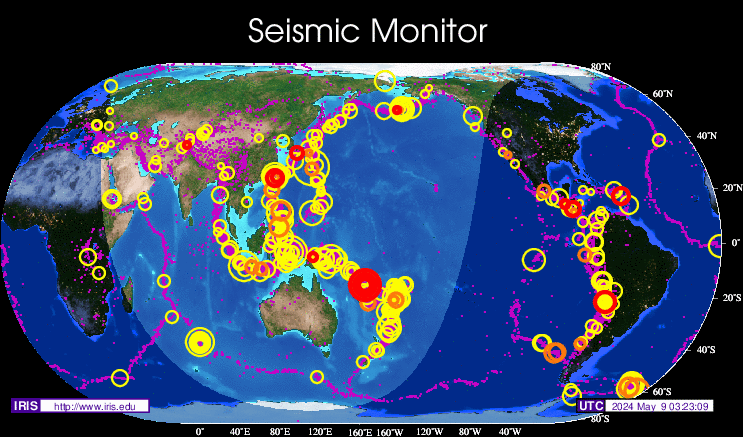
Seismic Map
What They Say About SDA
"Smalldeadanimals doesn't speak for the people of Saskatchewan" - Former Sask Premier Lorne Calvert
"I got so much traffic after your post my web host asked me to buy a larger traffic allowance." - Dr.Ross McKitrick
Holy hell, woman. When you send someone traffic, you send someone TRAFFIC.My hosting provider thought I was being DDoSed. - Sean McCormick
"The New York Times link to me yesterday [...] generated one-fifth of the traffic I normally get from a link from Small Dead Animals." - Kathy Shaidle
"You may be a nasty right winger, but you're not nasty all the time!" - Warren Kinsella
"Go back to collecting your welfare livelihood." - Michael E. Zilkowsky

The important question is does it identify as being structurally sound? That is all that matters.
“Are you good at math?”
“Do you get every question right 100% of the time?”
Just because the building is going to fall down is no reason to find fault with the designers, engineers, or other folks associated with the building. After all, who could have foreseen something like incompetent design or failure to not consider local conditions?
Engineer here (although not a structural engineer, I still know enough).
If I lived in that thing, I would move out and never return. If I owned a part of it, I would sell for whatever I could get. If I lived next to it, I would move and never return. I would not even walk near it.
It seems at major risk to fall without any seismic event. If a sesmic event were to occur, collapse seems highly probable.
Upright buildings are cis-heteronormative, and a sign of the toxic masculine aspects of patriarchy. They display a colonialist settler bias and white privilege. I think, my usual internet blog source for these things has been off line for about a year.
It’s all in my book, The 15 second city. A big hit in Turkey and Syria.
This is the sort of stuff I absolutely enjoy. I cannot be everywhere or know everything, but someone somewhere brought this to Kate’s attention. Fascinating. I see the problem, mechanically, as the crumbling of the concrete around the upper circumferance of the plate, rather than the plate itself.
The meta-problem is that it is already built and paid for, and now they have to live with it. The engineers have come up with a solution that, fingers crossed, will last beyond their own lifetimes. A lifetime guarantee, as it were.
The chief engineer, AKA the man with his signature on all the documents, he who would go to jail, appeared to be in his ’60s. So a lifetime of 30 years would be OK with him.
In an earthquake zone no less. What will be the peak load be during an earthquake? I would calculate that max load and then make everything twice as strong. It’s not like you have to carry those threaded rods around and replacing them would be a total pain.
It would be possible to place a tube under the plate between the ends of the thread rods. Connect to two vertical tubes ending above the concrete. Dropping a borescope down one vertical tube and a light down the other would allow engineers to monitor the plate for bending or shearing.
The SF City engineering ‘review’ reminds me of the Boeing 737 Max fiasco. The FAA does not have enough engineers so they delegated design approval to Boeing and then signed off on it. Then Boeing decided to go cheap and put two AOA sensors instead of three with a comparator (if A and B agree but C doesn’t C is kicked out of the system and flagged as unserviceable). Then to keep costs low Boeing decided that no simulator time was needed for the pilots to practice responding to a runaway trim condition.
“What will be the peak load be during an earthquake?
Alternatively, what is the peak load during a severe wind storm ?
There’s a lot of building exposed to wind, and I believe that his earlier
video on this building mentioned that glass had not been installed on
upper stories to mitigate wind forces, until a fix was instituted.
Started to watch. What’s with the continued repetition of the two ‘experts’ at the beginning? Trying to heighten the drama or something??
So I just turned it off. I hate these video links – give me text that I can read quickly, and stop subjecting me to these people who love the sound of their own voices and take forever to get to a point.